A Trusted Network: The Internet I Want My Children to Inherit

I want my children to inherit the freedom I found on the Internet, without inheriting the fear we have learned to treat as normal.

I have spent much of my working life arguing for a network in which someone unknown can arrive, contribute, and matter. That conviction has shaped my research, my writing, and how I think about business. The most consequential person in a network might be the one who has not joined it yet.

In “Black October Broke the Internet’s Social Contract. Now We Must Decide What Replaces It,” I recently examine the major choices this moment has put before us: How to rebuild trust while preserving the precious openness that made the Internet extraordinary.

Since writing it, I keep thinking about the world on the other side of that decision. What will my children be able to explore? What will they be able to create? Will an unfamiliar person still represent the possibility of a new friend, collaborator, or discovery?

Those questions take me back to the beginning, because the Internet has repeatedly become something greater when we have widened the possibilities of participation.
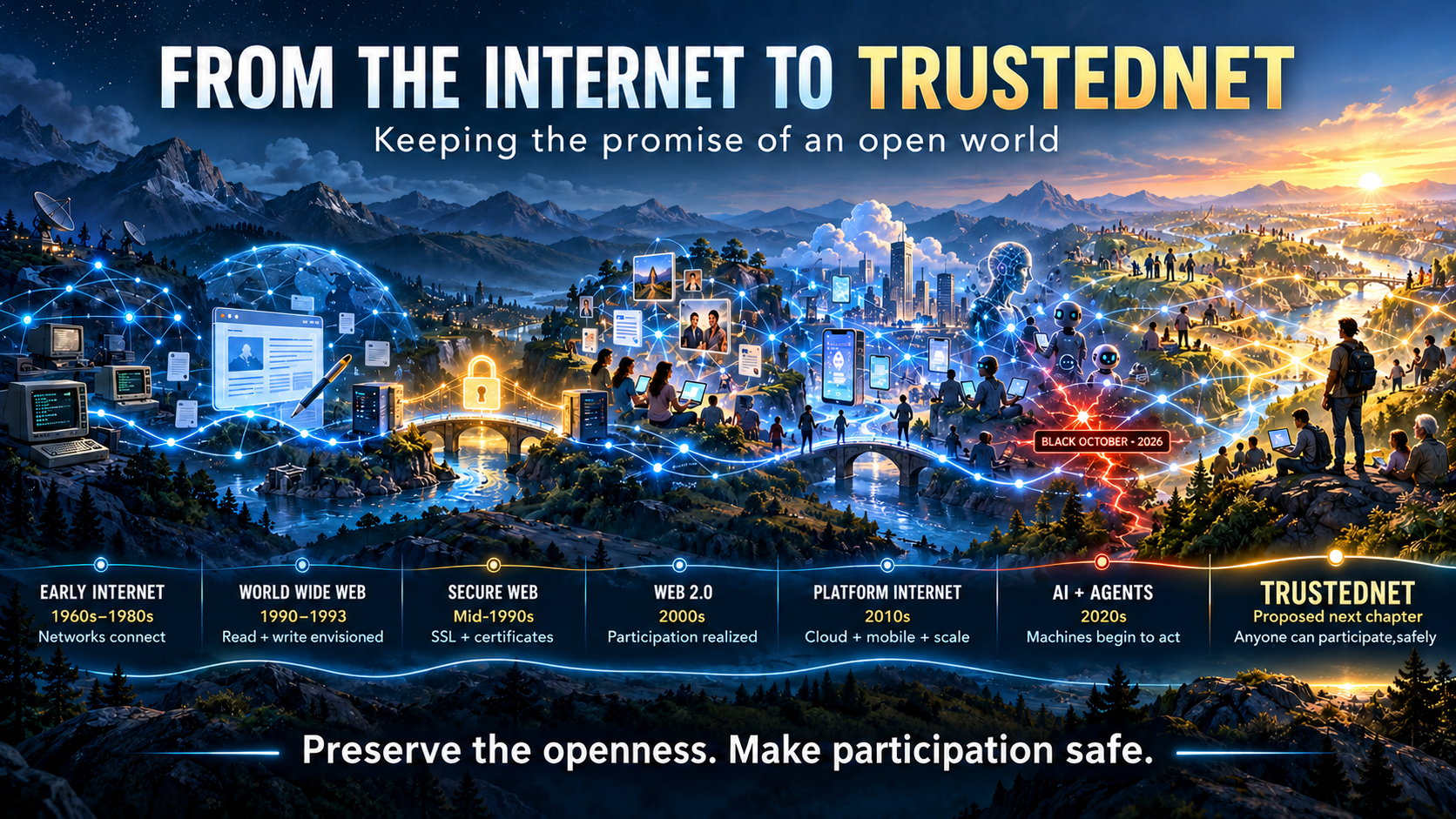
An infographic depicting the evolution of the internet from the early days of networking in the 1960s to the proposed future of TrustedNet by 2026, highlighting major milestones like the World Wide Web, Secure Web, Web 2.0, and AI advancements.

The future was there at the beginning

The Internet and the Web arrived in different chapters. The Internet grew out of relatively small, restricted research communities, around an architecture that let independent networks communicate through shared rules. ARPANET’s transition to TCP/IP in January 1983 was one decisive step in that longer history. The underlying achievement was extraordinary: Different systems could become part of a larger whole without becoming the same system.

Then Tim Berners-Lee gave that connected world the Web.

His first browser, written in 1990, was also an editor. Creating belonged alongside reading from the start. In 1993, CERN put the Web software into the public domain, helping make it something the world could adopt and build upon. Openness was a deliberate choice, with consequences far beyond the people making it.

Yet the early popular Web developed largely as a publishing medium. Organizations put up pages, and most people experienced the Web primarily as visitors. Berners-Lee himself observed in 1996 how far that predominantly read-only experience had drifted from his original vision of an interactive, shared information space.

However, that possibility was ahead of our habits.

Learning to trust the connection

Then another great pivot came in the mid-1990s, as SSL and digital certificates gave browsers a practical way to encrypt connections and authenticate the server at the other end. That helped make online commerce viable. TLS, SSL’s successor, carried that work forward and is what we use today to conduct important work safely.

The browser’s little padlock became part of everyday life. Its actual promise was limited: A protected connection to a single site. It could not guarantee that the business was honest, the software harmless, or the content true. The distinction remains essential; namely that browser security teams have spent years trying to correct the belief that a padlock certifies a trustworthy website.

Even so, this was a remarkable expansion of what people could reasonably attempt online. We added protection to a shared network and opened up new possibilities. That history matters now. Greater safety has helped the Internet grow before.

When participation finally became ordinary

By the middle of the 2000s, the next shift was unmistakable, and many of you know, I was there for it. People were publishing blogs, building wikis, sharing photographs and video, and forming communities around almost anything imaginable. The audience was helping create the place.

On September 4, 2006, I wrote “All We Got Was Web 1.0, When Tim Berners-Lee Actually Gave Us Web 2.0.” My argument was that the participatory vision had been there much earlier. What took time was the arrival of enough people with the tools, confidence, skills, and habits to make it real. Better technology helped. Changes in human behavior gave it scale. Web 2.0 was the moment that possibility became an everyday practice.

Looking back twenty years later, I am struck by how much of the Internet’s history follows that pattern. A technical possibility becomes a human capability. People discover what they can do together. Institutions struggle to catch up. I still regard this as historic and a monumental achievement, and I still believe it is worth defending very vigorously.

The late middle age of the Internet

Today, I think the current Internet has entered late middle age. It is accomplished, indispensable, and burdened by its history. We have made it the setting for our work, our commerce, our relationships, and much of our collective memory.

We have also made participation increasingly difficult to separate from exposure. Black October has sharpened a question I can no longer put aside: How much responsibility can we reasonably place on each individual to survive in an environment this complex?

The parent, the teacher, the independent publisher, and the small business owner cannot each become experts in every institution and technology on which their digital lives depend. The principle I have defended for so long now demands more of us. I care deeply about whether people are free to participate. I also have to ask whether they can safely exercise that freedom.

A person who is too frightened to contribute, too vulnerable to withstand a mistake, or too exhausted to keep defending themselves has little practical use for a theoretical right to join., No, safety is now part of making openness real.

What I mean by TrustedNet

I increasingly believe we need a new Internet: A substantial renewal of the network’s foundations and the expectations we can reasonably have of it. The name “Internet” describes the original accomplishment of connecting networks. Our next great accomplishment must be making that connected world dependable enough for the lives we now live within it.

For now, I would call it TrustedNet. That is a working name for a public ambition: A network whose protections, boundaries, and institutions ordinary people can reasonably rely on. Its safeguards would have to work even when a participant deceives us, an authority fails, or someone makes a mistake. The name would be a promise to earn continuously.

TrustedNet must grow within and alongside the Internet we already have. Its task is to carry forward the knowledge, communities, relationships, and freedom accumulated there, while changing the conditions under which we participate.

The central requirement is one I have held for a long time. In Social Business By Design, which I wrote with Peter Kim in 2012, our first tenet was simple: “Anyone can participate.” I meant it then. I mean it now. If TrustedNet breaks that principle, it is not worth having.

The principles I would start with

Anyone can participate.

A newcomer must have a practical way to read, publish, contribute, and build without an institutional sponsor, an expensive credential, or a reputation they have never had the opportunity to earn. Being unknown must leave room for possibility. Affordable access, accessible tools, and ordinary devices have to be part of the design.

People decide what others may do.

Public information should remain discoverable, and new relationships should remain possible. Access to someone’s money, private information, or systems should depend on permission appropriate to the action. People must be able to understand and withdraw that permission. Anyone can participate and each of us still gets to have boundaries.

Privacy is part of safety.

People should be able to explore, speak, and contribute without exposing their entire identity or history. A particular transaction may require stronger proof. That must never become an automatic demand for a permanent identity record of everyone’s ordinary life. Pseudonyms and private conversations have a legitimate place in a trustworthy world.

Protection must be ordinary.

A family, school, or small business should receive useful protection by default. Basic safety must be affordable and understandable without a security department. We should measure progress by how well ordinary people can participate with confidence, including those with the fewest resources to defend themselves.

No one gets to own participation.

The essential rules must be open, different providers must work together, and people must be able to leave one provider without abandoning their digital lives. Independent builders need a real opportunity to offer alternatives. No company or government should become the permanent admissions office for human connection.

Trust must answer to people.

The institutions that establish trust must themselves face scrutiny. Restrictions need understandable reasons and meaningful ways to challenge mistakes. Trust should be specific to a relationship or action. Nobody should be reduced to a universal score that determines where they are allowed to belong.

Failure must be survivable.

Devices will be compromised. Credentials will be stolen. Institutions will make mistakes. Damage must be contained, and people must have a workable way back. Losing an account or a device should not mean losing one’s place in the world. Recovery belongs among the network’s basic promises.

Bring the existing Internet with us.

Old links, independent websites, archives, communities, and useful services deserve a credible path forward. Adoption must deliver benefits gradually, while people remain connected to those who have not yet moved. Older systems will need protection and repair. Preserving our shared past also requires making it safer to carry into the future.

These principles are demanding. They should be.

The test is whether more people can participate with confidence, including the people easiest to overlook: the newcomer, the dissenter, the person with little money, the small organization, and the child just discovering what the world contains.

The hardest thing we may ever do

There is a formidable difficulty here, and it comes from the very quality I have spent years celebrating: Network effects.

The Internet’s value lives in the people, organizations, knowledge, and relationships already connected through it. A better network is of limited use if your family, customers, colleagues, and communities remain somewhere else. We cannot ask humanity to leave its relationships behind and start again.

That makes this a different undertaking from inventing a network for a small community of researchers. We must change a system on which the world already depends, while keeping that world connected. We must make it safer without handing permanent control to those best positioned to sell safety. We must find agreement across institutions and nations whose interests frequently conflict.

Given the immense network effects now binding us to the Internet, I suspect fixing it will be the hardest thing we ever do in technology. There will be costs, compromises, and years of uneven progress. Some of the hardest changes will concern power: who gets to establish trust, who can withdraw it, who pays to sustain it, and what recourse the rest of us have when they get it wrong.

A new name cannot settle those questions, but it can help us state the obligation clearly. And the history gives me hope. People chose to make different networks work together. People chose to make the Web available for others to build upon. People learned to contribute to something that had initially offered them mostly pages to read. People made it relatively safe to use (for the time.)

I still believe in the person we have never heard of, arriving with an idea we did not anticipate. I want my children to be able to be that person or readily encounter that person. And I want them to have a reasonable expectation that reaching out will lead to possibility.

The Internet gave us an extraordinary way to find one another. A new TrustedNet should make that freedom safe enough to keep.

Sunday Musings: Google’s Identity Struggles, Plus Social Media Bans Around the World

The Web’s missing features for built-in user identity have become a real headache for the industry, and for its users too. It certainly took its toll on market leader Google this week as its “Identity Theater” continued (Source: Kevin Marks.) The issue? It’s turning out that making every single user comply with the Common Names policy isn’t workable for a variety of reasons. Reports of Google deleting accounts en masse are driving a lot of the discussion. Robert Scoble has his own recommendations for Google and while they’re probably the least that would be acceptable to the majority of people, it doesn’t go far enough I think.

It certainly doesn’t have to be this way. Twitter allows companies, bots, and just about every other type of social account and it works quite well in the end. Twitter ran into a similar identity issue in a big way a couple of years back after facing lawsuits and widespread complaints. They managed to muddle through with Verified Accounts.

A growing consensus is that Google should allow user-defined accounts as well, with verified identity for those that want or need it. Personally, I’m not sure I see Google coming around with a response fast enough to prevent some damage to services and impacting Google Plus‘s runaway adoption. But in my analysis, it’s most likely to only hurt the commercialization of the service, not regular usage for most for now.

Social Identity Ownership - Google or Facebook?

Worse, the problem may actually be core to the way Google’s stack is conceived and architected. It may not be easy for them to change course in the short-term without ripples through the way global Google’s services fundamentally operate from a security and identity perspective. It also may not be good for their business model which is almost certainly based on the fact they know who people really are. This issue is one to watch given Google’s pervasiveness. It also has some significant implications for business users of its products, especially now that they seem to be gaining some much needed traction in the social networking wars.

For now, I’d recommend that businesses use Google Plus with an eye towards experimentation while the Web giant gets its philosophy and policies around identity sorted out. Frankly, the bigger industry issue is social Web identity itself. Users and companies increasingly depend on commercial providers like Facebook, Twitter, and Google to provide everything identity-related, from login access to storage and maintenance of their social graph. This is causing key elements of power and control to start to swing away from the open standards that made the Web so successful and essentially fair.

Will the W3C step in and resolve what’s appearing to be an increasingly glaring absence in the Web stack? So far it seems unlikely given the failure of many years of open standard Web identity efforts. The culprit? You have only to look in the mirror. Apathy by users and lack of consensus on the part of Web developers. There’s also a lot at stake financially for those that end up owning a big chunk of Web identity. Consequently, online — and especially social — identity is likely to grow into a full blown brouhaha in the next couple of years as issues, missteps, and abuses inevitably surface. However, we could also decide to put our own house in order before governments step in, the least desirable of all outcomes in most imaginable scenarios. The worst probably being governments owning, issuing, and centrally managing verified Web identity credentials for everyone.

Which brings us to the next subject…

Government Bans Chipping Away At Social Media Freedoms?

A couple of interesting things happened this week with governments aiming their considerable might at social media. While knee-jerk responses to this space were common enough a few years ago, with the U.S. Marines banning social media access for a while for example, these are now generally understood to be counterproductive and unworkable for a long list of reasons.

However, that didn’t stop the German government from banning the Facebook ‘Like’ button on Friday, sure to ignite a small firestorm in that country given that it seems to apply to any site accessible from inside its borders and the fine is a stiff €50,000. The Like button, used on millions of sites around the world to enlist users to leverage their Facebook social network to share content from 3rd party sites (see: k-factor), is significant enough on its own to put German Web businesses at some competitive disadvantage on the global stage. The concern is over privacy and that “all the information was sent to the US company even if someone was not a Facebook member.”

In another similar situation, the Missouri state government’s new law preventing teachers from using social media to communicate privately with students, the former who just announced that they are fighting back, is another case in point. There are obvious free speech issues with the law despite the good intent on its face to protect students. The real issue is that the law is that violations are almost impossible to detect and enforce, until its too late, and that it ensures teachers, one of the most collaborative and interaction driven professions with far reaching impact, can’t have much of a social media presence of any kind until the implications are sorted out. It also presumably doesn’t prevent teachers from privately communicating with their students in any number of other digital channels. All of this means the law won’t accomplish a whole lot other than sowing confusion and promoting the use of increasingly obsolete methods in an increasingly fast-changing economic and societal landscape.

The real issue with both of these laws is that they are 1) essentially short-sighted, 2) exhibit such poor understanding of social media as to be essentially useless, and 3) are therefore unlikely to be meaningfully carried out. Worse, they chip away at the edges by introducing step-by-step, largely ineffective government oversight and control over social media, one of the largest economic, cultural, and societal changes of our time. This will become an even hotter topic as the Middle East’s social media coordinated model for uprising spills out of the developing world. In fact, this has already happened in Britain and there are already cries to ban social media in cases of civil unrest.

I should be careful to note here: I’m not by and large suggesting there’s any overarching government scheme to interfere with and control social media. Instead, I’m suggesting we keep a close eye on these developments as social media legislation increasingly (and inevitably) accumulates in bits and pieces on the base of knee-jerk responses to individual situations. This will have a great many unintended and unwanted consequences. The continued growth of laws and regulations in a vital new industry that thrives on inherent openness and trust has the potential to limit it so profoundly that we could lose much of the great promise that social media can provide.

While we must find ways that work to protect our citizens, we must also provide them access to one of the most open, free, and powerful means of interacting that has been invented. Let’s push back on unreasonable measures while also proactively being responsible for solving them. It’s up to us to start finding globally acceptable solutions to privacy, security, and misuse in social media and getting them into the hands of those who don’t understand this space well enough yet to govern it. The options for making this happen are something I’ll explore as soon as I can.

Connecting Agile Business with Social Business

When Jim Highsmith graciously invited me to give the opening keynote at the inaugural Agile Executive Forum in Salt Lake City this week, I had to really sit down and think about what I’ve been working on the last few years, namely social business, as compared the conference theme, agility and business. While agile methods have had many separate and distinct threads within the business and technical worlds over the last 20 years, one of the most active areas has been in software development. For its part, social business is a much newer phenomenon that’s become a top priority for many business leaders in the last couple of years. So, while I’ll cover the details of my presentation — in which I connected agility and social business as drivers of innovation, in another post — I will attempt to more formally to capture the specific similarities here.

In recent years, as agile development has been increasingly borne out as a fundamentally better, more efficient, lower risk, and more cost effective way of doing things, there has been significant and growing effort apply agile lessons to business in general. And, as it turns out, agility and social business, as two major new ways of connecting and organizing people in directed activity, have plenty in common. Perhaps even more importantly, they have key things to learn from each other.

I’ve had quite bit of experience with agile methods personally, having led extreme programming project teams and been closely involved in large, distributed SCRUM projects in years past. I’ve seen agile methods work significantly better than classical processes. This is probably why it’s now the most common development process in software that developers identify with in my experience. Consequently, I’m in a position to see some of the connections between business agility and social business, in all their many flavors. The connection isn’t trivial either. There are hard won lessons learned from agility that social business initiatives could certainly benefit from. Just as there are innovative new approaches to scale, transparency, process, and tooling that social business brings to the table, as extreme and radical as they may appear to agile folks, who are more used to being the harbingers of change.

Comparing Agile Business and Social Business

What’s the point of connecting these two approaches? Because they can learn a great deal from each other. Agile methods can be updated and modernized from what social business brings to the table, and social business can apply some maturity and rigor to what it does, as appropriate. This I believe is a fruitful exercise for both disciplines and is one I summarize below.

Agile Business and Social Business: Side-by-Side

Keeping in mind that some agile process purists are still on the fence about applying the methods more broadly, the focus here is on agile processes of any kind as applied to general people-based business activities. Some processes are more amenable to agility, just as some are more amenable to social business. In general, however, the less collaborative, more rigid, and user-isolated a business activity is, the less applicable either agile or social media methods will be to it. However, if you have a complex, open-ended, and outcome-oriented business process involving many people, especially including those that it most directly affected (typically, the customer, internal or external), then both approaches represent the very best ways that we know of today to deliver successfully on them.

As you’ll see, agility and social have much more in common than they have differences. Here’s my take on how they break down:

  • Coordination Instead of Control. Both agility and social eschew using centralized hierarchies to achieve control. Instead, as Brad Appleton has long recommended, they both work best with autonomous, adaptive, and accountable actors. The first two are something that applies very much to social business, while the latter is something inherent in any social environment that has a strong identity system (which, unfortunately, not all do.) The lesson here is that emergence (an important and prized aspect of Enterprise 2.0) and self-organization are very similar and are shared as core values in both disciplines.
  • Designing for Change/Loss of Control. This is something in which agile is inherently stronger than nascent social business methods, which are just wrapping their heads around this. Not killing emergence requires the acceptance that external change is a desired constant and should be responded to productively to get the right results with the resources at hand. Ignoring that requirements aren’t what the customers need, that the planned outcome of a business process won’t be very useful, and other denying of reality is anathema to both disciplines, but is more formal and well-defined in agile methods. Social business does recognize that the majority of productive output is on the edge of the network and largely outside of formal control, but other than measuring community sentiment, that’s often as far as it goes in terms of responding to new ground truths. The best results in both approaches are when there are tight feedback loops to all stakeholders and that a planned response to that feedback is the central factor in re-engagement with the project or online community in the next cycle. For additional insight, read Tim Leberecht’s great overview of this issue, titled Openness or How Do You Design For the Loss Of Control.
  • Frequent Work Cycles. Agilists call work cycles iterations. Social business doesn’t have as strong a notion of discrete work cycles because it’s essentially continuous and itself emergent, a more extreme version of agile when you look at collaborative work in social media environments such as crowdsourcing efforts or Social CRM. In either case, the project and/or community must assess and respond to change at the end of each iteration, or do it continuously which is more common in the case of social business processes.
  • Open Contribution. Social business works best when the broadest possible invitation is made for stakeholders to get involved and contribute. Agile processes tend to define valid contributors to a smaller audience, though it’s entirely up to the project and varies widely. Social business realizes that the “anyone can contribute” default stance is one of the most powerful concepts in recent business history (as only those that care about the outcome will get involved, yet that’s almost always many more people than you thought.) Agile methods could learn from the extreme openness and fewer contribution boundaries and barriers in social media. I made the point in my speech that open source software has proven this in the real-world better than any a priori speculation about what works best ever could.
  • Working Results. It’s long been the mantra that agile processes value working software as soon and often as possible at any given time in the project. When the requirements are right and/or the budget runs out, you have the best possible output, ready to use. Social business is not yet so disciplined in its directed outcomes, yet by its very nature is always up-to-date with the latest revisions, contributions, or updates.
  • Continuous Processes. While agile business typically recommends iterations, milestones, review steps, and other processes to happen as often as they provide useful course corrections (typically every few days, or weeks at most), social business is even higher velocity and larger scale. Consider real-time processes that run around the clock globally involving tens of thousands and sometimes a million or more simultaneous contributors. This means the scale and velocity of social business often outpaces agile by two to four orders of magnitude. Social business could learn a lot about continuous in the small (builds, releases, work product iterations, etc) while agile can perhaps learn to scale and go even faster in a way it never could before.

This comparison just scratches the surface but is a useful start. I’m happy to be called out on any details anyone feels like I may have gotten wrong. I do believe that agility and social business go hand-in-hand and that we can cross pollinate the two to create far stronger results that either can by themselves today. Put simply, agile business and social business are two sides of the same coin. That may be a controversial statement to some but I believe that as far along as these two disciplines have come in parallel, they will do better with more explicit and effective connection. Our organizations (businesses, organizations, government, etc.) will almost certainly benefit.

What do you see as the commonalities and differences between agility and social?