Dreamforce 11: Live Blogging the Benioff Keynote

Dreamforce 11I’m here at Dreamforce 11 right now in Moscone Center in San Francisco. Salesforce made major announcements last night about Chatter, their social business platform, that is now more Internet facing.

I once called Chatter an enterprise social operating system and these announcements make it even more true now. Expect that this will significantly improve their positioning in customer engagement as their CRM tool is probably the top product in the space. The move connects their core strengths to social computing even better than Chatter did before, while putting them into the Social CRM business in a significant way.

The new Chatter now has customer groups and social analytics features and more. Larry Dignan did a good round-up of the changes and additions this morning on ZDNet.

Social enterprise and Salesforce

It’s very clear with the prominent focus on social business this morning that Salesforce definitely wants to be seen as the social enterprise leader. They’re working very hard to position themselves as such. The confab certainly confirms no small level of market enthusiasm: There are huge crowds in the streets and tens of thousands of folks here.

Crowds at Dreamforce 11 outside Moscone CenterThough sales automation was Salesforce’s original focus, they are very much moving to become a full spectrum social business enabler. It’s a story all social business practitioners should follow closely and this is a pretty major series of announcements, not just for the products but because the messaging will be heard far and wide in boardrooms and the C-suite.

Liveblogging and analysis of the Dreamforce opening keynote

You can watch it live here and I’ll do some real-time analysis here, so refresh as often as you like. Note: If it’s in quotes, it’s very close to exact wording, otherwise it’s a paraphrasing of the speaker.

9:03 – The keynote is about to start with Marc Benioff on stage shortly.

9:11 – Still hasn’t started yet but they announced it will shortly.

9:14 – Salesforce’s Peter Coffee is announcing a Hawaiian themed opening ceremony, saying Marc Benioff has great appreciation for the state and its culture.

9:19 – Music montage, Benioff is not on stage yet.

9:23 – Benioff is up: “You are now part of the largest technology industry event.” Says 45,000 people in attendance and 35,000 people online.

9:24 – “Salesforce.com was born cloud and have now been born social.” “We want to delight our customers with something new. We’ll look at how Salesforce is helping organizations become more social.” Mentioning Twitter’s #df11 hashtag to follow everything.

Marc Benioff on stage at Dreamforce talking the Social Enterprise

9:26 – Talking about the transition from mainframe, to client-server, to cloud. Multi-tenant vision of shared services. Talking about their new philanthropic model. Took 1% of equity, profit, and employee time and put it into a 501(3c).

9:28 – Talking about the evolution of computing, from mainframe, to mini, client/server, Desktop/Cloud computing. Mentions Steve Jobs, everybody claps. “Entering new era, an exciting new era”. Not thanking IBM, not thanking big companies, we’re thanking Facebook that’s creating change and transformation, an “Arab Spring” in business.

9:32 – When will we hear a “corporate spring”, when customers rise up and demand that organizations listen? That’s the social revolution that’s coming. E-mail has eclipsed social networking users. Look at how Facebook is eating the Web. Now it’s all about Facebook.com/yourcompany, your company, your project, etc.

9:33 – It’s not just about social, it’s about mobile. Mobile apps are used now more than Web browsers. Tablets and smartphones are taking over.

The Five Stages of Computing Including Social Enterprise - Dreamforce 11

9:35 – It’s not just about consumers, it’s about the enterprise. “So, what’s happening, what do we need to be thinking about?” This social revolution has created a social divide. Your customers are social and employees are social. But are our companies? Our are enterprises social? This has really been on my mind since we last met.” It doesn’t matter if you’re in Japan, Russia, or the United States.

9:36 – We want to help organizations bridge that social divide. I’ve traveled more in the last six months than the last six years. This transformation is so important we need to find a new answer. “Think about this:” We’ve been looking for best practices, modeling the success stories, finding the companies breaking through and ask them when they are doing.

9:37 – We’ve come up with a 3 step process. First it’s about the database. You can learn more about your customers than ever before on the network. Step 2, we want to create an employee social network. We’ve been talking about that for several years now. We launched Chatter last year. We’ve learned from you that we need more than that, we need collaboration. It’s not just about another island of collaboration, or island of data, it’s about integrating all your business processes and workflow and applications into that employee social network. Including the sales force, the customer service organization, and including custom applications.

9:39 – Step 3, which was a huge wakeup call. Our really incredible customers were creating product and social networks. Including customers in the social network. It blew us away. We saw you doing this in social marketing, listening, analyzing, deeply in the network. In other words: Social analytics and social business intelligence (my take on this.)

9:40 – We have to step up. Want to excite you, inspire, and look into the social enterprise and take you through the door, a door we’ve locked ourselves. Now he’s talking about Salesforce and the cloud.

9:41 – Your project is portable, your data is portable. Everyone can participate.

9:44 – Discussing their social enterprise research from around the world. Says that their vision of the social enterprise “is inspired by you.” Telling the story about using social networks, travel, and their organization. How in his recent trip to Boston, they talked extensively on their network about their plans, yet the hotel knew nothing about what they discussed. “Delighting customers means knowing who they are and what they like.” Getting that customer database so that they have a great experience when they use your products.

9:46 – We have to get back to our data models, back to the core. Introducing Dan Darcy, VP of product development. Showing a contact record in Salesforce. “Your contacts, they’ve gone social.” The new social customer profile builds an entire picture. Name, picture, where they are geolocated, what apps they use, what deals they are involved in, what customer service issues they have. A deeply integrated view.

9:47 – Says social contacts is really exciting, the crowd claps. Talks about giving everyone the tools to really “delight their customers.” Takes everything from Facebook, Twitter, and public information and streams it into Salesforce. As of today, everyone can go into Database.com, with APIs, OAuth, and start working with this information.

9:50 – You can choose where your data is. It doesn’t have to be in our datacenter, it can be in your data center with the new data residency option (DRO) for those that store sensitive data and it is compliant with many corporate and government policies. Now you have the ability to keep it where you want. Note: This has been a major sticking point for many companies.

9:51 – This sets us up to for something really amazing, really critical. Inspired by Facebook, LinkedIn, and all these networks out there doing collaboration. “Why do I know more about those strangers on Facebook than my own family or employees?

9:53 – Let’s look at some stories about Chatter. CEOs on Chatter: “This is a change that is going to last forever.” “The conversations really focus around our customers and products, all in one location. How they’re thinking and interacting and that we’re moving in the right direction.” “Instead of wondering how such-and-such is going, now someone whips out an iPad, and says let’s find out.”

9:54 – “It’s a wonderful place to be. I can see using Chatter to really drive changes in our top line.” “Companies that don’t have this collaborative and competitive advantage will fall behind.” “Wherever I can, I can very effectively communicate with 18,000 people in our company.” “The biggest impact in the next 5 years for companies effectiveness will be the use of social media.”

9:56 – Dan claims Chatter has become the leader in employee social networking. “We’re excited to make a series of new announcements” (so far everything that’s in Larry Dignan’s post.) Including Chatter Now, screen sharing for collaboration. We’ve learned that the key to success with social collaboration is integrating social into workflow. Collaboration is not an island. (Note: Great stuff that’s spot on with current Enterprise 2.0 effectiveness discussions.) There is even Chatter for SharePoint.

New Chatter Features in Winter 12 - Dreamforce 11

9:58 – Introducing Kraig Swensrud, Salesforce CMO, to demo the new Chatter features. “Chatter has really started to bridge the divide between different departments.” New features are coming in the Winter 12 release. Sharing stories from meeting rooms, people chiming in, and streaming information back into the meeting. Says customers wanted an open system, says APIs are available for social integration. No word on OpenSocial support (yet.)

10:00 – The Chatter activity stream shows what’s going on in the entire company, “it’s never overwhelming, can be drilled into, filtered.” You don’t have to spam the whole company with questions. You can post something and “the answer finds you.” This is crowdsourcing. Chatter for your entire company means you don’t have to fumble around and find the right system. Including ambient IM, hyperlinks, file sharing is part of Chatter, a killer app we think.

10:02 – We have an amazing social collaboration happening inside our company. “Wouldn’t it be great if we could bring our customers into this process.” Can create customer groups, “user empowerment”. Looks like normal Chatter groups. Shows a group with 12 employees and 3 customers. Says it’s happening today, just with legacy technologies to share proposals, marketing, working on RFPs. It differentiates you as a business to connect with them this way. Customers don’t have access to private and secure company info, just what’s in the group.

10:04 – Kraig is talking about mobile social apps to customers, says all their capabilities work on mobile devices. Demoing the app now. Now showing Chatter working on Android Honeycomb, very cool. “This is the new world of social collaboration, the face of the new social enterprise.”

10:06 – Now going back to Marc. “Now customers can be part of your Chatter network.” They are firewalled off from all your other information. Just introduced Neil Young and is talking about how he’s using Chatter to collaboration and produce his next film. Also using it on their new Hires for the Masses product and more.

10:10 – “Now we’ve been talking about collaboration. But there’s another key part of building your employee social network.” Has been traveling around and getting inspired by his companies. Talking about Groupon visit and seeing the energy level, growing at 22,000%. The way they achieved it by hiring as fast as possible 5,000 sales people. The level of communication and collaboration, planning, logistics is amazing. $750 million in revenue, constant collaboration and building custom apps to support new capabilities.

10:12 – Talking about 150 new features. The big ones are social contacts and social sales. Now they are announcing Data.com, access leading providers of data including Dun and Bradstreet to connect it into the CRM process.

10:15 – Benioff is discussion how HTML 5 is going to revolutionize the mobile user experience. Pinching devices to access fields. They are announcing touch.salesforce.com. All these apps are going to run natively on HTML 5, including all the apps customers have already built are going to be brought forward. Note: I think this is a very smart move to improve user experience on Salesforce.

10:17 – Kraig is back and talking about Salesforce sales features. “Under every deal is Chatter.” Includes support for pricing approvals, sales strategy, mapping out the organization and influencers and decision makers.

10:18 – “Of course, everything is now mobile. This is what you’ve been asking for.” Showing a demo of the new touch site. Looks like a native iPad experience, but is not, all HTML 5. Showing how well the user experience works on touch-based tablets and smart devices. Everything apparently runs in this new interface with little to no rework.

10:20 – Now looking at social customer profiles. “What if I don’t have the information about the customer yet?” Shows how new Data.com services might have what you need. One-click integration of external social information from their partnership with Dun and Bradstreet. Then you can see who they are and what they’re talking about in external social networks. Salesforce clearly understands big data, social media, and the strategic value of data use.

10:22 – Talking about bring the customer into social meetings in Chatter to collaborate and discuss. One final new aspect, everything is integrated in real-time including mobile, so messages are immediate everywhere. Get an immediate Chatter notice “that someone has exceeded their sales quota” right when the order is booked.

10:25 – Marc introduces the president of Verizon Business, Bob Toohey, to talk about shaping the social enterprise. “Need the flexibility to create the B2B to C in a very simplified way.” Benioff asks him how their customers are becoming social. “They want to know more about their customers. They want identity management. Customers want to be able to say I want the flexibility to integrate everything and make it work.” Hints at predictive analytics.

10:27 – Now Marc is talking about the customer they are going to profile this morning, carefully selected so they can learn from it. It’s NBC Universal. Now showing video of talking about NBC Universal’s social enterprise experience.

10:30 – NBC Universal video concludes. Marc: “It was only a couple of years ago that we made a strategic decision to get involved into the customer service business.” Says it’s their fastest growing product line.

10:31 – Talking about Zynga, with 30,000 customer service cases per day. Over 1,000 representatives online. $597 million in revneu, 392% annual growth. Marc’s calling it a “new age company”. Now mentioning Bank of America handling over 1,100 tweets requesting support per day. Twitter.com/Bofa_Help. “An incredible story about a modern bank becoming a social enterprise.”

10:33 – It’s not just about banks. Now talking about airline KLM’s 130,000 Twitter followers, reduced first call resolution rate to 1 hour. KLM’s customer service is “deeply integrated into the social universe.” KLM has taken this “to a level I’ve never seen”.

10:37 – Marc asking if the CEO understands the need to become a social enterprise. Does the C-suite understand? Does the board understand? Do our employees understand? Announcing Chatter Service to enable customer service and taking “the Service Cloud even higher.” Community feeds, suggested knowledge, crowdsourced answers, agent escalation and much more.

10:39 – Kraig is back out showing off Chatter Service in the Service Cloud. “It all started with Twitter. When Twitter started amassing users, everything was public.” Instead of contacting the company, customers just post, hoping that someone will help them in hundreds of millions of users.

The Chatter Service Cloud at Dreamforce 11

10:40 – With the Service Cloud, customer service gets plugged into the social conversations. Showing a live demo of real-time streams of YouTube and other social media and route the issue right into the service center to resolve the problem proactively. Talking about taking all the “paradigms of the social world and plug it into your organization.” Exploring Cirrus computing story with an example of how it all works, including cross-posting resolutions back out to Facebook and Twitter.

10:43 – “Helps you service your customers in completely new ways.” Call center can’t be left behind. “Of course, we’re integrated into telephony”, including the social profile, right when they call in so the agent knows what they are doing and what their concerns are. The knowledge base will recommend the right answer and relay it to the customer via e-mail or telephone. But in a social world we can do something better. Can even do Facetime service to iOS devices. And he’s showing it live.

10:47 – Marc is back and talking about Avon, BMC, Kelly Services are running social apps on Force.com and others creating “breakthrough apps”. Very interesting: Now Facebook’s CIO Tim Campose is talking about how they use Chatter and “have been able to adopt it across the board”. 70% of Facebook’s internal apps run in the cloud and most of them use Force.com.

10:49 – Now Parker Harris is on video from the show floor talking about the exhibits and campground. Continuing to talk about Facetime integration. Invites those to come in and see how all the technologies discussed integrate together.

10:54 – Marc is talking about Step 3: creating a customer social network. “The customer social network has been a real eye-opener for me.” It started with their acquisition of Heroku. Has the Heroku team stand up. Says that it now runs Java, not just Ruby. Talking about Disney’s dynamic social communities. Games, vacation communities, photo sharing applications. ESPN, Best Buy, and Warner Brothers are all doing this and using Heroku technologies. Now with Heroku with Java and frictionless scale, availability immediately. Brings 6 million Java developers right into their social platform.

10:57 – Talking more about social marketing. Now having MC Hammer standing up in the front of the crowd. Now MC Hammer is actually saying pretty good sound bites about how the wall is coming down in enterprises. Social universes can be used to see if products “really resonate.” Relating his experiences with crowdsourcing ideas in the music industry, and using betas to strategically validate ideas with customers. What’s working, not working, and making changes dynamically based on social feedback loops.

10:59 – Marc is now bringing up the great (but now fairly old) story about Gatorade’s social media network operation center. Video is playing about their story.

The Challenge of Social Media Listening, Analytics, and Social Business Intelligence

11:01 – Here’s the exciting part of the confab for me: Discussing the Radian6 acquisition, social media analytics, and how it turns into social business intelligence. Half of the Fortune 100 uses Radian6 to analyze social media. “The beginning of the marketing cloud”. Demonstrating Heroku and Radian6 with a Disneyland app. Companies are creating social experiences and doing it on Facebook to create phenomenal customer experiences.

11:08 – Still demoing social customer experiences. “The next generation of listening and engagement. Marc is back up. “Most exciting part of the keynote. Going to talk about an incredible new capability.” A new product called “Product Social Networks”, will affect every company in the world. Showing a video about the Burberry CEO Angela Ahrendts about how to create a “consistent feel for customers regardless of how they were accessing the brand.” For any CEO that is skeptical, she says “You have to [do this]. You have to have a social enterprise. Otherwise I don’t know what your business model is in five years.

11:12 – Now Angela — who is actually here — is up talking about the borderless enterprise is the future. Talking about the Burberry Community vision. They want to bring together their “great customers”, suppliers, partners, into a social enterprise. “What is the next step?”, asks Benioff. “How do you plug all of this back into the existing infrastructure?” says Angela. None of that goes away, Salesforce is an addition to plug it all into to optimize the social enterprise. As a global luxury brand, and the brand is the #1 asset, is what they’re selling before they sell anything else. The opportunity to take Chatter and brand it completely as Burberry is the key for them.

11:17 – “It’s not about channel, it’s not about technology, it’s about wherever the customer goes.” – Angela. She looks at the audience, “you are the social revolution.”

Angela Ahrendts CEO of Burberry Talking about the Social Enterprise

11:19 – Marc is talking about Toyota and the social enterprise. Relating the story about Toyota Friend, and how they are using that as the first part of their transition to the social enterprise. Connecting dealerships, customers, distributors, support centers, and even vehicles together socially. “Get your cars running on these social networks.” Now they are going to show Toyota Friends actually working so the user can see the charge level, maintenance cycle, tire pressure, interior temperature, etc. All information streams to you in a chatter feed (great stuff showing how devices and sensors can be social as well.) Connects to the whole family of cars and can be extended out to Facebook, Twitter, and so on.

11:24 – Continuing the Toyota Friends demo. Not just for customers, dealers, but also internal employees of Toyota. Marc’s back up, saying “this is happening to companies all over the world.” Discussing Enterasys and how they redesigned their products to be social. “Their switches are social.” Users receive real-time alerts.

Toyota Becomes a Social Enterprise with Toyota Friends

11:26 – Coca-Cola is now being featured on how their rewards, events, and other communities including food service, mobile payments, and other capabilities to brought into a single social enterprise experience. Marc is now standing by a vending machine and uses his iPhone to get a loyalty point for standing in front of the machine using geo-location. “It starts to have a relationship with me. We can bring the offline world online and increase customer intimacy.”

11:27 – Bringing up the CTO of Coca Cola, Alan Boehme, and talking about the vision for Coca-Cola and the social enterprise. Where have you said “wow, this has really opened up for me.” Over 700,000 partners and colleagues around the world. Their big challenges: Who’s know who, who knows what, and who know who that knows what.” Technologies that bring people together creates major opportunities.

11:29 – Marc is taking about a new social enterprise license agreement so that per-user pricing delivers every product for every employee. Alan inspired them to create the new social enterprise licensing agreement.

11:31 – Wrapping up now, talking about transforming and “igniting” organizations around employee social networks, customer social networks, and product social networks. Eric Schmidt, Vivek Kundra, and Metallica are all coming up today and tomorrow.

Summary: Overall an impressive amount of messaging and pretty spot on for the most part. We definitely get a better sense of where their social strategy is going as well as the larger outlines of how they’ll be going to market with this. Frankly, I’d be worried if I were a lot of social software vendors, because of the deep cross-product integration, opening of the platform, and the sheer number of key, strategic features now operational for true social business. If I were a CIO considering the social enterprise, I’d now be including Salesforce in my short list. I’ll be analyzing this more on ZDNet, the Dachis Group Collaboratory, and elsewhere soon.
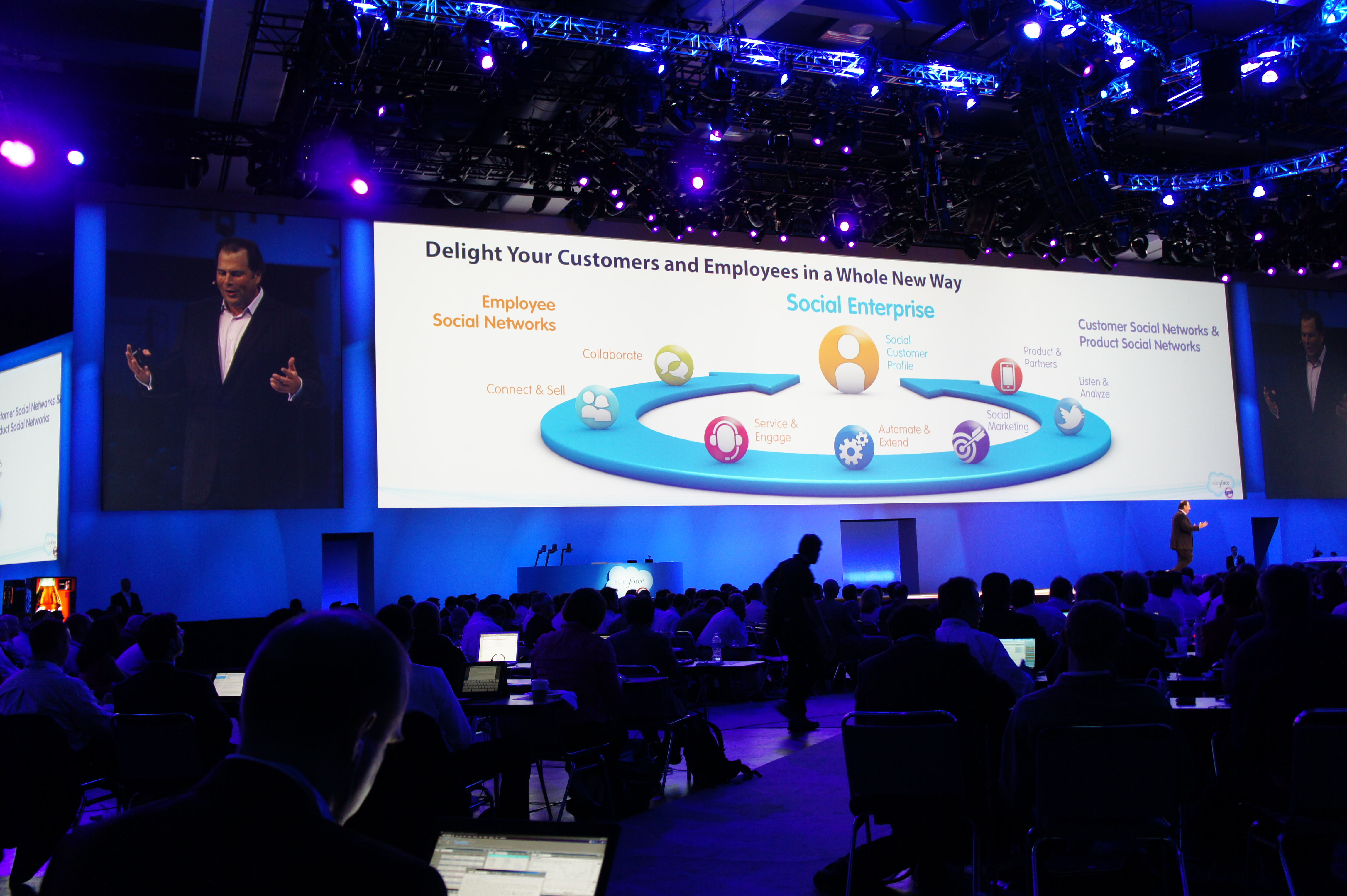
Marc Benioff Wraps Dreamforce 11 Keynote on the Social Enterprise

Sunday Musings: New Social Business Research, Plus Disruptors of Tomorrow’s Enterprise

All in all, it was a good week for the exploration of big ideas in social business. PWC’s Technology Forecast quarterly published an epic 68 page examination of the future of collaboration in the enterprise. For those without the time to read through it all, Sameer Patel wrote a great overview of the contents today.

Standout areas of focus in this report include 1) an emphasis on dealing with exception handling as the norm in collaborative environments, 2) an underscoring of the central role of the CIO, which is something I’ve seen as key for success in social business, and 3) last — but certainly not least — positioning social media to directly support ongoing business processes. Says Sameer:

One thing enterprises have learned is that siloed, standalone consumer Web-style microblogging or social networking tools rarely work well inside an enterprise. Social technology that’s embedded in the enterprise application environment to offer collaborative support to specific business processes, or explicitly targeted at unifying all communications and collaboration, can be much more useful.

If you’re not sure about this, the importance of connecting social business to workflow was clearly driven home this week in the discussion that Laurie Buczek sparked in the Enterprise 2.0/Social Business community. See the comments and pingbacks in the link for details but it’s clear the social media for its own sake just isn’t enough to drive significant business impact.

For me, it’s become abundantly clear that smart social business initiatives — and the ones that will ultimately have the most success — will focus on connecting their efforts directly with 1) meaningful line-of-business activities and/or 2) transforming and integrating the most important horizontal functions like the intranet, content management, and document management.

But PWC’s report and Laure’s noteworthy post were not the only significant happenings this week. Earlier today Ray Wang published an engrossing and significant overview of 43 Use Cases For Social Business. Maps like this are important to help those trying to understand how to apply social media to various parts of their business. Ray’s use cases cover the gamut of the following areas:

  • Public relations/ marketing (PR/MA). Key impacted business process: Campaign to lead
  • Sales (SFA). Key impacted business process: Lead to deal
  • Service and support (CSS). Key impacted business process: Incident to resolution
  • Projects (PBS). Key impacted business process: Kickoff to delivery
  • Innovation/ product life cycle management (PLM). Key impacted business process: Concept to production
  • Supply chain (SCM). Key impacted business process: Sourcing to acceptance
  • Human capital management (HCM). Key impacted business process: Hire to retire
  • Finance. Key impacted business process: Invoice to payment

I DM’d Ray and indicated I felt that this was just a start on where social business will have an impact and he agreed. The list is light on general purpose workflow/collaboration, but then again Ray’s view here is actually connected to specific business activities, as per the previous discussion. We should also keep in mind that Ray’s perspective is based on actual data gathered from those engaging in social business, which makes it particularly invaluable as a look at ground truth. I especially liked his chart on the top 20 use cases based on the responses of over 100 early adopters:

Top 20 Social Business Use Cases By Early Adopters

Ray and his team has been doing some great research lately and I look forward to watching what they put out next.

The Disruptive Business Landscape Adds Big Data, Algorithms

As enterprises get backed farther into a corner by the constant changes swirling around them, there’s been a lot of speculation about the root causes of disruption at present. Everyone knows that cloud, social, mobile, and now increasingly big data, are to blame, but are they really the whole story? Not by a long shot in my book and Michael Fauscette agrees.

Citing the usual suspects, Michael took a fairly deep dive this week into the additional forces that are remaking the way we work and operate our businesses and came up with some gems that paint a fairly complete picture. I’ve taken a shot at describing the macro changes several times in the last year or so, but Michael’s list has a great perspective. Be sure to read it yourself, but Organic Business Networks was the one that resonated most with me.

Disruptive Changes To The Enterprise Cloud Social Mobile and Big Data

For my part, I think the BBC’s When Algorithms Rule the World adds the final item of serious competitive disruption to both our lists. Will we truly be smart enough to rule over them while only reaping the benefits? I worry that we won’t and that few of us are putting enough thought into the implications of big data and the analytics that will pervade just about everything we do. Next-generation enterprises will be ones that own their classes of data while being able to maintain the highest leverage over what they know that others don’t. See my discussion on closing the “clue gap” between what most enterprises can do today, and what tomorrow’s leaders will be able to do.

Finally, as Web technology continues to provide an ever-growing force multiplier that’s placed into the hands that master it, I’ve been exploring one of the new leading edges of social business: The process of extracting strategic intelligence from the knowledge, connections, patterns that become much more visible when organizations become social. It’s a topic that’s growing central to the discussion of ROI as well as attaining long-term competitive advantage. You can see all the details at Harnessing Social Business Intelligence: Nine Strategic Uses and Social Business Intelligence: Positioning a Strategic Lens on Opportunity.

At Dreamforce in San Francisco this week

I’ll be in downtown San Francisco for Salesforce’s massive and increasingly influential Dreamforce 2011 conference from Tuesday onward. Expect pictures, videos, and blog posts in my Twitter feed as we see what they have in store for the social enterprise. I’ve been having discussions with a number of Salesforce partners this week that are announcing innovative and intriguing add-ons and support capabilities for Chatter and other elements of company’s growing and increasingly impressive ecosystem. I’ll cover as much as I can here and elsewhere. It’ll be a great week of conversations and moving the thinking forward in this fast moving space, even as social business tries to keep pace with social media.

Putting Social Business To Work

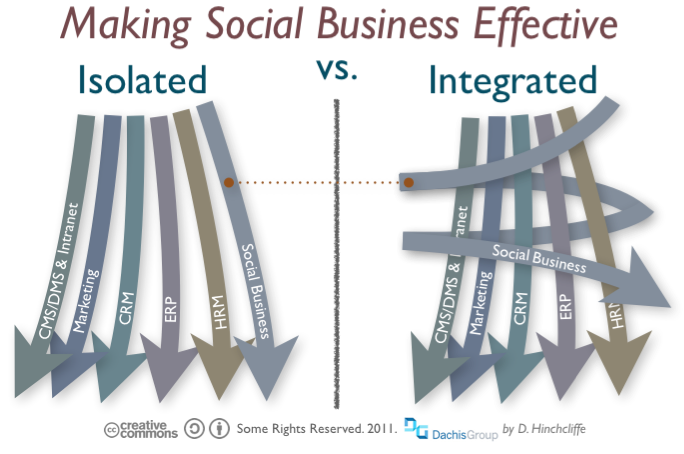
A great post yesterday by Laurie Buczek brought home for me a key issue that I’ve been pondering lately, namely how surprisingly disconnected some social business efforts end up becoming. We know many of the reasons this happens: Not-invented here, political fiefdoms, integration challenges, the tendency of many applications to turn into silos easily, etc. However, social media in the enterprise is about connecting deeply to those around us to improve the way we work. It’s certainly not about isolation, yet that sometimes becomes the state of affairs. How we organize for social business determines much of our success, as emergent as the process is. As Laurie said in her post (her emphasis):

The big failure of social business is a lack of integration of social tools into the collaborative workflow.

I should be clear that it’s not social business as a concept that’s the problem here. It’s that social must be connected to the day-to-day work that takes place. Unfortunately, most work today is done through existing systems that aren’t very social. If we’re lucky, we can forge a link to a piece of enterprise data from within a social tool, a basic requirement for social collaboration. But more likely we have to manually copy information from the systems of record in order to collaborate on it. Even more likely, the social business environment just becomes a parallel silo that’s not connected to the business and is used for light conversation and status updates instead of meaningful, high value line of business activities.
Social Business Connected To Flow Of Work

Yes, many large ERP, CRM, and HRM vendors including Oracle, Salesforce, IBM, Saba, and many others have either added or are otherwise incorporating social layers in their products that can help address this. But this is not necessarily the same as making our businesses fundamentally or more meaningfully social. Such duplication of social tools has its own silo issues and ultimately, rolling out social software on its own does not in itself produce results. No, the ladder of social business maturity requires more from us than that.

Instead we need to wrap our businesses in social in a more ambient and deeply connected manner. To work, this must be more than for example merely adding threaded conversations to our systems of record. It’s about weaving collaboration into everything we do, efficiently and simply. The good news is that there’s now hope to readily address what Laurie was referring to and connect social to workflow. With recent advances like real, mature, standardized social integration with OpenSocial 2.0 — with widespread support by enterprise software makers for the first time — there’s a genuine opportunity, right now, for us to connect our daily departmental and enterprise-scale work activities en masse to an overall social fabric that enables real change, real results, and real ROI.

Note: I do not think pure technology can ever be the full answer to this issue. But whenever we have a means of much more easily putting social in the flow of work we must go well beyond paper strategy and employ them.

So it’s up to us to see the importance of doing this and making it happen. Want social business become just a fancy chat tool in your organization? Don’t put social business to work. Do you want to unleash untapped worker potential, including cognitive surplus, peer production, and collective intelligence and all the big strategic buzzwords? Then put social business to work. The big lesson here: Failure to connect social business to work on the ground will pretty quickly result in limited value. We are now in the possessions of techniques to avoid this and we must use them.

See my writings on connecting business software to systems of engagement, social networking applications, and social app stores for more details on this subject. The Social Business CIO Shortlist can help as well.

Sunday Musings: Google’s Identity Struggles, Plus Social Media Bans Around the World

The Web’s missing features for built-in user identity have become a real headache for the industry, and for its users too. It certainly took its toll on market leader Google this week as its “Identity Theater” continued (Source: Kevin Marks.) The issue? It’s turning out that making every single user comply with the Common Names policy isn’t workable for a variety of reasons. Reports of Google deleting accounts en masse are driving a lot of the discussion. Robert Scoble has his own recommendations for Google and while they’re probably the least that would be acceptable to the majority of people, it doesn’t go far enough I think.

It certainly doesn’t have to be this way. Twitter allows companies, bots, and just about every other type of social account and it works quite well in the end. Twitter ran into a similar identity issue in a big way a couple of years back after facing lawsuits and widespread complaints. They managed to muddle through with Verified Accounts.

A growing consensus is that Google should allow user-defined accounts as well, with verified identity for those that want or need it. Personally, I’m not sure I see Google coming around with a response fast enough to prevent some damage to services and impacting Google Plus‘s runaway adoption. But in my analysis, it’s most likely to only hurt the commercialization of the service, not regular usage for most for now.

Social Identity Ownership - Google or Facebook?

Worse, the problem may actually be core to the way Google’s stack is conceived and architected. It may not be easy for them to change course in the short-term without ripples through the way global Google’s services fundamentally operate from a security and identity perspective. It also may not be good for their business model which is almost certainly based on the fact they know who people really are. This issue is one to watch given Google’s pervasiveness. It also has some significant implications for business users of its products, especially now that they seem to be gaining some much needed traction in the social networking wars.

For now, I’d recommend that businesses use Google Plus with an eye towards experimentation while the Web giant gets its philosophy and policies around identity sorted out. Frankly, the bigger industry issue is social Web identity itself. Users and companies increasingly depend on commercial providers like Facebook, Twitter, and Google to provide everything identity-related, from login access to storage and maintenance of their social graph. This is causing key elements of power and control to start to swing away from the open standards that made the Web so successful and essentially fair.

Will the W3C step in and resolve what’s appearing to be an increasingly glaring absence in the Web stack? So far it seems unlikely given the failure of many years of open standard Web identity efforts. The culprit? You have only to look in the mirror. Apathy by users and lack of consensus on the part of Web developers. There’s also a lot at stake financially for those that end up owning a big chunk of Web identity. Consequently, online — and especially social — identity is likely to grow into a full blown brouhaha in the next couple of years as issues, missteps, and abuses inevitably surface. However, we could also decide to put our own house in order before governments step in, the least desirable of all outcomes in most imaginable scenarios. The worst probably being governments owning, issuing, and centrally managing verified Web identity credentials for everyone.

Which brings us to the next subject…

Government Bans Chipping Away At Social Media Freedoms?

A couple of interesting things happened this week with governments aiming their considerable might at social media. While knee-jerk responses to this space were common enough a few years ago, with the U.S. Marines banning social media access for a while for example, these are now generally understood to be counterproductive and unworkable for a long list of reasons.

However, that didn’t stop the German government from banning the Facebook ‘Like’ button on Friday, sure to ignite a small firestorm in that country given that it seems to apply to any site accessible from inside its borders and the fine is a stiff €50,000. The Like button, used on millions of sites around the world to enlist users to leverage their Facebook social network to share content from 3rd party sites (see: k-factor), is significant enough on its own to put German Web businesses at some competitive disadvantage on the global stage. The concern is over privacy and that “all the information was sent to the US company even if someone was not a Facebook member.

In another similar situation, the Missouri state government’s new law preventing teachers from using social media to communicate privately with students, the former who just announced that they are fighting back, is another case in point. There are obvious free speech issues with the law despite the good intent on its face to protect students. The real issue is that the law is that violations are almost impossible to detect and enforce, until its too late, and that it ensures teachers, one of the most collaborative and interaction driven professions with far reaching impact, can’t have much of a social media presence of any kind until the implications are sorted out. It also presumably doesn’t prevent teachers from privately communicating with their students in any number of other digital channels. All of this means the law won’t accomplish a whole lot other than sowing confusion and promoting the use of increasingly obsolete methods in an increasingly fast-changing economic and societal landscape.

The real issue with both of these laws is that they are 1) essentially short-sighted, 2) exhibit such poor understanding of social media as to be essentially useless, and 3) are therefore unlikely to be meaningfully carried out. Worse, they chip away at the edges by introducing step-by-step, largely ineffective government oversight and control over social media, one of the largest economic, cultural, and societal changes of our time. This will become an even hotter topic as the Middle East’s social media coordinated model for uprising spills out of the developing world. In fact, this has already happened in Britain and there are already cries to ban social media in cases of civil unrest.

I should be careful to note here: I’m not by and large suggesting there’s any overarching government scheme to interfere with and control social media. Instead, I’m suggesting we keep a close eye on these developments as social media legislation increasingly (and inevitably) accumulates in bits and pieces on the base of knee-jerk responses to individual situations. This will have a great many unintended and unwanted consequences. The continued growth of laws and regulations in a vital new industry that thrives on inherent openness and trust has the potential to limit it so profoundly that we could lose much of the great promise that social media can provide.

While we must find ways that work to protect our citizens, we must also provide them access to one of the most open, free, and powerful means of interacting that has been invented. Let’s push back on unreasonable measures while also proactively being responsible for solving them. It’s up to us to start finding globally acceptable solutions to privacy, security, and misuse in social media and getting them into the hands of those who don’t understand this space well enough yet to govern it. The options for making this happen are something I’ll explore as soon as I can.

Connecting Agile Business with Social Business

When Jim Highsmith graciously invited me to give the opening keynote at the inaugural Agile Executive Forum in Salt Lake City this week, I had to really sit down and think about what I’ve been working on the last few years, namely social business, as compared the conference theme, agility and business. While agile methods have had many separate and distinct threads within the business and technical worlds over the last 20 years, one of the most active areas has been in software development. For its part, social business is a much newer phenomenon that’s become a top priority for many business leaders in the last couple of years. So, while I’ll cover the details of my presentation — in which I connected agility and social business as drivers of innovation, in another post — I will attempt to more formally to capture the specific similarities here.

In recent years, as agile development has been increasingly borne out as a fundamentally better, more efficient, lower risk, and more cost effective way of doing things, there has been significant and growing effort apply agile lessons to business in general. And, as it turns out, agility and social business, as two major new ways of connecting and organizing people in directed activity, have plenty in common. Perhaps even more importantly, they have key things to learn from each other.

I’ve had quite bit of experience with agile methods personally, having led extreme programming project teams and been closely involved in large, distributed SCRUM projects in years past. I’ve seen agile methods work significantly better than classical processes. This is probably why it’s now the most common development process in software that developers identify with in my experience. Consequently, I’m in a position to see some of the connections between business agility and social business, in all their many flavors. The connection isn’t trivial either. There are hard won lessons learned from agility that social business initiatives could certainly benefit from. Just as there are innovative new approaches to scale, transparency, process, and tooling that social business brings to the table, as extreme and radical as they may appear to agile folks, who are more used to being the harbingers of change.

Comparing Agile Business and Social Business

What’s the point of connecting these two approaches? Because they can learn a great deal from each other. Agile methods can be updated and modernized from what social business brings to the table, and social business can apply some maturity and rigor to what it does, as appropriate. This I believe is a fruitful exercise for both disciplines and is one I summarize below.

Agile Business and Social Business: Side-by-Side

Keeping in mind that some agile process purists are still on the fence about applying the methods more broadly, the focus here is on agile processes of any kind as applied to general people-based business activities. Some processes are more amenable to agility, just as some are more amenable to social business. In general, however, the less collaborative, more rigid, and user-isolated a business activity is, the less applicable either agile or social media methods will be to it. However, if you have a complex, open-ended, and outcome-oriented business process involving many people, especially including those that it most directly affected (typically, the customer, internal or external), then both approaches represent the very best ways that we know of today to deliver successfully on them.

As you’ll see, agility and social have much more in common than they have differences. Here’s my take on how they break down:

  • Coordination Instead of Control. Both agility and social eschew using centralized hierarchies to achieve control. Instead, as Brad Appleton has long recommended, they both work best with autonomous, adaptive, and accountable actors. The first two are something that applies very much to social business, while the latter is something inherent in any social environment that has a strong identity system (which, unfortunately, not all do.) The lesson here is that emergence (an important and prized aspect of Enterprise 2.0) and self-organization are very similar and are shared as core values in both disciplines.
  • Designing for Change/Loss of Control. This is something in which agile is inherently stronger than nascent social business methods, which are just wrapping their heads around this. Not killing emergence requires the acceptance that external change is a desired constant and should be responded to productively to get the right results with the resources at hand. Ignoring that requirements aren’t what the customers need, that the planned outcome of a business process won’t be very useful, and other denying of reality is anathema to both disciplines, but is more formal and well-defined in agile methods. Social business does recognize that the majority of productive output is on the edge of the network and largely outside of formal control, but other than measuring community sentiment, that’s often as far as it goes in terms of responding to new ground truths. The best results in both approaches are when there are tight feedback loops to all stakeholders and that a planned response to that feedback is the central factor in re-engagement with the project or online community in the next cycle. For additional insight, read Tim Leberecht’s great overview of this issue, titled Openness or How Do You Design For the Loss Of Control.
  • Frequent Work Cycles. Agilists call work cycles iterations. Social business doesn’t have as strong a notion of discrete work cycles because it’s essentially continuous and itself emergent, a more extreme version of agile when you look at collaborative work in social media environments such as crowdsourcing efforts or Social CRM. In either case, the project and/or community must assess and respond to change at the end of each iteration, or do it continuously which is more common in the case of social business processes.
  • Open Contribution. Social business works best when the broadest possible invitation is made for stakeholders to get involved and contribute. Agile processes tend to define valid contributors to a smaller audience, though it’s entirely up to the project and varies widely. Social business realizes that the “anyone can contribute” default stance is one of the most powerful concepts in recent business history (as only those that care about the outcome will get involved, yet that’s almost always many more people than you thought.) Agile methods could learn from the extreme openness and fewer contribution boundaries and barriers in social media. I made the point in my speech that open source software has proven this in the real-world better than any a priori speculation about what works best ever could.
  • Working Results. It’s long been the mantra that agile processes value working software as soon and often as possible at any given time in the project. When the requirements are right and/or the budget runs out, you have the best possible output, ready to use. Social business is not yet so disciplined in its directed outcomes, yet by its very nature is always up-to-date with the latest revisions, contributions, or updates.
  • Continuous Processes. While agile business typically recommends iterations, milestones, review steps, and other processes to happen as often as they provide useful course corrections (typically every few days, or weeks at most), social business is even higher velocity and larger scale. Consider real-time processes that run around the clock globally involving tens of thousands and sometimes a million or more simultaneous contributors. This means the scale and velocity of social business often outpaces agile by two to four orders of magnitude. Social business could learn a lot about continuous in the small (builds, releases, work product iterations, etc) while agile can perhaps learn to scale and go even faster in a way it never could before.

This comparison just scratches the surface but is a useful start. I’m happy to be called out on any details anyone feels like I may have gotten wrong. I do believe that agility and social business go hand-in-hand and that we can cross pollinate the two to create far stronger results that either can by themselves today. Put simply, agile business and social business are two sides of the same coin. That may be a controversial statement to some but I believe that as far along as these two disciplines have come in parallel, they will do better with more explicit and effective connection. Our organizations (businesses, organizations, government, etc.) will almost certainly benefit.

What do you see as the commonalities and differences between agility and social?

On Web Strategy

Global Use of Social Networks and E-mailMy old Web 2.0 blog is finally closing due to hosting issues so I’m moving the conversation here going forward. I’m also relocating my large library of old posts and visuals to this blog over the next few weeks. Collectively they’ve had over 12 million views and are witness to an amazing time in the history of the Web, business, and society. 

It’s been a profound era of change by any measure, and one that we’re fortunate to live through. Over the last seven years we’ve seen the rise of social media, Web 2.0, Enterprise 2.0, and now social business. Put simply, the Web-based world has changed nearly everything about the way we globally connect together and create shared value. For now, this blog as well as ZDNet, ebizQ, Dachis Group, and Hinchcliffe.org, will be where I will continue exploring the emerging edge of business and technology, with this blog focusing more on the Web itself and my other channels focusing more on the enterprise aspects.

I’m renaming this blog to On Web Strategy because I’ll continue to focus on the way the Web works, particularly what makes it so powerful for those that understand it. There’s lots of exposition available online about the changes taking place today, but not enough exploring the specifics of how Web-based networks are driving pervasive change. Among the endless information streams available now, there’s still room for more thorough examination of the way the Internet is co-evolving into the single most powerful platform for self-expression in history. I believe this is true whether you’re a person or a business; there is no other place nearly as compelling, innovative, valuable, or relevant today. And the Web itself, far from reaching maturity, remains the single most exciting — and most rapidly moving — place to improve and transform how we live and work.

Knowledge Work Dominates U.S. Labor by SectorWhile my primary interest lies in connecting the two too-often loosely connected roads of business and technology, I think the increasing convergence between them is where much, if not most, of tomorrow’s opportunity resides for those that can successfully overcome the obstacles. For its part, social media has become a leading force for value creation in the world along with the rest of our digital footprints, with which we are now creating the richest and most vibrant record of our times. Visionary enterprises are now seeing how to tap into this and join in partnership with the rest of the world to create entirely new types of products and services together with their customers. From the data, it’s clear that social co-creation and other new and closely related models, such as crowdsourcing, are genuinely changing the nature of human activity, especially value creation, control, ownership and other less-tangible qualities like trust, openness, and understanding.

While some organizations and individuals will continue to debate the actual magnitude of the changes that the new low-barrier, high scale, and virtually free tools of self-expression are fostering today in the large, there’s little doubt looking at the macro trends that momentous things are happening. I have certainly been asked, “are these changes as big as the printing press? As big as mass media? How about personal computing” Yes and yes and yes. And much more significant in terms of actual change wrought. I’ve included here a few recent pieces of my research that illustrate the case that the business, cultural, and societal landscape is being remade right now, and doing it quickly in some cases. This includes the following data points:

Trends and Drivers of Work and Life Today

    Portion of the Web That's Peer Produced

  • Social is how we communicate today. There has been a generational change of communication from point-to-point (e-mail) to social in four short years (see first figure above). Certainly e-mail is in decline and will be with us for a decade or two, but it has dramatically lost its prominence and relevance in recent years. For now, social media is the way we increasingly prefer to connect and work together. Traditional organizations have had some trouble catching up to these trends, but I’m finally seeing evidence that they’re doing so.
  • Knowledge work is the driver of our world economy. People-based activities centered around the creation and exchange of information (financial services, real estate, education, media, governing, etc.) are what modern economies are built on (see second figure above.) Methods that greatly improve the creation and exchange of information will have inordinate value, especially models that optimize for it, i.e. social media and by intent, social business. Knowledge work is about 60% of the labor force today and growing steadily. The less valuable service economy is growing as well and is also a beneficiary of these new and emerging forms of communication and collaboration.
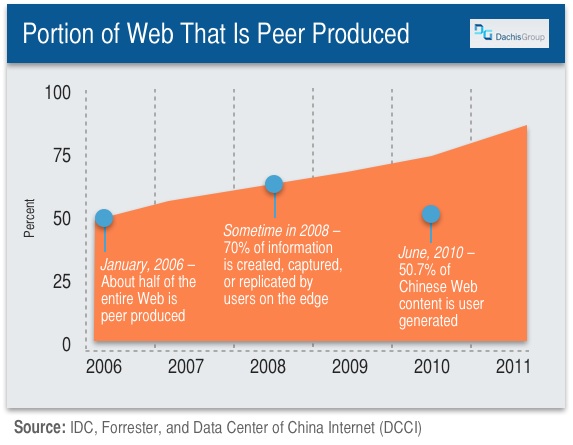
  • Peer production is now the primary motive force for creation and sharing. Centrally controlled models for production in business and government are much less powerful and inordinately more expensive. The creation of information on the “edge”, by individuals, has transformed traditional media as well as the Internet: It’s now made by us, with approximately 80% of information on the Web (see last figure, right) now coming from user generated content. In the future, sensors and other information generators may outpace us, but for now the most important trend is that productive capability has moved decisively into the hands of us out there in the long tail.

What does this all mean? That’s what this blog was developed to figure out. Come back and visit. I’ll be exploring Web strategy and cutting-edge innovations that are likely to have significant impact to the way we run our organizations and live our lives. Please drop me a line if you want to share your ideas, or better yet, contribute them in comments below or in your own blog or social network.

The K-factor Lesson: How Social Ecosystems Grow (Or Not)

Recently for some work that I’m doing I had to revisit the techniques for creating successful online social environments.  This is a surprisingly deep and nuanced topic that we as Web application architects or enterprise social computing practitioners are just now fully beginning to grasp.  The subject matter itself runs the gamut from key conceptual underpinnings — esoteric topics like systems theory and network effects — to the daily grind of understanding and managing the needs/expectations of an often difficult-to-control community of actual, live people.

In general, I’ve found that the ideas behind social systems themselves are clean and elegant while dealing with their practical realities can definitely be messier and many find them annoyingly unpredictable as well.  In the end, online social ecosystems are invariably a fascinating mix of the classic vagaries of technology and people.  However, despite the apparent science, making them grow into something undeniably successful is still very much an art form.

Interestingly, there’s no real name for this skill yet and it’s an important — even vitally strategic one — for any organization that has to engage with a lot of people over a network. And that’s increasingly most of us in these days of the ever-present Facebook news feed, Twitter microblog, and workplace Enterprise 2.0 environment.  It also means that creating a workable online community requires a good dose of hard-nosed engineering as well as highly effective “soft” skills in UX design, social architecture, and community management. For it to really work — to have a vibrant and growing community — you have to seamlessly connect both of these worlds: a well-crafted social environment together with the people that will use it. The rewards for doing it successfully speak for themselves: Ultimately, businesses and communities are groups of people, and if they produce more value for each other together than they can individually, then there is something in it for everyone. And the online world lets us create these entities far easier, more quickly, and with larger populations than ever before in history.

Related: Network effects are just one of several dozen “power laws” that social architects must know today.

We used to call this process “founding a business” or “creating an organization”.  We would call the people that did this entrepreneurs or occasionally philanthropists if their goal was non-commercial. But this terminology doesn’t seem to apply as much to what’s happening now.  For one thing, communities are organized differently and frequently have other motivations for participation than the usual one for traditional businesses: the worker/employer relationship.  Second, the output of large distributed online communities — especially when focused on discrete outcomes — can greatly exceed the results produced by densely concentrated single institutions.  While we are certainly in the very early days of this phenomenon, I’ve frequently pointed to numerous examples of these new models for creating shared value.

So putting aside the socialism vs. capitalism arguments for now (they are increasingly brought up in this discussion, though why they don’t seem to apply here is the subject of a future post) the 21st century networked economy — powered by people and knowledge connected together globally at virtually no cost — has set free fundamentally new ways of innovating and collaborating for mutual benefit.  Specifically, it’s the rules for how these new mechanisms thrive and create value that is the object of discussion here.

Viral Growth of Social Systems: The K-Factor Lesson

For my own part, I’ve been fortunate to encounter ways to reduce the concepts for creating growing social ecosystems to a short list, the key ones which I’ll present here. Please be warned, some jargon is necessary, but I will explain it along the way.

How To Create Self-Sustaining Social Ecosystems: The K-factor Lesson

Like my 50 Essential Strategies for Web 2.0 Products, this overview cannot possibly be exhaustive.  It does however highlight the central idea behind all successful communities: They are either busy growing or they’re busy dying.  Gaining critical mass early on is another important lesson that we’ve garnered from the early Web 2.0 pioneers.  Finally, the aforementioned and mysterious K-factor is introduced and explained below.

  • Fiat and network effects are the two primary ways that social ecosystems grow.  The first is based on an explicit or implicit mandate of some kind.  An example of a fiat is when an organization requires participation in a particular social group, perhaps a committee or online community.  The second, a network effect, is when a social group has more value the more that other people are involved in it too (which is usually, but not always the case.) Keep in mind that the degree of value in each new member, or their contributions, is based on the structure or design of the social system and will vary greatly.  Also note that the fiat approach that is common in business today is a top down effort to “push” participation, while network effects are a “pull” method and tend to be more bottom-up and organic.  Background: Read more about push vs. pull systems. Critically, the degree to which a network effect is realized can be influenced by many factors not the least including the intrinsic nature of the social ecosystem itself and how it is connected to the rest of the network (the Web or your intranet.)  In general, network effects will ultimately be more successful than fiat for most purposes, especially since the use of social systems are so often made optional, even in business environments.
  • Network effects can be encouraged by promoting self-sustaining growth via feedback loops (aka virality).  One of the myths of the online world is that viral growth can’t be engineered. While it’s sometimes not straightforward, it can indeed be created intentionally. While cynical uses of virtuous growth cycles won’t produce results for long, the basics work best: letting any user improve the community by contributing knowledge, often to a lightly structured data set or encouraging them to invite their friends and colleagues.  In fact, any good social ecosystem will make it easy and rewarding to do so, such as allowing users to discuss, converse, jointly edit, or otherwise work together on common goals.  Stated another way, the future of software applications that don’t provide more value when more people are present in an interaction is probably going to be fairly short. A good place for more background on the lifecycles of systems (social or otherwise) is William Varey’s Unlimited Growth.
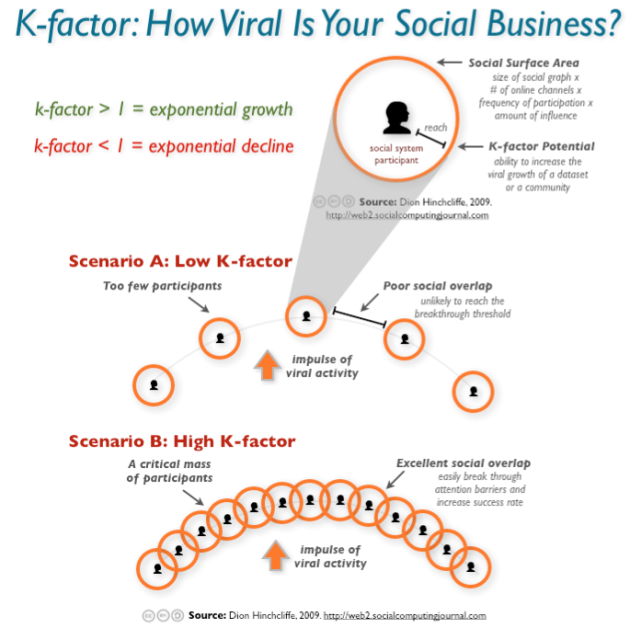
  • Measure your K-factor and keep it above 1.  The K-factor of an ecosystem is a statement of whether your network effect is self-sustaining or not.  A K-factor of less than one means that your organic growth level is falling (exponentially) and a K-factor of greater than one means that it’s growing naturally and again, exponentially.  How to increase your community’s K-factor? There are literally countless ways but allowing users to contribute to hard-to-recreate data set, adding user distributable widgets that provide useful offsite functionality, as well as integrating meaningfully with 3rd party social networks through their application model are a few of the more popular and effective ones.  I explored some of these distribution approaches in more detail a while back in my overview of the new distribution models of the Web.
  • The higher the social feedback loop intensity, the higher the breakthrough factor.  Feedback loops are created for example when a user invites another user to the community and then that user invites their friends and so on.  However, the quality of the feedback loop is a measure of how often it reaches outside of the community and how effective that outreach is (often stated as  k = e * i, where “e” is the efficiency of the feedback loop and “i” is the average number of invites per user.)  An individual user’s ability to affect the quality and intensity of the feedback loop is usually a measure of their social surface area, which I generally consider to be the size of their social graph x the number of online channels they use x the frequency of participation x the amount of influence they exert. If you have a social ecosystem with a lot of influencers or users that are very active online, they will clearly fuel the response to your feedback loops more effectively. The design of the social environment itself also has a major effect depending on whether it makes it easy to invite others or otherwise create feedback loops.  A breakthrough factor is achieved when the feedback loops rise above a certain threshold of attention, such as when multiple invites come from multiple persons over a short interval of time.  When this threshold is crossed for a prolonged period, the K-factor increases much more rapidly.  This rise can be self-sustaining (the so-called virtuous cycle) and can lead to a permanent and dramatic growth climb as evidenced by many of the popular social networks early on, such as MySpace and Facebook.
  • External “high impulse events” can be used in the short term as a catalyst to reach the breakthrough factor.  This was famously the case with MySpace which used a database of 50 million e-mail addresses to drive initial users to the site, whereupon their feedback loops soon created a particularly strong breakthrough factor.  Traditional marketing is often used as the seed to drive the initial population of communities, but unless the K-factor soon rises above 1, the long-term cost of this approach is usually prohibitive.  It’s worth noting that it all my research, I’ve never encountered a community that was successful long-term without naturally self-sustaining growth.  This is the K-factor lesson of this post’s title: You can grow any community in the short term using artificial means but it will only last and continue to grow on its own because of the inherent quality of the people and the knowledge that has accumulated.  That said, you must get your community growth primed in some way.  High impulse events can include (by no means exhaustive) traditional marketing, paid incentives (expensive but Paypal was very successful with this model in its early days), and — particularly for business communities — seeding initial high value content.
  • Growth in a social ecosystem is not endlessly exponential and eventually hits a ceiling. Plan for it.  Typically described by the S-curve, it is encountered when you either fight an existing network effect or when resources are exhausted on the network.  While hitting the upper bound of the S-curve is desirable and denotes a successful system (Facebook is just hitting this now), it can also be an indicator of a failure or a bottle-neck in the feedback loop design.  A false S-curve is most often evident in my research when a community undergoes a major UX redesign and users have to find their way again, often unable to find and use the features that drive growth and sustain the community. Be aware of this and guard against the potential causes of premature S-curves.

I’ve written in the past about deliberately creating emergent phenomenon and then capturing some kind of value from it.  Like most efforts on a fixed scale of zero to the maximum possible result, there is a reverse bell curve effect, meaning that most people will get middling results, some will get very poor, and some will hit it out of the park.  From the projects I’ve been involved in, I find that the most successful social efforts are ones that are highly agile and willing to capture lessons learned early and often and then make changes quickly and do it all over again the next week.  The Web favors those who experiment, adapt, and evolve and thus should go your social ecosystems.

Good luck with your social media and Enterprise 2.0 efforts.  Please don’t hesitate to ask questions below or contribute your own wisdom.

How Social Could Disrupt Search

The inimitable Fred Wilson concluded yesterday in "Why Social Beats Search", that "[m]achines can help us find what is good. But with the help of machines, our friends and trusted sources can and will do that even better."  This statement capped off a fresh debate over the weekend about automated, keyword-driven "McContent" creation that started when Michael Arrington posted about "the end of hand crafted content". Richard MacManus also explored the same issues in "Content Farms: Why Media, Blogs, and Google Should Be Worried".

I find this discussion very intriguing because it's nearly a mirror-image to the still-unfolding story of the last big change in this space: How the volume and timeliness of social media has disrupted traditional media.  I explored this subject in-depth recently on ZDNet about how this same transformation is now happening more broadly to other industries as well.  Now we're full circle already: What went around with social media is coming around again rather quickly with McContent. The machines are in the upstart role this time and have the potential to displace social media "moms and pops" who might not be able to match the volume and speed at which automated content can be created.  TWill Social Surpass Search?hat of course, depends on if you believe that machines can match the quality of handmade content.  And indeed, if quality ultimately matters as much as volume and timeliness. There's a balance here that I'm not sure we fully understand yet but I'm betting there's probably room for the full spectrum.  This will only be true, however, if we are prepared to accept that the online landscape and current ways of doing business are going to continue to evolve rapidly.

The premise of today's information abundance reaching an unsustainable place isn't a new one. Information overload is a  rapidly growing subject that a lot of smart folks are talking about these days.  One bright area however, and this is the point that Fred Wilson touches on, is that social systems might actually provide an effective filter that will separate the wheat from the chaff by decentralizing the expertise and work of content curation into a sort of crowdsourced collaborative process (an increasingly widespread approach.)  This could make it both scalable and sustainable and I do believe that social content curation is an important trend.  But it's only one step in the right direction as we head into the future dominated by truly vast information abundance. 

One holy grail of search is "search that finds you" just as and when you actually need it.  Encouragingly, I'm now starting to see this happen with social environments like Twitter where I've received more and more tweets lately in the vein of "@dhinchcliffe Thanks for the link, was just looking for this 10 mins ago!" This is the seed of a trend that could be exploited by a very smart company that created the right product design that systematically optimized social recommendations and content referrals into something so much more than it is today: ad hoc serendipity.  Will the company that does this be the ones with the largest active social networks, such as Twitter or Facebook?  Or perhaps Google will figure it out as a component of real-time search?  Or will it just as likely be someone that no one has heard of yet? If the history of the Web is any guide, it will come from a place we won't anticipate.

I also suspect that other forces are in the running and may end up limiting the impact of distributed social curation, or more likely co-opting it.  Emerging trends like Web Squared and its autonomic filters and recommendation systems powered by data shadows as well as advanced forms of Enterprise 2.0 BI are just as likely to provide the solution in the medium to long-term.  Either way, search is only going to get better and social will certainly improve it.  That's not to say social won't disrupt search, but it may only complement the changes happening more broadly.  One big question is whether social can be made to scale enough to be routinely effective for most users.  In the end, that's the big question in my mind: The output of machines can always exceed that of people and that's not necessarily a bad thing as long as we still get access to both results when we need them.

Web Squared Emerges To Refine Web 2.0

It’s been five years now that we’ve begun to understand what Web 2.0 is, starting way back in 2003.  It’s been a fairly impressive if winding road as a new online generation was born.  But far from getting long in the tooth, along the way Web 2.0 became vitally important — even central in some cases — to the very future of global culture and business.  Oh certainly, sometimes we get tired of the term itself, and admittedly it doesn’t describe something necessarily new anymore, but what we just do these days.  But the concepts identified as Web 2.0 have proved to be highly insightful, even prescient, and are used around the world daily to guide everything from product development to the future of government.

It has been today’s commonplace use of intensely popular and deeply pervasive social networks, the outright transformation of industries such as media and software, and the growing dominance of 2.0 techniques such as user generated content, open business methods, crowdsourcing, Enterprise 2.0, open APIs — in the business world and elsewhere — which has been striking, even if there’s a long way to go in some quarters.  Indeed, Web 2.0 is not just here to stay, it seems to be a revolution that just keeps on rolling and giving us, as I often say in my talks, an amazingly resourceful and resilient new lens with which to 1) look at the world and 2) the network that now surrounds it, and 3) the opportunities between the two.

Now, to paraphrase Churchill, “Now this is not the end. … But it is, perhaps, the end of the beginning” of Web 2.0, many are starting to perceive deeper patterns and concepts within Web 2.0 practices.  We can perhaps now see more clearly the next steps towards what some would like to call Web 3.0, and which Tim O’Reilly and John Battelle have decided to dub Web Squared, the deeper explanation of which you can find here on the Web 2.0 Summit site.  Whether we need a new term and whether Web Squared will be as accepted, or at least as widely repeated, as Web 2.0 is perhaps unlikely but it nevertheless is a cogent, if necessarily, incomplete next progression.  What is certain is, that like Web 2.0, the ideas within it are useful new strategic ones that are emerging from the countless practical experiences of Internet practitioners everywhere in the world’s largest living laboratory: The Internet.

At its core, the message is that the Web is becoming more autonomic, reflective, real-time, generative, and open while at the same time far more deeply embedded everywhere in the fabric of our environment.  And like what came before it, Web Squared is likely to have profound impact to the societies and organizations, either way, that choose to understand it or ignore it.

What is Web Squared?

While this is my personal take, Web Squared articulates a broader fusion between the world-at-large, the Web, and the people connected to it.  It’s a more extreme view of Web 2.0 while at the same time hinting that while social computing has been a major transformative force recently in the consumer world and beyond, the relentless growth of devices, network connectivity, and sensors into our lives across our homes, workplaces, and external environment is casting an growing “information shadow” that is increasingly hard to ignore.  At first glance this can seem to be an impersonal and inhuman concept as the network expands to surround everything and dominate the participation that so far at least is still driven (for a little bit longer anyway) by what people do and contribute online.  However, this bleak vision is tempered by the realization that far from being pushed to the side, we collectively must be the feedback loop that guides Web Squared through billions of daily interactions that makes it possible in the first place.  It’s the full environment, including us, which makes it all work.

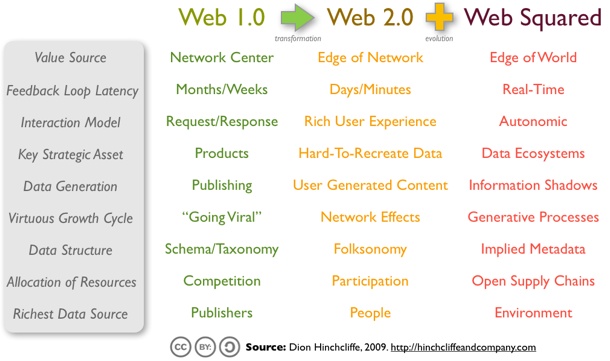
Web 1.0, Web 2.0, WebSquared Compared

The comparison above gives a cleaner, most succinct sense of what Web Squared is by comparing it to Web 1.0 and classic Web 2.0.  It’s not necessarily a generation beyond Web 2.0 since many of the concepts are simply more refined or focused.  But the “knobs” on many Web 2.0 ideas like collective intelligence, feedback loops, network effects, and so on are turned up quite a bit more and are fueled more directly by our interactions with the world as well as our synthesis of it.  We know now how to sharpen the scalpels that we use to design our online businesses a good bit better and Web Squared reflects this.

For my own part, it’s a useful evolution of Web 2.0 even if it’s not quite as dramatically transformative culturally.  However, the implications in terms of the types of new businesses that will be created have the potential to be as potent as Google (or even more so) when it comes to cornering the market on new classes of data and therefore entire industries, since most winners in on the online space have outsized dominance of their sectors.  You want to use Web 2.0 ideas for the most impact? Think in terms of Web Squared.

I’ll be exploring the concepts of Web Squared in further depth here as I am able, but it’s clear that we need to take what we’ve learned in the Web 2.0 era and focus on emerging techniques that seem particular promising.  In particular, I think the key aspect of Web Squared will lie in teaching our applications to “learn inferentially” from our online product’s strategic sets of data and drive out previously hidden value.  That’s where being able to create powerful new autonomic, environmentally-connected, database-driven applications, often from ecosystems of partners that will provide access to their data (for a price), has the potential to become a dominant new growth model for modern Web apps.  Whether this is video search engines built on top of YouTube’s content, near real-time language translation using peer production in social communities, or just better product/content recommendation engines remains to be seen.

But the chances are just as likely that entirely new types of break-out products will be created that we can only barely imagine today, like we did with Web 2.0 just a few short years ago.  These new applications will fully harness the Web of data powered by insightful and potent cooperative algorithms and novel integration strategies that are deeply connected to the world we live in.  Developing these generative algorithms will be the central challenge for a new era of product designer.  These product designers will be experts at developing interactive systems for drawing insight, collecting data, and creating value from instantaneous Web input.  We can look to examples such as the Netflix Prize as successful models for distributed, open design “studios” for creating, validating, and identifying the winners.  How we look at fostering innovation and harvesting it is being reshaped by this vision already.

One thing is for certain, however, the way we look at the network is in the process of taking another big leap.

I’d like to get together a list of Web Squared example applications and ideas.  Please leave your suggestions and comments below.

50 Essential Strategies For Creating A Successful Web 2.0 Product

I am fortunate enough to spend a lot of time looking at various online products and services in the development stage, mostly of the Web 2.0 variety, meaning they use one or more of the principles in the Web 2.0 set of practices.  It’s been going on 4 years now and what’s fascinating to me, despite the enormous amount of knowledge that we’ve accumulated on how to create modern Web applications, is how many of the same lessons are learned over and over again.

Wouldn’t it be handy if we had a cheat sheet that combined many of these lessons into one convenient list?  In this vein of thinking, I decided to sit down recently to capture are some of the most important lessons I’ve learned over the last few years along with some of the thinking that went into them.

The Web Community Gets Smarter Every Time It Builds A Product

If there’s one thing that the Web has taught us it’s that the network gets smarter by virtue of people using it and product development is no exception.  Not only do we have examples of great online applications and systems to point to and use for best practices, but the latest tools, frameworks, development platforms, APIs, widgets, and so on, which are largely developed today in the form of open source over the Internet, tend to accumulate many of these new best practices. I’ve lauded everything from frameworks like Rails, Cake PHP, and Grails to online community platforms like Drupal and Joomla as examples of guiding solutions that can be vital springboards for the next great Web product or service.  

However, most of the success of an online product, Web 2.0 or otherwise, comes from two things: Its software architecture and its product design.  It’s also the case that the story of any product is a story of ten of thousands of little decisions made throughout the life of the product, of which only a key — and heartbreakingly small — set will make much of a difference to its success on the network.  The list of strategies below tells part of the story of which decisions will make that critical difference.

What then is software architecture and product design when it comes to today’s Web applications?  The good news: They’re often the same as they’ve always been, albeit just a bit more extreme, though there are some additions for the 2.0 era as well: 

Software architecture determines a Web application’s fundamental structure and properties: Resilience, scalability, adaptability, reliability, changeability, maintainability, extensibility, security, technology base, standards compliance, and other key constraints, and not necessarily in that order. 

Product design determines a Web application’s observable function: Usability, audience, feature set, capabilities, functionality, business model, visual design, and more.  Again, not necessarily in priority order. 

Doing both of these top-level product development activities well, striking a healthy balance between them (one often dominates the other), and doing it with a small team, requires people with deep and multidisciplinary backgrounds in creating successful products across this extensive set of practice areas.  These people are often hard to find and extremely valuable.  This means it’s also not likely you’ll be able to easily put together a team with all the capabilities that are needed from the outset. 

Be prepared from the outset for on-the-job learning and study, relying on tools and products that embody best practices, and replicating only the best designs and ideas (while being very conscientious not to steal IP.)

Balancing Software Architecture and Product Design in Web 2.0 Applications

In this way, I’ve collected a set of strategies that address the most common issues that I see come up over and over again as online products go to market.  I’ve decided to share these with you so we can continue to teach the network, and consequently ourselves, a little bit more about how to make extraordinary Web applications that can really make a difference in the marketplace.

This of course is just my experience and is not intended to be a complete list of Web 2.0 strategies.  However, I think most people will find it a valuable perspective and useful cross check in their product design and development. And please keep in mind this list is for Web 2.0 applications, not necessary static Web sites, or traditional online Web presence, though there is much that here that can be applied to them to make them more useful and successful as well.

Finally, a good number of these strategies are not specifically Web 2.0 concepts.  They are on the list because they are pre-requisites to many Web 2.0 approaches and to any successful product created with software and powered by people.

Please add your own strategies in comments below for anything that I’ve missed.

50 Strategies For Creating A Successful Web 2.0 Product

1. Start with a simple problem.  All of the most successful online services start with a simple premise and execute on it well with great focus.  This could be Google with it’s command-line search engine, Flickr with photo sharing, Digg with user generated news.  State your problem simply: “I make it easier to do X”.  Focus on solving it elegantly and simply, only add features carefully.  Over time, complexity will become the enemy of both your product design and your software architecture, so start with as much focus as you can muster.

2. Create prototypes as early as possible.  Get your idea into a working piece of software as quickly as possible.  The longer you take to go through one entire cycle, the more unknown work you have ahead of you.  Not producing software also means that you are not getting better and better at turning the work of your team into the most important measurable output: Functioning software.  Throughout the life of your product, turning your ideas into software as quickly and inexpensively as possible will be one of the most important activities to get right.

3. Get people on the network to work with the product prototype rapidly and often.  The online world today is fundamentally people-centric.  If your product isn’t about them and how it makes their lives better, your product really doesn’t matter.  And if they’re not using your Web application as soon as possible, you just don’t know if you are building the right product.  Constant, direct feedback from real people is the most important input to our product design after your idea.  Don’t wait months for this to happen; get a beta out to the world, achieve marketplace contact in weeks, or at most a few months, and watch carefully what happens. This approach is sometimes called Web 2.0 Development .

4. Release early and release often.  Don’t get caught up in the massive release cycle approach, no matter how appealing it may be.  Large releases let you push off work tomorrow that should be done today.  It also creates too much change at once and often has too many dependencies, further driving an increase in the size of the release.  Small releases almost always work better, are easier to manage, but can require a bit more operations overhead. Done right, your online product will iterate smoothly as well as improve faster and more regularly than your competitors. Some online products, notably Flickr, have been on record as saying they make new releases to production up to several times a day.  This is a development velocity that many new startups have trouble appreciating or don’t know how to enable. Agile software development processes are a good model to start with and and these and even more extreme methods have worked well in the Web 2.0 community for years.

5. Manage your software development and operations to real numbers that matter.  One often unappreciated issue with software is its fundamentally intangible nature.  Combine that with human nature, which is to manage to what you can see, and you can have a real problem.  There is a reason why software development has such a variable nature in terms of time, budget, and resources.  Make sure you have as many real numbers as possible to manage to: Who is making how many commits a week to the source repository, how many registered users are there on a daily basis, what does the user analytics look like, which product features are being used most/least this month, what are the top 5 complaints of customers, and so on.  All of these are important key performance indicators that far too many startups don’t manage and respond to as closely as they should.

6. Gather usage data from your users and input it back into product design as often as possible.  Watch what your users do live with your product, what they click on, what do they try to do with it, what they don’t use, and so on.  You will be surprised; they will do things you never expected, have trouble with features that seem easy to you, and not understand parts of your product that seemed obvious.  Gather this data often and feed it back into your usability and information architecture processes.  Some Web applications teams do this almost daily, others look at click stream analytics once a quarter, and some don’t it at all.  Guess who is  shaping their product faster and in the right direction?

7. Put off irreversible architecture and product design decisions as long as possible. Get in the habit of asking “How difficult will it be to change our mind about this later?” Choosing a programming language, Web framework, relational database design, or a software interface tend to be one-way decisions that are hard to undo.  Picking a visual design, logo, layout, or analytics tool generally is not.  Consequently, while certain major decisions must be made up front, be vigilant for seemingly innocuous decisions that will be difficult to reverse.  Not all of these will be a big deal, but it’s all too often a surprise to many people when they discover their architecture isn’t malleable in the places that they want it to be.  Reduce unpleasant surprises by always asking this question.

8. Choose the technologies later and think carefully about what your product will do first.  First, make sure your ideas will work on the Web. I’ve seen too many startups with ideas that will work in software but not on the Web.  Second, Web technologies often have surprising limits, Ajax can’t do video or audio, Flash is hard to get to work with SEO for example.  Choosing a technology too early will constrain what is possible later on.  That being said, you have to choose as rapidly as you can within this constraint since you need to build prototypes and the initial product as soon as you are able.

9.  When you do select technologies, consider current skill sets and staff availability.  New, trendy technologies can have major benefits including higher levels of productivity and compelling new capabilities, but it also means it’ll be harder to find people who are competent with them.  Having staff learn new technology on the job can be painful, expensive, and risky.  Older technologies are in a similar boat; you can find people that know them but they’ll most likely not want to work with them.  This means the middle of the road is often the best place to be when it comes to selecting technology, though you all-too-often won’t have a choice depending on what your staff already knows or because of the pre-requisites of specific technologies that you have to use.

10. Balance programmer productivity with operational costs.  Programming time is the most expensive part of product creation up front while operations is after you launch.  Productivity-oriented platforms such as Ruby on Rails are very popular in the Web community to drive down the cost of product development but can have significant run-time penalties later when you are supporting millions of users.  I’ve previously discussed the issues and motivations around moving to newer programming languages and platforms designed for the modern Web, and I encourage you to read it. Productivity-oriented platforms tend to require more operational resources during run-time, and unlike traditional software products, the majority of the cost of operations falls upon the startup.  Be aware of the cost and scale of the trade-offs since every dollar you save on the development productivity side translates into a run-time cost forever after on the operations side.

11. Variability in the productivity amongst programmers and development platforms each varies by an order of magnitude.  Combined together and your choice of programming talent and software development platforms can result in a 100x overall effect on product development productivity.  This means that some teams can ship product in as little as 3 months and some projects won’t ship ever, at least not without truly prohibitive time and resource requirements.  While there are a great many inputs to an Internet startup that will help or hinder it (take a look at Paul Graham’s great 18 Mistakes That Kill Startups for a good list), these are two of the most central and variable: Who is developing the product and what development platform they are using. Joel Spolsky’s write-up on programmer productivity remains one of the best at understanding this issue.  It usually turns out that paying a bit more for the right developer can often mean tremendous output gains.  One the other side of the coin, choosing a development platform not designed for creating modern Web applications is another decision that can sap your team of productivity while they spend months retrofitting it for the features they’ll need to make it work properly in today’s Internet world. 

12. Plan for testing to be a larger part of software development process than non-Web applications.  Cross browser testing, usability, and performance/load testing are much bigger issues with Web applications than many non-Web applications.  Having to do thorough testing in a half-dozen to a dozen browser types can be an unexpected tax on the time and cost of creating a Web product.  Doing adequate load testing is another item that often waits until the end, the very worst time to find where the bottlenecks in your architecture are.  Plan to test more than usual.  Insist on automated unit and integration tests that build up over time and run without having to pay developers or testers to do it manually.

13. Move beyond traditional application hosting. Single Web-server hosting models are not going to suffice for your 2.0 applications.  Reliability, availability, and scalability are essential and must be designed into your run-time architecture and supported by your hosting environment.  Solutions like 3Tera, Amazon’s Elastic Compute Cloud, and Google’s App Engine are three compelling, yet very different solutions to the hosting problem.  Either way, grid and cloud approaches to hosting will help you meet your growth and scalability requirements while managing your costs.

14. Have an open source strategy.  This has two important aspects.  One, developing and hosting a product built with open source software (the ubiquitious LAMP stack) is almost always much less expensive than using commercial software and is what most online products use.  There are certainly commercial licenses that have fair terms for online services, but almost none of them will match the cost of free.  This is one reason why you won’t find Windows or Oracle embedded in very many Web 2.0 services.  Two, you’ll have to decide whether to open source or commercial open source your product.  This has entirely to do with what your product does and how it does it, but an increasing number of Web 2.0 hosted products are releasing their offerings as open source to appeal to customers, particularly if they are business customers. Done right, open sourcing can negate arguments about the size of your company while enlisting many 3rd party developers to help enrich and make your product better.

15. Consider mobile users as important as your regular browser customers.  Mobile devices will ultimately form the majority of your user base as the capability and adoption of smartphones, Internet tablets, laptops, and netbooks ushers in mobile Web use as the dominant model.  Having an application strategy as well as well-supported applications for the iPhone, Android, and RIM platforms is essential for most Web products these days.  By the time you get to market, mobile will be even more important than it is now.  Infoworld confirmed today, in fact, that wireless enterprise development will be one of 2009’s bright spots.

16. Search is the new navigation, make it easy to use in your application.  You have 5-10 seconds for a new user to find what they want from your site or application.  Existing users want to directly access what they need without going through layers of menu items and links.  Search is the fastest way to provide random access navigation.  Therefore, offer search across data, community, and help at a minimum.  A search box must be on the main page and indeed, every page of the modern Web application. 

17. Whenever users can provide data to your product, enable them.  Harnessing collective intelligence is the most central high-level principle of Web 2.0 applications.  To be a major online competitor, getting your millions of users to build a valuable data set around the clock is the key to success. Many product designers look at this too narrowly and usually at a small set of data.  Keep a broad view of this and look for innovative ways to get information from explicit contributions to the database of intentions can form your architecture of participation.

18. Offer an open API so that your Web application can be extended by partners around the world.  I’ve covered this topic many times in the past and if you do it right, your biggest customers will soon become 3rd party Web applications building upon your data and functionality.  Critically, offering an API converts your online product into an open platform with an ecosystem of 3rd party partners.  This is just one of many ways to realize Jakob’s law, as is the next item.

19. Make sure your product can be spread around the Web by users, provide widgets, badges, and gadgets.  If your application has any success at all, your users will want to take it with them and use your features elsewhere.  This is often low-effort but can drive enormous growth and adoption; think about YouTube’s badge. 

20. Create features to make the product distribute virally.  The potency of this is similar to widgets above and everything from simple e-mail friend invites to importing contact lists and social graphs from other Web apps are critical ways to ensure that a user can bring the people they want into the application to drive more value for them and you.   

21. The link is the fundamental unit of thought on the Web, therefore richly link-enable your applications.  Links are what make the Web so special and fundamentally makes it work.  Ensuring your application is URL addressable in a granular way, especially if you have a rich user experience, is vital to participate successfully on the Web.  The Web’s link ecosystem is enormously powerful and is needed for bookmarking, link sharing/propagation, advertising, makes SEO work, drives your page rank, and much more.  Your overall URL structure should be thought out and clean, look to Flickr and del.cio.us for good examples.

22. Create an online user community for your product and nurture it.  Online communities are ways to engage passionate users to provide feedback, support, promotion, evangelism and countless other useful outcomes.  While this is usually standard fare now with online products, too many companies don’t start this early enough or give it enough resources despite the benefits it confers in terms of customer support, user feedback, and free marketing, to name just three benefits.  Investing in online community approaches is ultimately one of the least expensive aspects of your product, no matter the upfront cost. Hire a good community manager and set them to work.

23. Offer a up-to-date, clean, compelling application design.  Attractive applications inherently attract new customers to try them and is a pre-requisite to good usability and user experience.  Visual and navigational unattractiveness and complexity is also the enemy of product adoption.  Finally, using the latest designs and modes provides visual cues that conveys that the product is timely and informed.  A good place to start to make sure you’re using the latest user experience ideas and trends is Smashing Magazine’s 2009 Web Design survey.

24. Load-time and responsiveness matter, measure and optimize for them on a regular basis.  This is not a glamorous aspect of Web applications but it’s a fundamental that is impossible to ignore.  Every second longer a key operation like main page load or a major feature interaction takes, the more likely a customer is to consider finding a faster product.  On the Web, time is literally money and building high speed user experiences is essential.  Rich Internet Application technologies such as Ajax and Flash, albeit used wisely, can help make an application seem as fast as the most responsive desktop application. Using content distribution networks and regional hosting centers.

25. User experience should follow a “complexity gradient.”  Novice users will require a simple interface but will want an application’s capabilities to become more sophisticated over time as they become more skilled in using it.  Offering more advanced features that are available when a user is ready but are hidden until they are allows a product to grow with the user and keeps them engaged instead of looking for a more advanced alternative. 

26. Monetize every page view.  There is no excuse for not making sure every page is driving bottom-line results for your online business.  Some people will disagree with this recommendation and advertising can often seem overly commercial early in a product’s life.  However, though a Web application should never look like a billboard, simple approaches like one line sponsorships or even public service messages are good ideas to maximize the business value of the product and there are other innovation approaches as well.

27. Users’ data belongs to them, not you.  This is a very hard strategy for some to accept and you might be able to get away with bending this rule for a while, that is, until some of your users want to move their data elsewhere.  Data can be a short-term lock-in strategy, but long-term user loyalty comes from treating them fairly and avoiding a ‘Roach Motel’ approach to user data (“they can check-in their data, but they can’t check out.”) Using your application should be a reversible process and users should have control of their data.  See DataPortability.org for examples of how to get started with this.

28. Go to the user, don’t only make them come to you.  The aforementioned APIs and widgets help with this but are not sufficient.  The drive strong user adoption, you have to be everywhere else on the Web that you can be.  This can mean everything from the usual advertising, PR, and press outreach but it also means creating Facebook applications, OpenSocial gadgets, and enabling use from mashups. These methods can often be more powerful than all the traditional ways combined.

29. SEO is as important as ever, so design for it.  One of the most important stream of new users will be people coming in from search engines looking for exactly what you have.  This stream is free and quite large if you are ensuring your data is URL addressable and can be found via search engine Web crawlers.  Your information architecture should be deeply SEO-friendly and highly granular.

30. Know thy popular Web standards and use them.  From a consumer or creator standpoint, the data you will exchange with everyone else will be in some format or another.  And the usefulness of that data or protocol will be in inverse proportion to how well-known and accepted the standard is.  This generally means using CSS, Javascript, XHTML, HTTP, ATOM, RSS, XML, JSON, and so on. Following open standards enables the maximum amount of choice, flexibility, time-to-market, access to talent pools, and many other benefits over time to both you and your customers.

31. Understand and apply Web-Oriented Architecture (WOA). The Web has a certain way that it works best and understanding how HTTP works at a deep level is vital for getting the most out of the unique power that the Internet has to offer.  But HTTP is just the beginning of this way of thinking about the Web and how to use its intrinsic power to be successful with with it.  This includes knowing why and how link structure, network effects, SEO, API ecosystems, mashups, and other aspects of the Web are key to making your application flourish.  It’s important to note that your internal application architecture is likely not fundamentally Web-oriented itself (because most software development platforms are not Web-oriented) and you’ll have to be diligent in enabling a WOA model in your Web-facing product design.  The bottom line: Non-Web-oriented products tend not to fare very well by failing to take advantage of the very things that have made the Web itself so successful.

32. Online products that build upon enterprise systems should use open SOA principles. Large companies building their first 2.0 products will often use existing IT systems and infrastructure that already have the data and functionality they need.  Although they will often decouple and cache them for scalability and performance, the connectedness itself is best done using the principles of SOA. That doesn’t necessarily mean traditional SOA products and standards, although it could, often using more Web-oriented methods works better.  What does this really mean? Stay away from proprietary integration methods and use the most open models you can find, understanding that the back-end of most online products will be consumed by more than just your front-end (see API discussion above for a fuller exploration).

33. Strategically use feeds and syndication to enable deep content distribution.  This is another way to use Jakob’s Law to increase unintended uses and consumption of an application from other sites and ecosystems.  Feeds enable many beneficial use cases such as near real-time perception of fresh data in your application from across the Web in feed readers, syndication sites, aggregators, and elsewhere.  Like many other techniques here, knee-jerk use of feeds won’t drive much additional usage and adoption, but carefully designing feeds to achieve objectives like driving new customers back to the application directly from the feed can make a big difference.  Failing to offer useful feeds is one of the easiest ways to miss out on business opportunities while giving your competitors an edge.

34. Build on the shoulders of giants; don’t recreate what you can source from elsewhere.  Today’s Internet application usually require too much functionality to be cost-effectively built by a single effort.  Typically, an application will actually source dozens of components and external functionality from 3rd parties.  This could be off-the-shelf libraries or it could be the live use of another site’s API, the latter which has become one of the most interesting new business models in the Web 2.0 era.  The general rule of thumb: Unless it’s a strategic capability of your application, try hard to source it from elsewhere before you build it; 3rd parties sources are already more hardened, robust, less expensive, and lower defect than any initial code could that you could produce. Get used to doing a rapid build vs. buy evaluation for each major component of your application.

35. Register the user as soon as possible.  One of the most valuable aspects of your onine product will be the registered user base.  Make sure you application gives them a good reason to register and that the process is as painless as possible.  Each additional step or input field will increase abandonment of the process and you can always ask for more information later. Consider making OpenID the default login, with your local user database a 2nd tier, to make the process even easier and more comfortable for the user.

36. Explicitly enable your users to co-develop the product.  I call this concept Product Development 2.0 and it’s one of the most potent ways to create a market-leading product by engaging the full capabilities of the network.  The richest source of creative input you will have is your audience of passionate, engaged users.  This can be enabled via simple feedback forms, harvested from surveys and online community forums, via services such as GetSatisfaction, or as the ingredients to mashups and user generated software. As you’ll see below, you can even open the code base or provide a plug-in approach/open APIs to allow motivated users and 3rd parties to contribute working functionality.  Whichever of these you do, you’ll find that the innovation and direction to be key to making your product the richest and most robust it can be.  A significant percentage of the top online products in the world take advantage of this key 2.0 technique.

37. Provide the legal and collaborative foundations for others to build on your data and platform.  A good place to start is to license as much of your product as you can via Creative Commons or another licensing model that is less restrictive and more open than copyright or patents. Unfortunately, this is something for which 20th century business models around law, legal precedent, and traditional product design are ill-equipped to support and you’ll have to look at what other market leaders are doing with IP licensing that is working.  Giving others explicit permission up-front to repurpose and reuse your data and functionality in theirs can be essential to drive market share and success. Another good method is to let your users license their data as well and Flickr is famous for doing this.  It’s important to understand that this is now the Some Right Reserved era, not the All Rights Reserved era.  So openly license what your have for others to use; the general rule of thumb is that the more you give away, the more you’ll get back, as long as you have a means of exercising control.  This is why open APIs have become as popular as they have, since they are essentially “IP-as-a-service” and poorly behaving partner/licensees can be dealt with quickly and easily.

38. Design your product to build a strong network effect.  The concept of the network effect is something I’ve covered here extensively before and it’s one of the most important items in this list.  At their most basic, Web 2.0 applications are successful because they explicitly leverage network effects successfully. This is the underlying reason why most of the leading Internet companies got so big, so fast.  Measuring network effects and driving them remains one of the most poorly understood yet critical aspects of competing successfully online.  The short version: It’s extremely hard to fight an established network effect (particularly because research has shown them to be highly exponential).  Instead, find a class of data or a blue ocean market segment for your product and its data to serve.

39. Know your Web 2.0 design patterns and business models.  The fundamental principles of Web 2.0 were all identifid and collected together for a good reason.  Each principle is something that must be considered carefully in the design of your product given how they can magnify your network effect. Your development team must understand them and know why they’re important, especially what outcomes they will drive in your product and business.  It’s the same with Enterprise 2.0 products: There is another, related set of design principles (which I’ve summarized as FLATNESSES) that makes them successful as well.  And as with everything on this list, you don’t apply 2.0 principles reflexively; they need to be intelligently used for good reason.

40. Integrate a coherent social experience into your product.  Social systems tend to have a much more pronounced network effect (Reed’s Law) than non-social systems. Though no site should be social without a good reason, it turns out that most applications will benefit from having a social experience.  What does this mean in practice? In general, social applications let users perceive what other users are doing and actively encourage them to interact, work together, and drive participation through social encouragement and competition.  There is a lot of art to the design of the social architecture of an online product, but there is also an increasing amount of science.  Again, you can look at what successful sites are doing with their social interaction but good places to start are with user profiles, friends lists, activity streams, status messages, social media such as blogs and microsharing, and it goes up from there.  Understand how Facebook Connect and other open social network efforts such as OpenSocial can help you expand your social experience.

41. Understand your business model and use it to drive your product design.  Too many Web 2.0 applications hope that they will create large amounts of traffic and will then find someone interested in acquiring them.  Alternatively, some products charge too much up front and prevent themselves from reaching critical mass. While over-thinking your exit strategy or trying to determine your ultimate business model before you do anything isn’t good either, too many startups don’t sit down and do the rigorous thinking around how to make their business a successful one in the nearer term.  Take a look at Andrew Chen’s How To Create a Profitable Freemium Startup for a good example of the framework on how to do some of the business model planning.  Taking into account the current economic downturn and making sure you’re addressing how you offering can help people and businesses in the current business climate will also help right now.

42. Embrace emergent development methods.  While a great many of the Web’s best products had a strong product designer with a clear vision that truly understood his or her industry, the other half of the equation that often gets short shrift is the quality of emergent design through open development.  This captures the innate crowdsourcing aspects of ecosystem-based products, specifically those that have well-defined points of connectedness with external development inputs and 3rd party additions.   Any Web application has some emergent development if it takes development inputs or extensibility with via 3rd party plug-ins, widgets, open APIs, open source contributions, and so on.  The development (and a good bit of the design) of the product then “emerges” as a function of multiple inputs.  Though there is still some top-down control, in essence, the product becomes more than the sum total of its raw inputs.  Products like Drupal and Facebook are good examples of this, with thousands of plug-ins or 3rd party apps that have been added to them by other developers.

43. It’s all about usability, usability, and usability.  I’ve mentioned usability before in this list but I want to make it a first class citizen.  Nothing will be a more imposing barrier to adoption that people not understanding how your product works.  Almost nothing on this list will work until the usability of your application is a given.  And hands down the most common mistake I see are Web developers creating user experiences in isolation.  If you’re not funded to have a usability lab (and you probably should be, at some level), then you need to grab every friend and family member you have to watch how they use your application for the first time.  Do this again for every release that makes user experience changes.  You will change a surprising number of assumptions and hear feedback that you desperately need to hear before you invest any more in a new user experience approach.  This now true even if you’re developing enterprise applications for the Web.

44. Security isn’t an afterthought.  It’s a sad fact that far too much of a successful startup’s time will be spent on security issues.  Once you are popular, you will be the target of every so-called script kiddie with a grudge or with the desire to get at your customer data, etc. Software vulnerability are numerous and the surface area of modern Web apps large. You not only have your own user experience but also your API, widgets, semantic Web connections, social networking applications, and other points of attack.  Put aside time and budget for regular vulnerability assessments.  You can’t afford a public data spill or exploit due to a security hole that will compromise your user’s data, or you may well find yourself with a lot of departing customers.Web 2.0 applications also need unique types of security systems, from rate limiters to prevent valuable user-generated data from being systematically scraped from the site (this is vital to “maintaining control of unique and hard-to-re-create datasets”) to monitoring software that will screen for objectionable or copyrighted contributions.

45. Stress test regularly and before releases.  It’s a well known saying in the scalability business that your next bottleneck is hiding just behind your last high water mark. Before your launch, data volumes and loads that work fine in the lab should be tested to expected production volumes before launch.  The Web 2.0 industry is rife with examples of companies that went down the first time they got a good traffic spike.  That’s the very worst time to fail, since it’s your best chance of getting a strong initial network effect and may forever reduce your ultimate success.  Know your volume limits and ceilings with each release and prepare for the worst.

46. Backup and disaster recovery, know your plan.  This is another unglamorous but essential aspect for any online product.  How often are backups being made of all your data? Are the backups tested? Are they kept offsite? If you don’t know the answers, the chances that you’ll survive a major event is not high.

47. Good Web products understand that there is more than the Web.  Do you have a desktop widget for Vista or the Mac? Might you benefit from offering an Adobe AIR client version of your application? How about integration and representation in vitual worlds and games?  How about linkages to RFID or GPS sensors? Startups thinking outside the box might even create their own hardware device if it makes sense (see Chumby and the iPhone/iPod for examples).  If one thing that is certain is that the next generation of successful Web startups will only partially resemble what we see today.  Successful new online products will take advantage of “software above the level of a single device” and deliver compelling combinations of elements into entirely new products that are as useful and innovative as they are unexpected.  A great Web 2.0 product often has a traditional Web application as only part of its overall design, see the Doritos Crash the Superbowl campaign for just one small example of this.

48. Look for emerging areas on the edge of the Web.  These are the spaces that have plenty of room for new players and new ideas, where network effects aren’t overly established and marketshare is for the taking. What spaces are these? The Semantic Web seems to be coming back with all new approaches (I continue to be amazed at how much appears about this topic on http://delicious.com/popular/web3.0 these days.) Open platform virtual worlds such as Second Life were hot a few years ago and may be again.  Mobile Web applications are extremely hot today but slated to get over crowded this year as everyone plans a mobile application for phone platforms.  What is coming after this?  That is less clear but those that are watching closely will benefit the most.

49.  Plan to evolve over time, for a long time.  The Web never sits still.  Users change, competitors improve, what’s possible continues to expand as new capabilities emerge in the software and hardware landscape.  In the Perpetual Beta era, products are never really done.  Never forget that, continue to push yourself, or be relegated to a niche in history.

50. Continually improve yourself and your Web 2.0 strategies. While process improvement is one of those lip-service topics that most people will at least admit to aspire to, few have the time and resources to carry it out on a regular basis.  But without that introspection on our previous experience we wouldn’t have many of the “aha” moments that drove forward our industry at various points in term.  Without explicit attempts at improvement, we might not have developed the ideas that became object-oriented languages, search engine marketing, Web 2.0, or even the Internet itself.  This list itself is about that very process and encapsulates a lot of what we’ve learned in the last 4 years.  Consequently, if you’re not sitting down and making your own list from your own experiences, you’re much more likely to repeat past history, never mind raising the bar.  Like I’m often fond of saving; civilization progresses when we make something that was formerly hard to do and make it easy to do.  Take the time, capture your lessons learned, and improve your strategies.

What else is missing here? Please contribute your own 2.0 strategies in comments below:

You can also get help with these strategies from a Web 2.0 assessment, get a deeper perspective on these ideas at Web 2.0 University, or attend our upcoming Economics 2.0 workshop at Web 2.0 Expo SF on March 31st, 2009.