When a novel AI system can rapidly design useful new antibiotics like Halicin or engineer advanced chip layouts in hours that rival the best work of humans, we’re witnessing civilization-scale innovation as a real form of economic power. Hundreds of billions (and soon trillions) of dollars are currently flowing into AI R&D, from startups, big tech, and governments. Many of them are now sprinting toward superintelligence, which is basically defined as AI smarter (at least by a bit) than the most intelligent humans. Whoever controls the most powerful superintelligent models will literally hold the keys to future economies, scientific discovery, and social order.
Unfortunately, for now, today’s policymaking remains light-speed behind the technological development of AI. In 2023, Biden’s Executive Order 14110 instituted watermarking and a number of federal AI safety roles, but the follow-through was quite limited. And now, today, the White House under Trump unveiled “America’s AI Action Plan”, which is a bold pivot focusing on deregulation, rapid data-center expansion, and AI export bundles to allied nations.
The core recommendation: Create secure, full-stack AI export packages — hardware, software, standards — to anchor global model adoption to U.S. influence. It is essentially a geopolitical and economic gambit, not a working policy that will actually address the implications of how maintain some level of control over the key technical breakthroughs of superintelligence, when it arrives.
🔍 What’s at Stake
Scientific breakthroughs: AI is already accelerating drug discovery by years. The investment Just for Mitochondrial diseases has crossed $500M this year alone. More dramatic discoveries are likely when superintelligence arrives. The economic potential is almost certainly in the trillions.
Unexpected spin-offs: Quantum-safe optimization, climate model reductions, brain‑computer interface advances—none of which fit neatly into today’s regulatory boxes.
Global norms on open models vs. closed: Hugging Face CEO Clem Delangue warned this week that China’s open‑source models risk embedding state-driven censorship “cultural aspects…the Western world wouldn’t want to see spread”.
🚦 Forks in the Road Ahead: Open vs Closed AI Models
This is the defining dilemma of AI: Open models accelerate progress, but closed models consolidate power. Early evidence is clear: Open-source AI models can boost economic value and innovation, by enabling faster iteration, reproducibility, and a broader developer base. But openness comes with a steep geopolitical price: China now leads in open AI development, controlling 60% of global frontier models as of 2024 by some measures.
The reality is that state actors can co-opt Western breakthroughs overnight, at least in open settings. On the other hand, closed models may slow innovation and limit oversight but they can retain strategic control, keeping the most advanced capabilities behind corporate or national walls. The question isn’t whether openness or secrecy is better—it’s which risks we are prepared to absorb: Stagnation and concentration, or proliferation and misuse. This tradeoff now defines the fork in the road ahead:
Full-Steam Race No regulation; model innovation runs wild. Risk: Runaway power without checks. Global surveillance, identity manipulation, or misaligned AGI. The new AI Action Plan from the White House essentially puts us on this trajectory.
Carefully Coordinated Regime Binding export and compute caps, model provenance tracking, IP control, and multilateral audit frameworks—akin to nuclear treaties. Think: Global AI Marshall Plan calling for democratic compute and monitoring consensus.
Hybrid Path Strong national innovation, transparent oversight, and alliance-level tech guarantees—domestic push with democratic allied coordination that protects and controls technical advances in AI models to keep them out of the hands of unfriendly foreign governments and bad actors.
🔗 Key Policy Gaps
Export as influence: The new plan is about embedding U.S. standards through export bundles, not regulating domestic model releases .
Open-source bias: Without norms, Chinese models on open platforms may propagate censorship or propaganda .
No AGI governance: While massive investment is being spent on data centers and power generation, there are no mechanisms to regulate frontier model alignment on superintelligence and beyond.
🧭 Recommendations—Hedging Civilizational Risk
The core risk of uncontrolled open AI is this: Once a sufficiently advanced model is released, it cannot be recalled. And unlike traditional software, frontier models can enable catastrophic misuse with minimal modification. Researchers have already shown that large language models can generate viable biological weapon synthesis protocols, design novel pathogens, and construct autonomous cyberattack chains. These are capabilities once limited to nation-state labs are now one fine-tune away from public availability (RAND, Nov 2024; NTIA, Jan 2024).
The threat isn’t theoretical: Open models like LLaMA have been jailbroken and proven to work around safeguards within weeks of release. Without shared global standards for provenance, control, and auditing, we risk seeding the digital equivalent of unregulated nuclear material into the open internet. The recommendation section that follows assumes this reality—and asks what firms, enterprises, and governments must now do to stay ahead of the curve, without ceding the future to chaos or authoritarian dominance.
For AI Firms (OpenAI, Meta, Anthropic, etc.)
Implement secure-by-design: Watermarking + weight-signing + open audits.
Delay frontier model release until audit, licensing, and multi-party governance are in place (e.g., export as package, not leak).
Join international coalitions to standardize responsible openness.
For Enterprises
Demand model provenance, watermark verifiability, and supply-chain traceability.
Invest in hybrid infrastructures: cloud + on-prem control to hedge against AI ecosystem failure.
Insist on explainable alignment as a procurement standard.
For Governments
Embed AI export strategy within a democratic bloc—U.S., EU, Japan, UK—to enforce safety norms.
Mandate transparency: National oversight bodies to certify “open-yet-aligned” frontier models.
Prepare deterrence doctrine: credible threat of sanction or tech suspension against misaligned or weaponized AI use.
🏁 Conclusion
Those who follow my work know that I’m very much a tech positivist. But all innovation is a two-edged sword, and AI is likely the most powerful technology we’ve ever developed. It’s a watershed moment and we stand at a genuinely historic juncture: Build democracy-enabling superintelligence, or unleash power that could reshape societies without democratic control. The path ahead demands fusion. Bold innovation with ironbound governance, while we still can. If we balance speed with structure, we might just build the bright future that many of us are hoping for.
With the recent arrival of potent new AI-based models for representing knowledge, the methods enterprises use to manage data today is now faced with yet another major new transformation. I remember a few decades back when the arrival of SQL databases were a major innovation. At the time, they were both quite costly and took great skill to use well. Despite this, enterprises readily understood they were the best new game in town in which their most important data had to live, and so move they did.
Now vector databases and especially foundation/large language models (LLMs) have shifted the focus — in just a couple of short years — on the way organizations must now store and retrieve their own data . And we are also right back at the beginning of the maturity curve that most of us left behind a couple of decades ago.
While not everyone realizes this yet, the writing is now on the wall: Much of our business data now has to migrate again and be recontextualized into these new models. Because the organizations that don’t will likely be at a significant disadvantage, given what AI models of our data can deliver in terms of value.
Our Marathon with Organizational Data Will Continue With AI
The result, like a lot of technology disruption, will be an journey through a series of key stages of maturation. Each one will progressively enrich the way our organizations store, understand, and leverage our vast reservoirs of information using AI. This process will naturally be somewhat painful, and not all data will need to migrate. And certainly, our older database models aren’t going anywhere either. Butatthe core of this shift will be the creation of our own private AI models of organizational knowledge. These models must be carefully developed, nurtured, and protected, while also made highly accessible, with appropriate security models.
We’ve moved on from the early days of digital documents, capturing loosely structured data in primitive forms, to the highly structured revolutions introduced by relational and graph databases. Both phases marked a significant movement forward in how data is conceptualized and utilized within the enterprise. The subsequent emergence of JSON as a lightweight, text-based lingua franca further bridged the gap between these two worlds and the burgeoning Web, offering a structured yet flexible way to represent data that catered to the needs of modern Internet applications/services and also helped give rise to NoSQL, a mini-boom of a new database model that ultimately found a home in many Internet-based systems, but largely didn’t disrupt our businesses like AI will.
AI-Models Are A Distinct Conceptual Shift in Working with Data
However, the latest advancements in knowledge representation really do usher in a steep increase in technical sophistication and complexity. Vector databases and foundation models, including large language models (LLMs), represent a genuine quantum leap in how enterprises can manage their data, introducing unprecedented levels of semantic insight, contextual understanding, and universal access to knowledge. Such AI models are able to find and understand the hidden patterns that tie diverse datasets together. This ability can’t be understated and is a key attribute that emerges from a successful model training process. As such, it is one of the signature breakthroughs of generative AI.
Let’s go back to the unknown issues with AI in the enterprise. This uncertainty ranges from what the more effective technical and operational approaches are to picking the best tools/platforms and supporting vendors. This new vector- and model-based era is characterized by an exponential increase in not just the sophistication with which data is stored and interpreted, but in the very way it is vectorized, tokenized, embedded, trained on, represented and transformed. Each of these requires a separate set of skills and understanding, and very considerable compute resources. While this can be outsourced to some degree, this has many risks of its own, not least is that such outsourcers may not deeply understanding the domain of the business and how best to translate it into an AI model.
AI-Based Technologies for Enterprise Data
Vector databases, leveraging the power of machine learning to deeply understand and query enterprise data in ways that mimic human cognitive processes, offered us the first new glimpse into a new future. Going forward, the contextual understanding of our data will largely be based on these radical new forms that bear little resemblance to what came before. Similarly, foundation models like LLMs have revolutionized information management by providing tools that can seemingly comprehend, generate, synthesize, and interact with human language in a manner using neural nets, vast pre-trained parameter sets, and complex transformer blocks that each have a high learning curve to set up and create (using them, however, is very easy.) These technologies provide us with a new dawn of possibilities, from enhanced decision-making processes with unparalleled insights using all our available knowledge, to automating complex tasks with a nuanced understanding of language and context. But all these new AI technologies are generally not familiar to IT departments, which now have to make strategic sense of them for the organization.
Thus, this remarkable progress brings with it a large number of concerns and hurdles to make reality. First, the creation, deployment, and utilization of these sophisticated data models — at least with current technologies — entrails significantly higher costs compared to previous approaches to representing data, according to HBR. A real-world cost example: Google has a useful AI pricing page for benchmarking fundamental costs, which breaks down the various cloud-based AI rates, with grounding requests costing $35 per 1K requests,. Grounding — the process of ensuring that the output of an AI is factually correct — is probably necessary for many types of business scenarios using AI, and is thus a significant extra cost not required in other types of data management systems.
Furthermore, the computational resources, available time, and time required to develop and maintain such systems are also quite substantial. Moreover, the transition to these advanced data management solutions involves navigating a complex landscape of technical, organizational, and ethical considerations.
As enterprises stand on the cusp of this major new migration to AI, the journey ahead promises real rewards. It also demands careful strategizing, intelligent adoption, and I would argue at this early date, a lot of experimentation, prototyping, and validation. The phases of integrating vector databases and foundation models into the fabric of enterprise knowledge management will require a nuanced approach backed by rigorous testing, balancing the potential for transformative improvements against the practicalities of implementation costs and the readiness of organizational infrastructures to support such advancements.
That this is already happening, there is little doubt, based on my conversations with IT leaders around the world. We are witnessing the beginning of a significant shift in how enterprise knowledge is stored, accessed, and utilized. This transition, while demanding serious talent development and capability acquisition, offers an opportunity to redefine the very boundaries of what is possible in data management and utilization. The key to navigating this evolution lies in a strategic, informed approach to adopting these powerful new models, ensuring that an enterprise can harness its full potential while mitigating the risks and costs associated with such groundbreaking technological advancements.
Early Approaches For Private AI Models of Enterprise Data
Right now, the question I’m most often asked about enterprise AI is how best to create private AI models. Given the extensive concerns that organizations currently have about losing intellectual property, protecting customer/employee/partner privacy, complying with regulations, and giving up control over the irreplaceable asset of enterprise data to cloud vendors, there is a lot of searching around for workable approaches that produce cost-effective private AI models that produce results while minimizing the potential downsides and risks of AI.
As part of my current research agenda on generative AI strategy for the CIO, I’ve identified a number of initial services and solutions from the market to help with creating, operating, and managing private AI models. Each has their own pros and cons.
Services to Create Private AI Models of Enterprise Data
PrivateLLM.AI – This service will train an AI model on your enterprise data and host it privately for exclusive use. They specialize in a number of vertical and functional domains including legal, healthcare, financial services, government, marketing, and advertising.
Turing’s LLM Training Service – Trains large language models (LLMs) for enterprises. Turing uses a variety of techniques to improve the LLMs they create, including data analysis, coding, and multimodal reasoning. They also offer speciality AI services like supervised fine-tuning, reinforcement learning from human feedback (RLHF), and direct preference optimization (DPO), which helps optimizing language models to adhere to human preferences.
LlamaIndex – A popular way to connect LLMs to enterprise data. Has hundreds of connectors to common applications and impressive community metrics (700 contributors with 5K+ apps created.) Enables use of many commercial LLMs, so must be carefully evaluated for control and privacy issues. Make it very easy to use Retrieval-Augmented Generation (RAG), a way to combine a vector database of enterprise information with pass-through to a LLM for targeted but highly enriched results, and even has a dedicated RAG offering to make it easy.
Gradient AI Development Lab – This is an end-to-end service for creating private LLMs. They offer LLM strategy, model selection, training and fine-tuning services to create custom AIs. They specialize in high security AI models and offer SOC2, GDPR, and HIPAA certifications and guarantees enterprise data “never leaves their hands.”
Datasaur.AI – They offer an LLM creation service that provides customized models for LLM development including using vector stores to provide enterprise-grade domain-specific context. They offer a wide choice of existing commercial LLMs to build on as well, so care must be taken to create a private LLM instance. They are more platform-based than some of the others, which makes it easier to get started, but may limit customization downstream.
Signity – Has a private LLM development service that is optimized more to specific data science applications.However, they can handle the whole LLM development process, from designing the model architecture, developing the model and then tuning it. They can create custom models using PyTorch, TensorFlow and many other popular frameworks.
TrainMy.AI – A service that enables enterprises to run an LLM on a private server using retrieval augmented generation (RAG) for enterprise content. While it is more aimed at chatbot and customer service scenarios, it’s very easy to use and allows organizations to bring in vectorized enterprise data for RAG enhancement into a conversational AI service that is entirely controlled privately.
NVIDIA NeMo – For creating serious enterprise-grade custom models, NVIDIA, the GPU industry leader and leading provider of AI chips, offers an end-to-end “compete” solution to creating enterprise LLMs. From model evaluation to AI guardrails, the platform is very rich and is ready to use, if you can come up with the requisite GPUs.
Clarifai – Offers a service that enterprise can quickly use for AI model training. It’s somewhat self-service and allows organization to set up models quickly and continually learn from production data. Has pay-as-you-go pricing and can train pre-built, pre-optimized models of their own already pre-trained with millions of expertly labeled inputs, or you can build your own model.
Hyperscaler LLM Offerings – If you trust your enterprise data to commercial clouds and want to run your own private models in them, that is possible too and all the major cloud vendors offer such capabilities including AWS’s SageMaker JumpStart, Azure Machine Learning, and Google Cloud offers private model training on Vertex AI. These are more for IT departments wanting to roll their own AI models and don’t produce business-ready results without technical experience, unlike many of the services listed above.
Cerebras AI Model Services– The maker of the world’s largest AI chip also offers large-scale private LLM training. They take a more rigorous approach with a team of PhD researchers and ML engineers that they report will meticulously prepare experiments and quality assurance checks to ensure a predictable AI model creation journey to achieve desired outcomes.
Note: If you want to appear on this list, please send me a short description to dion@constrellationr.com.
Build or Customize an LLM: The Major Fork in the Road
Many organizations, especially those unable to maintain sufficient internal AI resources, will have to decide whether to build their own AI model of enterprise data or carefully use a third party service. The choice will be tricky. For example, OpenAI now offers a fine-tuning service, for example, that allows enterprise data to augment how GPT-3.5 or 4 produces domain specific data. This is a slippery slope, as there are many advantages to building on a high capability model, but many risks, including losing control over valuable IP.
Currently, I believe that the cost of training private LLMs will continue to fall steadily, and that service bureaus will increasingly make it turn-key for anyone to create capable AI models while preserving control and privacy. The reality is, that most enterprises will have a growing percentage of their knowledge stored and accessed in AI-ready formats, and the ones that move their most strategic and high value data early are likely to be the most competitive in the long run. Will vector databases and LLMs become the dominant model for enterprise knowledge? The jury is still out, but I believe they will almost certainly become about as important as SQL databases are today. But the main point is clear: It is high time for most organizations to proactively cultivate their AI data-readiness.
I clearly remember when the original Macintosh was unveiled in 1984. It was more than just a piece of technology, it was a bold declaration by Steve Jobs that computing was now for literally everyone. With its graphical user interface (GUI), the Macintosh turned what was once the exclusive domain of the technically adept—taking orders solely through arcane text commands—into a immediately accessible and intuitive visual experience. At the time, I recall that this leap was not without a good number of skeptics, many of them with vested skills who liked the inherent barriers of entry to computing. Others at the time believed the GUI to be a mere gimmick, a dead-end in the face of “serious” computing models.
I was a budding software designer myself back then, and I had plenty of experience on the command-lines of the day. But when I started to use my first Macintosh, I realized almost immediately that we had now entered a completely new era. An era where computing was going to be forever visual. I was struck at the time how the visual interface was really a high bandwidth conduit right into the human mind. There was so much more you could experience than with just a screen of characters, and it was so much faster. And it went both ways, input was infinitely more exploratory and revealing. Syntax errors were replaced with easily-clicked functionality.
What’s Old Is New Again: Symbolic Interaction
Yet, as a software architect and thought leader who has witnessed and contributed to the myriad transformations in technology over the last forty years—including the eventual rise of mobile and social platforms to the current era of AI-as-UI—I can see the original Macintosh was more than just a significant footnote in history but the harbinger of the many fundamental shifts that would follow. The 40-year journey from the playful but profound simplicity of the initial Macintosh to the sophisticated and similarly very nascent capabilities of today’s equally visionary Apple Vision Pro neatly bookends a period of unprecedented innovation in visual interfaces and reimagining of human-computer interaction.
In short, the GUI genuinely did what it set out to do: It truly democratized computing. It made technology accessible and personal, laying the groundwork for the subsequent mobile revolution that would bring computing into our pockets with new, even easier user interfaces made of touch and voice. Social media platforms capitalized very well on these intuitive interfaces, connecting billions and embedding computing even deeper into the fabric of daily life, for the better and then sometimes, to my regret, for the worse.
Throughout these shifts, my role has steadily evolved from designing systems within predefined paradigms to questioning and redefining exactly what those paradigms should be. Is there an end-state to this journey? Where are spatial computing and AI actually taking us? Just asking this question will reveal vital insights to aid our passage, a topic of my current research.
Today, we are now fully in the resurgence of the command line, powered and made far more workable again by AI. It marks a fascinating turn in this ongoing evolution. Far from the hard-to-master command lines of the past, today’s AI-driven interfaces are as approachable as the GUI, but often more profound: Conversational, capable of understanding and generating sophisticated natural language.
AI-as-UI represents a full digital realization of the most ancient and powerful mode of human interaction: Symbolic dialogue. Unlike the static command lines of old, these AI interfaces are dynamic, learning and adapting to the user’s needs in real time. They democratize computing in a way the original GUI only hinted at, tapping into radically advanced computational capabilities now accessible to anyone with the ability to ask a question.
Maximization Is Not the Path: Simplicity Is
However, as we marvel at the capabilities of AI, I believe it’s crucial to consider the places where the GUI—and its three-dimensional evolutions in virtual and augmented reality—may have overreached. The push towards ever more immersive 3D environments has, in some instances, prioritized spectacle over substance, complexity over clarity. This is not to dismiss the potential of spatial computing in any way. I believe it’s a major part of our future. But I wish to caution against losing sight of good user experience in the rush towards technological maximalism. As many designers would tell you, the most profound innovations often come not from adding complexity but from removing barriers, a lesson the Macintosh taught us four decades ago. It’s one of the reasons that I’ve added simplicity maximization as one of my most important trends for the Future of Work in 2030.
Our User Experiences Risk Getting As Complex As Our Minds. Image: DALL*E 3
Amidst these reflections, I find that in my research that the role of AI stands out not as a competitor to spatial computing but as a highly complementary force. AI has the potential to make spatial computing more intuitive, more nuanced, deeply personalized responsiveness to our needs, and ultimately more, well, human. By integrating AI’s understanding of language and context with spatial computing’s immersive capabilities, we will create effective environments that are not only visually and interactively rich but also deeply personalized, far more potent to use, and highly accessible.
From where we are today, the intertwining paths of AI and spatial computing is what actually represents the cutting edge of digital experience. They are not at odds, but are instead two sides of the same coin. Each will push the other towards greater heights and major new breakthroughs. Importantly, one (AI) can return simplicity to the other (spatial computing.)
No, the challenge and opportunity for us as architects of these digital realms are to ensure that these technologies properly reinforce and complement each other in ways that enhance human capabilities and enrich our lives. Our immersive experiences will have AI interfaces. In the end, it’s as I’ve started to remind people lately, if all this tech is not here to serve humans well, it does not have much of a purpose.
So, as we chart this course, I’d like us to remember the lessons of the original Macintosh and now the Apple Vision Pro and ChatGPT as well as crossovers like Mobeus: That the true power of technology lies not in its complexity but in its ability to connect with us, to understand us, and to make the once unimaginable a part of our everyday lives. To the extent spatial computing and AI manage to keep us on this road towards progress, they will flourish and open up the future.
As we stand at the threshold of our AI-powered future, it’s now clear that artificial intelligence is no longer merely a tantalizing possibility, it’s a practical necessity in the workplace already. Leaders in all sectors are recognizing that AI has the power to transform not only their business but their industry. Yet, as with any technological innovation, deploying AI to the workforce isn’t as simple as flipping a switch. AI in particular will be a nuanced, multifaceted endeavor that requires real understanding of the issues and sustained, adequate preparation.
One of the most important starting points in this journey is understanding the journey itself. To do this, I’ve begun assembling an early map of the AI transformation of work, which I lay out below. It’s a work in progress but substantially what most organizations will have to go through over the next few years. Most organizations won’t realize all of these moving parts as a single effort, but instead as a series of efforts over the years that will increasingly connect and integrate.
Understanding the Path Towards Responsible Use of AI for Work
Today, creating a capable foundation for AI for the workforce is no longer a luxury; it’s an essential step towards proper integration of the technology to our work. Now, we must craft thoughtful and robust policies and strategies that align AI with our broader organizational goals. This includes setting data and tech standards that ensure quality, consistency, and ethical use of AI. Without these foundational elements, our over-hasty attempts to harness the power of AI can lead to significant challenges, inefficiency, and undesired consequences. Therefore, taking a more methodical and strategic approach is not just wise, it’s indispensable.
One of the questions I get asked most often these days is what transforming work with AI looks like. In the figure above, I depict the key elements for an enterprise-wide effort to do this. This is an early take and as I mentioned, bound to change, but it’s about as accurate as we can determine right now, in terms of the moving parts across people, technology, and process.
This maturity curve for AI work transformation will be turned into a living artifact that I’ll be developing into a more in-depth research effort soon. However, I break down the key components here so that we can have an basic industry vocabulary and understanding of what must be done to realize AI properly in the workplace over the next 3-5 years, which this maturity curve roughly covers.
The Key Activities for Transforming Work with AI
Here are what I currently believe should be the top activities — from the maturity curve show above — and what each activity represents:
Initial AI Policy. An enterprise-class AI policy is far more than a mere set of guidelines. It’s a vital blueprint that governs how artificial intelligence will function, integrate, and evolve within our organizations. A well-crafted AI policy will include, at its core, a clear articulation of the ethical principles guiding the use of AI, ensuring alignment with both societal norms and legal requirements. It will define roles and responsibilities for AI governance, creating accountability and oversight. To facilitate compliance and quality control, standardized procedures and methodologies (like ModelOps, discussed below) will be laid out. This includes comprehensive data management practices, addressing everything from security to privacy to the integrity and bias of data. The policy must also encompass risk management strategies to identify and mitigate potential pitfalls and unwanted outcomes. Perhaps most crucially, an enterprise-class AI policy will embed mechanisms for continuous learning and adaptation by the workforce. AI is a very rapidly changing field. Thus, the policy must be agile enough to evolve, ensuring that it remains relevant and effective. Such a comprehensive policy isn’t merely a bureaucratic necessity; it’s a strategic imperative and must be regularly updated. By clearly defining the rules of the game, it creates a safe and fertile ground for innovation, collaboration, and growth, positioning the enterprise to fully leverage the transformative power of AI.
AI Strategy for the Enterprise. An AI strategy stands as a compass, helping navigate the complex and often turbulent waters of innovation using cognitive technologies. A robust business and tech-focused AI strategy must work in harmony, resonating with the broader business goals while leveraging the cutting-edge capabilities of AI tech. At its core, the strategy will align AI initiatives with business objectives, ensuring that each investment and every project, is targeted towards tangible outcomes and measurable ROI. It will sketch a clear roadmap, outlining the technology infrastructure, skills development, partnerships, and investments needed to bring AI to life within the organization. But more than a roadmap, it’s also a adaptable framework, that links technological advancements to needed market shifts. It must delineate ethical guidelines, ensuring that AI is developed and deployed responsibly. It must also embrace innovation, fostering a culture that encourages experimentation and learning. Perhaps most essentially, it should be interwoven with a clear understanding of customer/stakeholder needs, how AI will meet those needs, and add value in meaningful new ways. This isn’t merely a plan, it’s a promise, a commitment to integrating AI into the fabric of the organization, leveraging it as a tool, a partner, and a catalyst for growth and transformation. Every worker should be familiar with the strategy at a high-level at least.
DataOps for AI. This capability represents a critical operational shift in how we approach data management and integration within the internal AI landscape of a business. It’s not only a methodology but a cultural transformation that brings agility, quality, and collaboration together as a key practice. By creating a seamless conduit between data scientists, engineers, and business stakeholders, DataOps streamlines the flow of data, ensuring that it’s readily accessible, trustworthy, and aligned with business goals. It’s the oil in the AI machine, reducing friction and accelerating innovation. The result is enhanced AI capabilities, reduced time-to-value, and a more responsive, adaptable, and higher quality approach to leveraging AI.
AI Literacy Program for the Workforce. AI literacy for the workforce is no longer confined to the realm of technologists. It’s a universal workforce imperative. Several facets are key: AI literacy that weaves together technological comprehension with ethical responsibility. It’s not just understanding algorithms; it’s about grasping the ‘why’ and ‘how’ behind AI decisions, known as explainability. Workers must have the tools to interrogate AI, to ask not only what it’s doing but why it’s doing it, ensuring alignment with human values and corporate policies. Ethical responsibilities loom large, requiring a proper appreciation of the potential biases that can inadvertently be built into AI systems. The ability to identify, challenge, and remove these biases is a key skill, reflecting a commitment to fairness and equity. Understanding and following corporate AI policy becomes not merely a rule but a cultural norm, integrating the safe and responsible use of AI into the fabric of organizational life. But AI literacy is more than a set of skills. It’s a mindset, a recognition that every worker, regardless of role or rank, must be empowered to engage with AI, to understand it, question it, and harness it. This is not just about staying ahead of the curve. It’s about defining the curve, transforming AI from just a tool into a business partner, and leveraging it to create a more intelligent, ethical, and innovative future. Such literacy programs will be delivered using today’s advanced learning technologies.
Establish an AI Center/Network of Excellence. The establishment of an AI Center of Excellence (CoE) is an essential milestone in the journey of AI adoption, embodying a central hub of knowledge, innovation, and excellence. The AI CoE acts as the organizational nerve center, driving AI strategy, governance, best practices, resource kits, project advisory, and collaboration. It houses experts and practitioners who not only understand the intricacies of AI but also have the vision to align it with the overarching business goals. The CoE ensures that AI is not a disparate set of projects but an integrated, strategic initiative that permeates every aspect of the organization. However, the pervasive nature of AI, its broad impact across all functions and levels, demands a more nuanced approach. A Network of Excellence, a more decentralized version of the CoE that I’ve developed and proven out over the years, may be more apt. It recognizes that AI excellence doesn’t reside in a single point but is a collective endeavor, a shared responsibility. By fostering collaboration and knowledge-sharing across various units and teams, a Network of Excellence democratizes AI, making it accessible, relevant, and responsive to the unique needs and opportunities of different parts of the organization. This isn’t just a structural adjustment; it’s a philosophical shift, a recognition that the power of AI lies in its integration into the fabric of the organization, facilitated by a network that is as dynamic, diverse, and decentralized as the technology itself.
Realizing MLOps and ModelOps for AI. The burgeoning disciplines of MLOps and ModelOps stand as pivotal frameworks for AI. They essentially sculpt the chaos of AI being used ad hoc in every corner of the org into a more coherent effort. MLOps, or Machine Learning Operations, integrates the world of machine learning with DevOps principles, orchestrating a seamless flow from development to deployment to monitoring. It’s about creating a collaborative environment where data scientists, engineers, and operations professionals converge, ensuring that machine learning models are not just created but effectively implemented and continuously optimized. ModelOps takes this a step further, focusing on the lifecycle management of AI and machine learning models, ensuring that they remain relevant, accurate, and aligned with business objectives, including vitally, cost efficiency. Together, MLOps and ModelOps embody a systematic, enterprise-wide approach, turning the art of AI into a precise science. In an age where AI is not a mere accessory but a core business driver, the disciplined, structured approach of MLOps and ModelOps is not really an option; it’s a necessity and now best practice. It’s the operational architecture that allows AI to live, to adapt, and to thrive, transforming it from a tool into a strategic partner.
Upskilling Technical Workers on AI. In the competitive and turbulent waters of AI talent acquisition, organizations are facing a stark reality: the pursuit of external AI expertise is a race that is both exhausting and expensive. That’s why upskilling existing technical workers on AI tech emerges not merely as an alternative but often as a superior strategy. It leverages an existing understanding of the organization’s culture, goals, and systems, embedding AI expertise within a context of institutional knowledge. Upskilling fosters a sense of growth and loyalty, turning current employees into AI champions who are invested in the organization’s success. It’s a recognition that the seeds of innovation often reside within, waiting for the nourishment of knowledge and opportunity. In an era where AI talent is a precious commodity, upskilling is not just a path to empowerment. It can be a strategic imperative, transforming existing resources into a source of innovation and growth.
Cybersecurity, Regulatory Compliance, Ethics, Privacy, and IP Protection for AI Readiness. Embracing AI is not just a technological endeavor. It’s a complex journey that binds together the strands of cybersecurity, regulatory compliance, ethics, privacy, and intellectual property protection. As a cross check of policy and governance — especially if it is being operationalized properly — organizations must craft a more holistic AI readiness strategy, one that recognizes AI’s transformative power while also respecting its intricate risks and responsibilities. This involves creating a robust framework that aligns AI with legal obligations, ethical principles, and societal expectations. It means forging a culture where security is not an afterthought but an integral part of AI design and deployment. It demands transparency, accountability, and a relentless commitment to protecting both individual privacy and intellectual property. This isn’t merely about compliance; it’s about trust. Building readiness for these crucial aspects is not just a safeguard; it’s a covenant with customers, employees, and stakeholders, a promise that the organization’s journey with AI will be responsible, respectful, and reliable.
Establish an AI technology Stack, Including Generative AI. In the diverse and dynamic landscape of AI, consistency and robustness are not just incidental features. An organization’s enterprise AI stack must be a carefully constructed edifice, where each layer and every component is aligned and harmonized. This includes the vital inclusion of generative AI platforms, which open the door to creativity, innovation, and customization at an unprecedented scale. A consistent and robust AI stack ensures that the various elements of AI, from data processing to modeling to deployment, work in concert, not conflict. It creates a shared language and a unified framework, removing silos and fostering collaboration across teams and functions. Generative AI platforms add a layer of adaptability, enabling the organization to create new foundation models, solutions, and experiences, tailored to specific needs and opportunities. This isn’t merely about efficiency, it’s about agility and relevance. In an environment where change is constant and disruption is the norm, a well-defined, consistent, and robust enterprise AI stack reduces unnecessary duplication, inconsistency, and time-to-value. It’s the strong and scalable backbone that supports the organization’s AI ambitions, ensuring that they are not just experiments but efforts that are sustainable, scalable, and impactful initiatives from the outset.
Introduce Tactical AI Solutions to the Workplace. Rolling out generative AI to the workforce, especially when leveraging 3rd party applications, is a combined effort of innovation and control, creativity and compliance. It begins with alignment with internal corporate information, creating bridges between 3rd party tools and proprietary data, ensuring that they speak the same language but also adhere to the same rules, especially security and customer privacy. Protecting Intellectual Property (IP) in these systems is a key goal, and thus, robust security protocols and clear usage guidelines must be woven into the fabric of the integration. The effort continues with a thoughtful measurement of Return on Investment (ROI), crafting KPIs that capture not only the tangible efficiencies and savings but also the sometime hard to measure qualities of agility, innovation, and user satisfaction. Providing workers with clear, actionable guidance is essential. They must not only understand how to use the tools but also how to leverage them to save time, innovate, and add value. Attribution to AI, recognizing and celebrating where and how it contributes, fosters a culture of transparency and trust. This isn’t only a technical rollout. It’s a cultural transformation, a strategic alignment of technology, people, and purpose. It’s about turning generative AI into a useful partner, empowering the workforce to explore, create, and excel, all within a framework that safeguards the organization’s values, assets, and integrity.
AIOps for All Service Desk Functions. The transformative wave of AIOps (Artificial Intelligence for Operations) is not merely a technological shift; it’s a harbinger of a new era of efficiency and responsiveness. Typically one of the first systematic operational transformations that leverage AI, AI is revolutionizing service desk activities across domains like IT and HR. By infusing intelligence into operations, it’s turning mundane tasks into automated workflows and complex problems into AI-powered service solutions. It’s providing real-time insights, predictive analytics, and intelligent automation, making service desks not just reactive but proactive. It’s a reimagining of what service desks can be, transforming them from cost centers into value generators, from problem solvers into drivers of innovation, as the AI service desk can steadily improve itself over time.
Tactical Automation of Work. Once enough of a foundational has been built to move more quickly and comprehensively with AI automation, businesses will embarking on the systematic automation of work using AI. It will be a multifaceted endeavor, filled with promise and complexity in equal measure. For an enterprise, this journey begins with the rigorous mapping of workflows using tools like process mining, identifying areas ripe for automation, where AI can add value without diluting quality or humanity. It’s about striking a balance, harnessing the power of AI to enhance efficiency and accuracy without losing the essence of creativity and empathy. Integrating AI into existing systems requires seamless orchestration, ensuring that automated workflows align with human processes, complementing rather than conflicting. Building robust, transparent AI models that adhere to ethical guidelines and legal compliance is paramount, weaving trust into the very fabric of automation. Monitoring, evaluating, and continuously refining AI-driven automation becomes an standard process and a commitment to excellence and adaptability. Systematic automation with AI is not a singular act. It’s done in concert with, a confluence of technology, strategy, ethics, culture, and vision. It’s a journey that requires planning, agility, and an ongoing commitment to transforming work, not just doing work. The goal is not merely to do more with less but to do better with more, leveraging AI to unlock potential, creativity, and growth.
No-Code AI App Development Platforms. The brand-new industry of AI-led application development tools is upending the traditional expectations of software engineering, turning app creation from an advanced human craft into a collaboration with an intelligent agent that can code. Initially, AI algorithms will help analyze requirements, user needs, and business goals to develop apps that are not just functional but intuitive. But the real revolution begins post-deployment. Conversational app development takes the reins, enabling to user to engage in continuous evolution, refinement, and enhancement of the app without the need for traditional coding skills. Users can interact with the AI app dev agent, ask for new features, report issues, and suggest capabilities through natural language. The app listens, learns, and adapts, adding features, refining capabilities, and fixing bugs. It’s an organic, dynamic process where the app grows not just with the users but because of the users. This unleashes a new wave of AI automation within organizations, democratizing app development, and turning it from a technical specialty into a shared endeavor. It fosters innovation, agility, and inclusiveness, allowing apps to be living entities that evolve, adapt, and innovate. AI-led application development is not merely a new technology; it’s a new philosophy, a recognition that the best apps are not built but grown, nurtured by the collective intelligence of AI and humanity. I’ll be releasing a new AI App Dev ShortList later this year to describe the companies I’m now seeing emerging to realize this vision.
Executives and Managers Adapt to AI. As work becomes steadily more automated and AI-enabled, managers and executives face a profound transformation themselves. The traditional skills of oversight, coordination, and control, though still relevant, must be infused with new capabilities and a new mindset that recognizes automation as a partner. Managers must evolve from being supervisors to being orchestrators, understanding how to leverage automation to enhance human capabilities, not replace them. It’s about recognizing the nuanced interplay between machine efficiency and human creativity, knowing when to automate and when to humanize. Executives must become visionaries, seeing beyond the immediate gains of cost and time savings, recognizing the broader strategic potential of automation. It’s about fostering a culture of innovation and agility, where automation is a catalyst for growth, a tool for exploration, a means to unleash potential. Adaptation will also involve understanding the ethics and responsibilities of automation, ensuring that decisions are not just driven by algorithms but guided by values and policy. Transparency, fairness, empathy – these must be woven into the fabric of the automated workplace. Learning to communicate with, interpret, and even question AI-driven insights will become a vital skill, turning data into wisdom, information into strategy. And perhaps most importantly, managers and executives must learn to lead in an environment where leadership is shared, where machines are not just tools but collaborators, where the wisdom of the crowd includes both human and artificial voices. In the automated workplace, being a manager or executive is a linchpin role. It’s not about wielding authority but inspiring collaboration between human and machine to explore possibilities. It’s a journey that requires courage, curiosity, and a willingness to redefine not just how we work but why we work.
Digital Transformation of Work. Digitally transforming work with AI will then go well beyond tactical automation; it’s an orchestration of technology, strategy, and vision, aimed at reinventing how work is done. For instance, in customer service, AI can create personalized, 24/7 support experiences, not just answering queries but predicting and pre-empting issues. In supply chain management, AI can transcend basic tracking and inventory control, employing predictive analytics to optimize logistics, reduce waste, and enhance sustainability. In human resources, AI’s role is not confined to sorting resumes but extends to identifying skill gaps, personalizing training, and fostering a culture of continuous learning and growth. It’s a journey from the mundane to the meaningful, from the mechanical to the magical, turning work from a task into a purpose, an opportunity not just to do more but to be more.
Recalibrate Org Roles for the Impact of AI. After the initial stages of an AI transformation of work within an organization, there will emerge a pivotal moment — and probably several such stages — where roles and responsibilities must be restructured and recalibrated. AI doesn’t merely change how tasks are performed; it alters the very nature of roles, turning them from fixed functions into fluid collaborations. Responsibilities shift from executing tasks to managing, interpreting, and innovating with AI. The hierarchy flattens, silos break down, and the organization evolves into a network of interconnected, AI-enhanced roles. It’s a reimagining of the workplace where titles give way to talents, where the emphasis is not on what you do but how you contribute. This restructuring is not a disruption. It’s an evolution, a necessary step in the journey from a traditional organization to a transformative, agile, AI-enabled enterprise.
AIOps for All Operations. AI operations are destined to expand beyond the boundaries of IT and HR, permeating all operational functions and processes within an organization. This is a recognition that AI’s potential is universal, its applicability almost certainly boundless. From marketing, where AI can personalize campaigns and predict trends, to manufacturing, where it can optimize production and enhance quality control, to finance, where it can manage risk and automate compliance, AI is quickly becoming the common thread that weaves through every function. It’s turning organizations into seamless, interconnected, intelligent entities, where data flows and insights are put to use automatically, where decisions are informed and agile, where innovation is not confined to departments but is a shared endeavor. Yet it is all still guided by humans. AI operations are not an add-on; they’re an ethos, a strategic alignment of technology and purpose that redefines what an organization can be and what it can achieve.
The Ongoing Journey of AI Transformation of Work
At some point, most tactical work and about half of strategic work will be completely automated after be re-imagined for an intelligent world. This is for now, as far as we can reliably see into the AI future. I’ll be working on fleshing this journey out in more detail, as our digital workplaces and employee experiences evolve and become much more AI-centric.
Throughout this year, I’ve been carefully observing the seismic shifts in the realm of work, spurred by ongoing economic uncertainties and the rapidly evolving technology landscape. Both of these factors has made it unusually challenging this year to anticipate the forthcoming trends and paint a clear picture of the future of work in 2024. Yet, amid the turbulence, I believe the pivotal shifts have begun to crystallize, illuminating the path ahead in the digital workplace, as workplaces continue to traverse the top-level shift to hybrid work.
Two closely-watched reports this year, the McKinsey Global Institute’s “The Future of Work After COVID-19” and the World Economic Forum’s “Future of Jobs Report 2023,” have unveiled significant insights about the trends I’ve observed in 2023 that will undeniably mold the digital workplace in 2024. Accordingly, I note that there has been three major shifts: A significant surge in the adoption of advanced technologies in the workspace, a heightened focus on employee well-being, and especially the rise of remote and hybrid work models. These priorities are not only reshaping our present work environment but also setting the stage for a more digitized, flexible, and employee-centric future.
As we gear up for 2024 and as I having budget conversations with CIOs and digital workplace teams, it’s becoming increasingly evident how these key shifts will unfold into next year’s trends. The accelerated adoption of AI, machine learning, and data analytics will continue to automate tasks of every kind, giving employees the liberty to engage in more strategic and creative endeavors.
On the other hand, the continued commitment to employee happiness (typically viewed through the lens of retention activities), coupled with the rapid expansion of remote and still largely-unproven hybrid work models, will ultimately cultivate a more inclusive and flexible work environment, even though we largely aren’t there yet. These progressive transformations will empower employees, drive productivity, and can genuinely foster a culture of innovation and resilience for those that embrace them. As we embark on next year’s journey, leaders and workers both will need to keep an open mind, adapt, and learn, for the future of work in 2024 actually holds great promise and potential in its uncertainty.
What Will 2024 Hold When It Comes to Digital Workplace and Employee Experience?
I’ve identified eight trends that I believe will be the most overarching and important for organizations to grapple with successfully. While there are more trends than this, if organizations just buy down progress towards most of these eight in a meaningful way next year, it will be a definitive win for them, given so many simultaneous threads that IT, HR, and digital workplace teams currently face.
The following are the eight trends most likely to make a real difference and improve not just the quality of digital employee of experience but provide substantial business benefits to those that adopt them. They will also aid in attraction and retention of leading talent next year, probably the most important issue of all.
1. AI Work-Enablement
Since ChatGPT entered the work landscape late last year, I’ve been closely observing the paradigm shifts created by the rapid rise of generative artificial intelligence. The myriad capabilities AI brings to the workforce are expansive and truly transformational. Yet, as with any potent technological advancement, it also presents its unique set of challenges. Over the next two years, I believe we’re poised to witness the true essence of AI’s potential and the ways it will enable and empower the workforce.
Firstly, AI is set to enhance the tactical efficiency and productivity of our workforces by automating repetitive tasks. AI will thus liberate workers from mundane duties, providing them more time to engage in strategic and creative undertakings. This reallocation of human capital to areas where they truly shine is likely to significantly boost productivity and job satisfaction. On the flip side, this shift will necessitate reskilling and upskilling efforts, to prepare workers for these elevated roles.
Furthermore, AI is set to revolutionize decision-making processes. With advanced analytics and prediction capabilities, AI can offer managers and executives crucial insights that drive more informed and strategic decisions. However, the challenge lies in maintaining the right balance between human intuition and AI-guided decision-making, ensuring we don’t compromise on the human touch in our operations.
Lastly, the advent of AI in the workplace promises more personalized and effective training and development programs. Leveraging AI’s ability to adapt to individual learning patterns, businesses can create personalized training content that resonates with every worker. Yet, the successful implementation of such systems requires robust infrastructure and careful data privacy considerations.
Accenture’s seminal report on AI, “Reworking the Revolution“, further supports these observations, underscoring that AI, if used strategically, holds the potential to boost business revenues by an estimated 38% and employment by 10%. In short, AI’s advent in the workforce presents both exciting opportunities and substantial challenges. As our workplaces venture into this new era, we must strive to maximize its benefits while consciously navigating its hurdles. That said, I’m also seeing real reservations about blindly deployed generative AI in the workplace. I’ll be releasing some new data on this topic soon.
2. Delivering on the Promise of Digital Employee Experience
As we venture deeper into the digital era, it is becoming apparent that crafting robust and usable digital employee experiences isn’t merely an option, it’s now a necessity. Work is digital, today. While we have made significant strides in this arena, there’s still significant work to be done in most organizations, especially when it comes to integration, design, analytics feedback loops, support for hybrid work, and of course, the integration of AI.
When it comes to integration, we need to create more unified digital workplace environments that promotes seamless interaction between different systems and tools. The goal should be to ensure that the digital workplace mirrors the interconnectedness of tasks in the physical workspace. However, integration is a challenging endeavor, especially considering the vast array of tools and platforms in use today. Nevertheless, the benefits — improved workflow, enhanced productivity, and reduced redundancy — are worth the effort. Achieving this is also far easier now due to recent technical advances.
Design, on the other hand, demands a far more empathetic user-centric approach than we’ve typically used in digital workplace or employee experience. We need to ensure that our digital tools are not just functional, but also intuitive and aesthetically pleasing. Poorly designed digital work experiences can lead to inefficiencies and frustration among employees, hindering rather than promoting productivity. However, good design can increase user adoption and satisfaction, making the digital workplace a more engaging and productive environment. I also see that, as EX and CX efforts blur, CX-style journey mapping is appearing more often in digital workplace design.
We also need to improve our feedback loops from analytics. Organizations are collecting vast amounts of data, but most efforts are not leveraging it as effectively as they could be. With better analytics feedback loops, organizations can gain more insights into employee behavior and preferences, allowing them to refine our digital tools and strategies to better meet their needs.
Finally, we must not overlook the specific needs of hybrid work. The digital tools we provide need to support remote work as effectively as they support in-office work. This might include features for remote collaboration, project management, and even social interaction.
In a recent report by Harvard Business Review, the importance of all these factors is reinforced. It highlights that a thoughtfully designed digital workplace can enhance employee engagement, productivity, and satisfaction, ultimately driving business growth. As we look forward to 2024, it is essential to tackle these challenges head-on, to fully harness the potential of the digital workplace. For many of us, it’s vital to finish a job that started when COVID remade the workplace suddenly and dramatically in 2020.
3. Autonomous Business Digitization and Operations
As we move deeper into the world of automation in the workplace, we stand on the cusp of a revolution characterized by pervasive automation and something known as hyperautomation. The very way we perceive and conduct work is poised for a transformative shift, driven primarily by democratized platforms and AI-enabled automation. These emerging technologies are set to rethink operations across industries. This will catalyze efficiency, productivity, and innovation in the process.
One of the critical levers of this impending revolution is the democratization of a new generation of automation platforms, especially those built around the model of low code. These platforms aim to make automation accessible to everyone, regardless of their technical expertise. By employing user-friendly interfaces and intuitive design, these platforms enable workers across all levels of an organization to design and implement automated processes. This form of democratized automation could profoundly enhance operational efficiency and empower employees to take greater control over their work processes. However, the challenge lies in ensuring adequate training and cultivating a culture of acceptance and adoption. This is not a theory about what might come. I’m seeing this actively in my practice, as I’ve been exploring recently.
AI-enabled automation is another major force in this automation revolution. It takes automation to the next level by allowing systems to learn from data, adapt to changing circumstances, and make intelligent decisions. From predictive maintenance in manufacturing to intelligent customer service in retail, AI-enabled automation is reshaping operations across many sectors. Yet, it brings its own set of challenges. Ethical considerations, data privacy concerns, and the fear of job displacement are some hurdles that we need to navigate conscientiously.
Hyperautomation extends automation beyond routine tasks to adaptively encompass more complex operations. By combining AI, machine learning, robotic process automation (RPA), and other advanced technologies, hyperautomation aims to automate almost any repetitive task. The benefits are immense, including cost savings, enhanced accuracy, and freeing up employees for more strategic tasks. However, hyperautomation requires significant upfront investment and ongoing maintenance, which can be a deterrent for some organizations. Day-to-day IT operations and business operations will be most transformed by this trend.
4. Improved Digital Onboarding and Adoption
Digital transformation continues to sweep across the business landscape, with most organizations hovering between early successes and just building a head of steam according to my CIO surveys. In this era of rapid change, improving digital employee onboarding and sustaining momentum through digital adoption platforms is becoming increasingly critical to move quickly in getting newly hired/contracted workers adapting and existing ones better absorbing change. These two focus areas present the ripest untapped opportunities, or the “low hanging fruit,” for organizations to improve the immediate impact of the digital workplace on workers as they initially come on board and progress through their worker lifecycle.
A smooth and effective digital onboarding process is essential in setting the right tone for a worker’s journey in an organization. In a digital workspace, traditional onboarding methods typically fall short, making it imperative for organizations to design a more tailored, interactive, and digitally adept onboarding experience. This not only ensures that new hires are well-acquainted with the digital tools and processes they will be using, but also boosts their confidence, productivity, and job satisfaction right from the start.
The benefits of digital onboarding extend beyond the initial phase of a worker’s journey. A strong start sets the stage for continued growth and productivity, leading to higher employee engagement and reduced turnover. However, to sustain this momentum and ensure employees continue to use digital tools effectively, organizations must invest in digital adoption platforms, the easiest way to keep them climbing the learning and productivity curve
Digital adoption platforms provide ongoing support and learning to employees, helping them to understand and utilize digital tools effectively. These platforms typically use interactive guides and in-app support to provide real-time assistance, reducing the learning curve and enhancing user engagement. The benefits include improved productivity, higher user adoption rates, reduced support costs, and an overall improved digital experience.
In a world where the digital workplace is becoming the norm, focusing on these aspects can provide organizations with a significant return on investment. Not only do they enhance the employee experience, but they also increase the overall efficiency and effectiveness of the digital workplace, leading to substantial improvements in organizational performance.
As we continue to navigate through our new, more distributed organizations, we are learning from early experiments, refining our approach, and adjusting our hybrid work models and culture. The goal is clear: To balance and optimize work from anywhere for productivity and well-being. However, the path to achieving this balance is still fraught with challenges and demands innovative thinking, strategic planning, and a willingness to adapt.
One of the key issues with hybrid work is maintaining a cohesive and inclusive culture. In a hybrid work environment, which most organizations are today, fostering a sense of belonging and maintaining consistent communication can be challenging. To overcome this, organizations are leveraging technology to create virtual water cooler moments and maintain regular touchpoints with their teams. The lessons learned in the industry point towards the significance of empathy and understanding in leading remote teams. Virtual team building activities, regular check-ins, and open communication channels can help maintain a strong team dynamic. Visual collaboration is also becoming a leading tool for bringing teams closer together, and I’ll have a report out soon taking a look at this.
Another challenge is managing productivity and work-life balance. The lines between work and personal life can blur in a hybrid setup, leading to burnout and reduced productivity. Organizations are learning to set clear boundaries and expectations, while also providing flexibility to employees. Tools for project management, time tracking, and productivity analytics are being employed to monitor and enhance productivity without infringing on personal time.
Lastly, the physical and mental well-being of employees has come into sharp focus in a hybrid work setup. This has highlighted the need for robust wellness programs and mental health support. The benefits of addressing these challenges are very non-trivial. Apart from improved productivity and employee satisfaction, a well-managed hybrid work model can attract and retain top talent, reduce overhead costs, and foster innovation.
In the face of these challenges, organizations must continue to learn and adapt in 2024, refining their hybrid work models, while leveraging technology and feedback to create a balanced and effective work-from-anywhere culture. The journey has been and will continue to be challenging, but the potential rewards make it a worthwhile endeavor, and mutually reinforce several of the other trends on this list.
As we journey further into the digital age, the very nature of employment is undergoing a profound shift. Traditional career paths are giving way to more dynamic, fluid, and personalized models. Both the nature of a career and work assignments themselves are evolving to be more gig-centric and marketplace-based, ushering in a new era of on-demand work. This shift is not only changing the way we work, but it’s also fundamentally reshaping the concept of a career itself.
Gig-centric and marketplace-based work models provide a greater degree of flexibility and control to workers. They can choose projects that best align with their skills, interests, and work-life balance. This is a stark contrast to traditional models where the trajectory of a career was largely pre-determined and rigid. The gig economy offers an element of dynamism, enabling workers to continually reinvent their career paths based on their evolving interests and life circumstances.
On the flip side, this shift also benefits employers. They get access to a diverse talent pool equipped with the latest skills. Furthermore, workers in the gig economy are often highly engaged because they choose projects they are genuinely interested in. This can result in improved productivity and innovative outcomes. I’ve examined the data from several hundred white collar gig economy projects in a rigorous analysis and these points are borne out in hard data. While the shift is very uneven, I’ve seen IT and professional work in particular shift steadily towards this model in recent years, and a cottage industry of white collar gig marketplaces form.
Yet, this new career model also comes with challenges. Issues around job security, benefits, and the lack of a predictable income are areas of concern. Addressing these concerns will require reimagining labor laws and employment practices. Despite these challenges, the shift towards a more dynamic, marketplace-centric, and on-demand model of work is gaining momentum. As we embrace this new reality, it’s clear that the future of work is not just about where and how we work, but also about the very nature of what we consider a career.
7. Proactive Management of EX and CX in a More Unified Model
The digital age has unleashed a multitude of transformations in the business landscape, a key one of which is the increasing overlap between customer experience and employee experience. Although I’ve projected it for a long while, as organizations chart their course into 2024, I’m finally seeing this emerging companies are preemptively managing both realms in a more unified way. The recognition is growing that an enhanced employee experience is not just a perk, it directly translates into improved customer satisfaction and loyalty. Never mind that from a brand, design, development, platforms, and orchestration perspective, it make great sense to coordinate the efforts.
As we’ve seen in our annual AXS conference, which I help chair, organizations are now recognizing that the experiences and engagement levels of their employees can significantly impact the customer experience they deliver. It’s not just that employee experience is used to deliver a great deal of customer experience. It’s that engaged employees who feel valued, respected, and supported are more likely to exhibit a higher level of commitment and dedication to their roles, resulting in better service to customers. It’s the basic principle of internal service quality: Treat your employees well and they, in turn, will treat your customers well.
In the past, challenges in achieving this included disparate data sources, inadequate technology, and the lack of a cohesive strategy to link employee experience with customer experience. However, recent advancements in AI, data analytics, and digital experience and integration platforms are overcoming these hurdles. These tools are providing insights into both customer and employee experiences, enabling organizations to identify gaps, implement changes, and monitor the impact in real-time.
I predict 2024 will be a banner year for this approach. The convergence of employee experience and customer experience is poised to create a win-win situation: Happier employees, satisfied customers, and consequently, successful organizations. It’s an exciting time for businesses willing to embrace this holistic approach to experience management, signaling a major shift in their strategic focus. As we move forward, this blurring of lines between the customer and employee experiences is expected to create a more harmonious and productive business environment.
8. Worker Flexibility and Inclusion
In 2024, workplace flexibility and inclusion will continue to strongly emerged as two intertwined leading trends. Each of these are shaping the future of work and are, in essence, redefining how we perceive and interact within our workplaces. The workplaces of the future will span increasingly broader human and technology dimensions, accommodating not only hybrid workers in highly distributed environments but also individuals from a vast array of diverse backgrounds.
Workplace flexibility, empowered by advances in digital technologies and collaborative tools, has been a key driver for the shift towards hybrid working models. This shift has offered workers the freedom to tailor their work schedules and environments to best suit their needs, thereby enhancing productivity, engagement, and well-being. In parallel, we are witnessing an increased focus on diversity and inclusion. Companies are recognizing the value of a diverse workforce and are making concerted efforts to create an inclusive culture where everyone feels valued and heard.
The confluence of these trends is creating a workplace ecosystem that is not only flexible but also inclusive, fostering more dynamic, innovative, and representative teams. In this model, team members are not bound by their geographical locations, and the collaboration occurs across time zones and cultural boundaries. This fluidity of collaboration brings together diverse perspectives, sparking innovation, and driving growth.
The fly in the ointment is that business leaders and workers are often far apart on the flexibility of work issue, which then curtails the diversity element, preventing many from joining into workplaces that lack needed flexibility, which can be well-provided by our digital workplace technologies like never before.
As we step into 2024, we’re still have work to do to realize the possibilities that these two combined trends can bring, as well as overcoming the challenges we face in realizing them. The fusion of workplace flexibility and inclusion promises to unlock immense potential. The transformation will have real challenges, but with a forward-thinking mindset and a commitment to embracing change, companies are gearing up to create workplaces that are a melting pot of ideas, innovation, and inclusivity.
The Future of Work in 2024: The Transformation Depends on Us
As we cast our eyes to next year, I can see a landscape of immense potential and change. The realms of work and employment are being reshaped, driven by rapid advancements in emerging technology, evolving socio-economic trends, and a collective reimagining of what work can and should be, and given a solid push by the rather different Gen-Z expectations of work.
The tech shifts will continue to arrive at a rapid pace: AI will increasingly empower our workforce, transforming the digital workplace and enhancing the employee experience. The advent of a gig-centric, marketplace-based work model is redefining the concept of a career, giving rise to a new era of on-demand work. The convergence of customer and employee experiences is creating more harmonious and productive business environments, while the intertwining of workplace flexibility and inclusion is paving the way for more dynamic, innovative, and representative teams. What’s not to like?
Yet, amid this hopeful outlook, resilience is as important as ever. The transformations that lie ahead will not be without their challenges, including “legacy mountain”, talent shortages, and technical debt. The ability to adapt will be crucial. There will be hurdles to overcome, lessons to be learned, and adjustments to be made. But as recent history has shown us, we are more than capable of rising to the occasion. The future of work in 2024 promises to be a fascinating journey, marked by a new high water mark of innovation, inclusivity, and unprecedented change. Unlike the years of recent disruption, for those organizations willing to make sufficient commitment, there is a great deal of potential to be captured next year.
I’ve waited a bit to weigh in on Web3, to see how it evolved and whether it actually took a meaningful and significant direction. While not exactly a new concept — many credit the term itself to Ethereum co-founder Gavin Wood in 2014, even though it has been discussed since the early Web 2.0 days back in the 2000s — Web3 as we currently know it today exploded onto the global stage in 2021 along with the metaverse, another popular and closely overlapping/adjacent concept.
Like its various predecessors, Web3 represents a major rethinking for a new iteration of the World Wide Web. This vision is both far-reaching and as we will see, truly transformative in nature. It requires us to fundamentally shift our ideas about many important concepts in the realms of digital data and the online world in general. The good news is yes, we do now have a general sense of how Web3 has evolved and whether it has become a significant force in the future of the Web.
My take: Web3 has very much arrived as a major trend with a towering stack of tech behind it and quite impressive economic results to match. It’s a trend that is now is increasingly informing technology evolution as a whole. Most organizations now need to understand what Web3 is and how it will affect their organization’s technology development trajectories and digital strategies going forward.
Now, the good news is that explaining Web3 can be achieved with some fairly brief definitions. The most cogent is simply the notion that the future of the Web, especially as it relates to creating, storing, and exchanging information, can be better achieved by incorporating decentralization based on blockchains. That’s really it, at its core.
That doesn’t sound like much, especially to the uninitiated, and probably wasn’t what many expected. But as it turned out, this idea of deep decentralization has proven to be a uniquely potent one that has given rise to several very significant and useful shifts. One proof point: Despite the ups and downs of the crypto markets, cryptocurrencies, including now NFTs, have resulted in nothing short of a global phenomenon that has led to the creation of hundreds of digital currencies, exchanges, application ecosystems, and supporting frameworks that has a combined worth today in the trillions of dollars.
Naturally, like most new higher-order technologies and the often disruptive changes they usher in, there are many underlying concepts and moving parts to them that make them work, which I’ll explore shortly. There are also a number of important implicit assumptions in the designs of Web3 technologies, that if one doesn’t understand going in, makes the first principles and design choices behind them seem both confusing and needlessly complex even after a good bit of study.
The Motivation for Web3
The why behind Web3 is perhaps the most interesting question of all. Let’s explore that first and then see what Web3 is really made of.
Web3 is borne of the growing criticism that the Internet of today tends to favor large, centralized organizations like Google, Amazon, or Meta (Facebook) over individual users — a trend I’ve long lamented — and that this should change. Conversely, there is a belief that decentralized, more autonomous infrastructures can tilt the balance toward a more user-controlled environment with various benefits that include (but are not limited to): The reclamation of data sovereignty back to individuals, improved — and really, total — transparency in our digital systems, and the inability for bad or misguided actors to disrupt or co-opt our shared digital environments that follow these rules.
Furthermore, Web3 is borne of the direct knowledge of the ongoing success of certain well-known radically decentralized systems to change the status quo, most notably Bitcoin and its now-famous underlying blockchain. It has essentially resisted all comers to date, many of which have been quite determined. Bitcoin’s underlying ideas have proven to work in practice over a sustained period of time (over a decade now and counting.) At the root of this is a growing belief that radical decentralization has wide applicability to much or most of what we do online, and that blockchains are so far the best vehicle we have to realize this.
Crypto Roots, Yes, But Much Broader Applicability
The flourishing of cryptocurrency over the last few years has certainly created a gold rush mentality, luring increasingly large investments, including vast venture capital involvement from the most sober firms. Crypto has also attracted to it some of the brightest tech entrepreneurs and makers in the world. The result has been nothing short of a global high-octane creative genesis that’s resulted a extremely dense, deep, and at times quite difficult to navigate set of interconnected projects, technologies, stacks, ecosystems, currencies, exchanges, and enabling applications. The sheer vibrance and velocity of these efforts have elicited great excitement, with numerous innovations and breakthroughs having occurred along the way.
It’s crucial to appreciate that back in the early days cryptocurrencies originally had — and still continue to have — a central problem to solve, namely answering the question of who would ever actually trust them as forms of currency. And they eventually came up with effective new models that successfully created the needed faith and buy-in by people in a way that still, to me, seems remarkable today. The premise is that the blockchains underneath many popular cryptocurrencies embody designs and rules in code that can be empirically verified even by the non-technical. One doesn’t need to technically understand the blockchain deeply in order to verify it works as advertised and trust it.
So, getting back to first principles, I would argue that at the core of Web3 concepts is the crucial and increasingly problematic question of trust in digital systems. How do you know who you can genuinely trust with your data? Who really owns and controls the data we store online? Is it possible to create ground rules that everyone is guaranteed to live by that fosters new trust? Can we store data online in a way that we will always remain in control of it? Are there designs for systems that make us hopeful that the online world can be a place that is safe for everyone over the long term? All of these questions are addressed inherently and explicitly by Web3 technologies in various interesting and practical ways.
Web3 is Based on Decentralized Trust
So I would also observe that trust is the fundamental basis for all human relationships. While Web3 is still working on trusted identity and I find it unfortunate that concepts like digital wallets — instead of people — play perhaps a too central role in the design of many of the resulting efforts, it’s clear that communities of individuals have come together to trust a given distributed system of data and its associated rules (blockchains). This is at the very core of how many Web3 efforts have succeeded as well as they have.
The blockchain is too complex a concept to go into detail here, suffice to say that what it brings to the table is a set of shared and well-documented processes for managing digital data, enforced consistently and relentlessly by code. If those behaviors are reliable, highly valued, and then profoundly decentralized in such a way that they cannot be easily co-opted, lost, or abused, then a community can — and apparently will with the right value proposition — form around it. And I do mean a human community. That this will happen has now been proven over and over again in the living laboratory of the online world.
Short version: A blockchain is like a digital nation with clearly enumerated rules that is made up of nothing more than people’s data and the rules of its operation codified in its very structure. Yes, these are today often digital currency records, but it can be and increasingly is digital information of any kind.
Once trust in a digital system exists and is sustained, and once a community has formed around such a living digital system — remember, it’s a dedicated decentralized network with countless distributed copies of the data that’s coupled with matching and well-documented rules realized rigorously in code — then the next outcome can safely and by design take place: Transactions. Or what more high-level thinking would call commerce or value exchange. This focus on transactions makes Web3 notably different that previous iterations of the Web, which certainly enabled the realization of e-commerce and other digital business models, but did not really have them in their core architecture.
Web3 in Practice
Web3 then is the realization that we now possess very specific and working designs for trusted decentralized systems of data with matching rules that can effectively attract human communities around them. This allows safe, trusted commerce at scale and genuinely seems to work well over time. These systems, with very specific design constraints, appear to foster human trust and cultivate communities if they do so in a way that provides shared value.
Again, like so much on the Internet, it’s taken countless trial and error to get where we are with today with Web3. It’s not a accident but a distributed yet mostly informal design effort in its own right to find ways to build better networks of digital systems, although organized groups do exist including the Web3 Foundation.
So how does Web3 actually work? This is where, from an implementation standpoint, that the result is nothing short of the proverbial technology rabbit hole. Web3 on a conceptual and technology level goes deep. Below, I explain its various parts and how they fit together as I see it. Just be aware that it has taken some of the most brilliant people in the world to have figured out the pieces and make them work together in a unique way that is compelling to the marketplace. The result has attracted the intense interest and participation of thousands of technologists and many millions of regular people around the world, pulled in by either the arguably positive notions that Web3 embodies, the evident results that it has produced, or both.
The Technologies of Web3
While there are a vast and oft-bewildering array of technologies, frameworks, and chain implementations that fall under the Web3 umbrella, the following are the core technologies most often associated with the trend:
Blockchain. A data storage and retrieval system in which a typically immutable record of data and associated transactions is kept, often involving cryptocurrency but can be any type of data, are maintained across numerous distributed computers of multiple ownership that are linked in a peer-to-peer network. Distributed ledgers are similar but may not be on a peer network or have multiple ownership. Smart chains have emerged that have sophisticated smart contract and value-add AI features built-in. Consensus rules are often established to determine which data is actually stored as the official record.
Wallets. In Web3, a digital wallet, usually associate with cryptocurrency, is a device, application, or service which stores the public and/or private keys used blockchain transactions. In addition to this prime function of securely storing the keys (the actual currency is stored in the chain), a cryptocurrency wallet often also offers the functionality of encrypting and/or signing information. Signing can for example result in conducting transaction or executing a smart contract.
Decentralized Identity (DID). Decentralized identifiers are a newer type of identifier that enables a verifiable, decentralized digital identity. They are an important component of decentralized web applications. I believe they are vital to making Web3 a fully evolved architecture for the future. They are based on the concept of self-sovereign identity. A DID identifies any entity (such as a person, organization, object, data model, abstract entity, etc.) that the creator of the DID decides that it identifies. These identifiers are designed to enable the controller of a DID to prove control over it and to be implemented independently of any centralized registry. Over time DIDs are likely to become a core identity system of Web3 applications, allowing stronger communities, more trust to be established, and enabling many high value use cases. The respected W3C has now weighed in on a proposed standard for them as well, further bolstering their credibility.
Exchanges. A exchange is a service that handles cryptocurrency and other forms of digital value that allows users to trade for other assets, such as traditional fiat money or other digital currencies. Exchanges are a key source of liquid value and usually accept credit card payments, wire transfers or other forms of payment in exchange for digital tokens or cryptocurrencies. Exchanges connect the Web3 world to the traditional world and are in numerous ways a crucial service to allow transactions to cross between them. Exchanges have been instrumental in fueling the crypto boom and will likely be just as key to the broader evolution of Web3.
Decentralized apps (dApps). An application that uses smart contracts that run on a blockchain. Just like traditional apps, DApps provide a particular function or use to its users. Very much unlike traditional applications, however, DApps are technically not owned by any one entity. Instead, DApps distribute tokens that represent ownership. These tokens are allocated according to a pre-designed algorithm to the users of a blockchain-based system, diluting ownership and control of the dApp. In this way, since no one entity controls the system, the application becomes decentralised. A lot of the utility and innovation in Web3 comes from the add-on dApp ecosystem, which can work with data in the blockchain according to the smart contract associated with it.
Smart contracts. Smart contracts are predefined digital agreements stored on a blockchain that run when predetermined conditions are met or transactions are conducted. They are usually used to automate the execution of an agreement within the rules of the blockchain so that all participants can be absolutely sure that the outcome will take place, without any intermediary’s involvement or effort. Smart contracts enable rich scenarios for ensuring that economic activity follows the rules and that the digital economy the blockchain support is open, transparent, and 100% rule-based in executable code. They are rapidly becoming the backbone of Web3 transactional systems and should in theory, also mostly eliminate the need for legal recourse.
Distributed Autonomous Organizations (DAOs). A DAO is an organization represented by the rules encoded as a software system that is entirely transparent, controlled by the organization’s members and typically not influenced by a central government or authority. DAOs show what a genuine digital organizations might truly look like. They will help reshape management thinking and theory for the next decade at least. An example of a DAO is Augur, a decentralized prediction market platform.
Metaverse. While Web3 apps can come in any type of UX form factor, one of the most interesting is the Metaverse, which is a still-mostly-notional deeply integrated virtual world that allows people to visualize, experience, formulate, publish and monetize digital information and content using virtual reality and other interfaces For now, this is still in early evolution but it will allow seamless 3D experiences that enable shopping, business deals/transactions, education, advertising, and entertainment and may other forms of business activity with a full multi-channel, multi-currency financial ecosystem behind it.
What Organizations Should Prepare for with Web3
The advent of Web3 has a number of significant yet often uncomfortable implications for enterprises that seek to adapt and take advantage of the energy, vibrancy, and innovation in the fast-growing sector. Or more importantly, avoid to disruption that it likely to occur in many key areas, from payments and e-commerce to customer experience and digital transformation as a whole.
Here’s is my best advice heading into 2022 on what the typical organization should be preparing for with Web3:
Assess Web3 adoption in your industry. Understand what your competitors are doing, from blockchain-based loyalty programs and crafting their assets into NFT offerings all the way up to creating crypto payment strategies and building dedicated metaverses for customers, partners, and even employees. I’m seeing quite a bit of activities across all these fronts as we head into 2022 in my client conversations. Organizations in most industries should be conducting at least a high level assessment of Web3 competitive activity.
Research and educate your staff on Web3. While Web3 is very much emerging technology, some parts of its are getting a decade or more old, and the subject matter is both large and complex, so time should be invested now, early on. Now is the time to begin getting your digital and IT staff up to speed where it makes the most sense. Basic blockchain education is a great place to start, but understanding cryptocurrency markets, smart contracts, and DAOs are all good areas for strategic staff right now, from digital strategists and transformation leads allway the way to the office of the CTO.
Build Web3 capability . The reality is that most organizations will be interacting a growing portion of their business in various blockchains. Understanding how to conduct transactions safely, securely, and efficiently is key, as is understanding and maintaining a perspective on the strongest offerings, along with their pros and cons will go a long way to being prepare as vendors and suppliers increasingly conduct business using Web3 models.
Revise digital strategy roadmaps with eye on opportunity. Once the Web3 competitive and opportunity landscape is understood, make time and resources available to incorporate it into the broader digital strategy and transformation roadmap.
Web3 is part of a major new generation of technology evolution that will dramatically change business and IT for the long term. It has far-reaching implications that can help enterprises identify significant opportunities as well as avoid disruptions in the road ahead. I strongly urge all organizations to begin to assess Web3 uptake in their competitive landscape and prepare for the necessary activities in technology adoption and evolution. Like many emerging technology developments at the present, Web3 also has significant business implications as well that will require tech and business leaders to come together to create and validate their roadmap going forward. It’s not an easy time, but Web3 represents enormous promise that will also remake numerous industries in the process.
At the top of most organizations’ priority lists right now is how to keep their workers productive and engaged. Except for in-person businesses and essential workers, the workforce has largely been physically disbanded until the pandemic comes to an end, one way or another. In unprecedented fashion, technology has suddenly become one of the single most important tools in moderating the effect of shuttered offices, physical distancing, and remote work from home.
However, most organizations have largely been paving the proverbial cowpath. Meaning that they’ve largely a) just turned up the volume on how often they use their existing meeting and collaboration tools such as Zoom, Slack, Teams, e-mail, and conference calls, and b) not really been able to think about new and better ways they could work together. Ones that inherently take real advantage of how people are now working in a much more distributed fashion.
From my experience in spending much of my life helping organizations better adopt and use technology to improve the workplace, I believe that the focus on using these tools was necessary. However, it is also woefully far from sufficient.
The Journey of Understanding To Get to the New Future Of Work
Simply put, the imperative today for getting remote work right is this:
To revitalize and thrive in our current global situation, organizations can and must do better in rethinking their near-term future state in terms of the digital art-of-the-possible.
Our workers need it, our customers deserve it, and the reality is that the future is already here, but unevenly distributed as Mr. Gibson famously noted. That means we know what many of those better ways of working actually are. But they are just foreign enough that they’ve largely stayed on the margins of many our workplaces so far. Yet as we’ll see below, within these new ways lies astronomical riches if we are prepared to act. Now most organizations are in the middle of being forced act. Described herein is what they can fully achieve, if they are to truly thrive in their current distributed state.
The Most Important Discoveries in Digital Collaboration
In the 30+ years that we’ve all been digitally connected worldwide via the Internet, we have collectively made many profound discoveries about how people can come together through computer networks to create mass shared value. Since I find that this is still not as common knowledge as it should be, I’ve collected together the most significant insights about digital collaboration that we’ve acquired from the vast and infinitely innovative living laboratory that is the global Internet. Here they are in rough order of importance:
a) Digital networks can create value exponentially according to their size.
This has been known going as far back as Metcalfe’s Law. Networks have the potential to create enormous value for those using them. Yet the networks through which we collaborate today — whether digital or in life — generally underperform greatly and don’t come anywhere close to reaching their full potential. We don’t communicate and collaborate nearly as much as we can or should. We also over-communicate (think CC: fields in e-mail) and over-collaborate when we shouldn’t or don’t need to. There were some good reasons for this, in the past. But no longer.
b) Whenever we have removed the barriers to connecting and collaborating between people, much more value has been created.
Our lessons over the history of digital networks has been nothing short of revolutionary. Perhaps the most essential is that we have simply made it far too hard to connect, share, and collaborate with each other. Many examples exist: Not having access to the necessary networks, or the right conversations. Finding the right channels, the best apps, having the necessary permissions, being in the appropriate groups, teams, or project. Having access to experts, leaders, and far-flung colleagues, all in order to just get our work done. For management and control reasons, we’ve often made it too difficult or complicated to engage, which is surprisingly easy to do with technology (even one additional step to participate sharply reduces said participation says the research). We often make the process of collaboration take a great many steps (the early and profound lessons of Wikipedia should be required reading by anyone in charge of human collaboration at any level in an organization.)
Thus in our quest to design collaboration, to control it, to shape it, and direct it, to secure it, and make it safe, we also tend to kill it. Human collaboration is in reality a delicate and easily disturbed flower, an often unwieldy balancing act of human exchange between people who are often quite different themselves and work/think very differently from each other. So we must remove all possible barriers to helping them engage. And we must take great care not to add new barriers. It’s worth noting that this is why Twitter and LinkedIn work so well (they only have one main place to type), and it’s why e-mail (which only has two fields and can generally talk to anyone else on Earth who has a connection) has lasted so long while other technologies have fallen by the wayside.
c) The biggest barrier to human collaboration is inability to participate.
For the reasons cited above, we’ve learned that we must work assiduously to make it possible for as many people to participate in a given process as possible. Whether this is a team, project, initiative or vast corporate program, we have learned that we generally have rather poor foreknowledge on who the full range of stakeholders in the process actually is and who should be included. We then get them involved far too late in the process when we finally do learn who all those stakeholders are. To add insult to injury, we then we make it far too hard for them to engage with us, so historically they haven’t.
This insight is so important, so critical to the success of collaboration at any level, especially the virtual kind. It is because of these barriers that when I wrote Social Business By Design, I took great care to state that the fundamental principle of effective collaboration must be “anyone can participate.” I mean this literally: Unless there is a very good reason not to (and there usually isn’t), in order for you to begin to tap into anything close to the full potential of digital collaboration, you must open it up by default to any stakeholder who feels they have a stake in what’s being done. I realize that this can be hard, for many reasons (which is my point.) But it is very important, even critical, to seek to address.
d) Asynchronous collaboration at scale is the richest and most powerful model for working together that we know.
Throughout most of human history, we’ve collaborated in real-time, face-to-face. It’s great for small groups, but soon breaks down when more than a few people are involved. That’s largely because it stops everyone else from working (since only one person can communicate with the group at a time.) Asynchronous collaboration has existed since human writing has existed, but it’s long been a niche method because it couldn’t travel fast enough or scale well enough. With digital networks however, both of those obstacles completely fall away. Now everyone can communicate and collaborate instantly and at the same time without interrupting anyone, and there is no limit to how many people can collaborate this way.
The gift this insight gives us is remarkable. The fact that we don’t realize the immense power that this gives us to work with each other in a vast hive of parallel yet deeply connected flows of work is because it is still quite new. It’s just a decade and half old or so in real terms, compared to the other methods that have existed for thousands of years in some cases. Asynchronous collaboration has led to some of the most remarkable outcomes in fields such as open source software (now the dominant model for how software is created, no coincidence), pharmacology, hard sciences, social media such as YouTube (the most popular TV channel on Earth now, all asynchronously co-created by us), shared public information (see: Wikipedia and similar sites), crowdsourcing, and much more.
e) The collaborative model that taps most directly into these world-changing insights is the online community and enterprise social network.
All digital communication and collaboration is more efficient than the physical models that came before it, even if they don’t quite replace the human dimension of the in-person experience. Within digital communication and collaboration there is again an enormous variability in what scales and how many people can simultaneously contribute and create value.
Relentless experimentation by the millions of people using the Internet has consistently and repeatedly found certain models that enable much higher level of participation with much lower level of friction. They also delivered noticeably better results as an immediate consequence. Social media was a direct outcome of these experiments. It’s what worked best in large scale communication and within businesses, in collaboration as well, which became known as social business just a decade ago. Of all the forms of social media, it’s the online community and enterprise social network which best fits the bill for complex collaboration, inherently takes advantage of how digital networks create value, and for truly empowering knowledge workers in almost any given situation.
Open Collaboration is the Most Strategic Model
I’ll be very clear then as to the core lesson here: By default the single best model for digital communication and collaboration — and the one that produces the most human engagement and the richest outcomes — is the online community or enterprise social network. Nothing else compares in terms of openness, transparency, ability to enable wide participation, ensuring diversity, encouraging agile business methods, collecting and preserving knowledge, doing all this at any magnitude, and the list goes on.
In fact, a whole revolution in work has already taken place with these ideas and platforms, but has been more limited than many proponents would like. it’s just that we haven’t had the imperative like we do today, with almost entirely distributed workforces forced upon us. While many organizations have experimented with these new models, and not given them the time or resources to make them deliver their power and value, others certainly have over the years (see my social business success series for case studies.)
It Is Up To You To Deliver a Revolution in Better Digital Work
There are two visuals shown above that make a powerful case for a) the scale and sustainability of large-scale open collaboration and b) why community tends to be the better model for most work including projects, enterprise-wide initiatives, and a lot of teamwork. While chat tools like Slack do have value at the team level, they are absolutely not focused on or able to realize the full capabilities of our networks or our people as a whole. Collectively, wo actually do know today what the best digital models are for many types of work. Please realize that I’m not prescribing communities/ESNs for everything. But I am saying that we should make them the default choice today to unsilo our organizations and fully unleash our true potential as individuals and organizations.
In this time of vast disruption of business and life, when the ways of working that we’re used to have simply gone away, the answer is not to double down on the approaches of yesterday that were not designed for the highly distributed world of work today. We now know of much better, more human, more engaging, and more effective ways of working together. As leaders, we must now better connect and cultivate our workforce, customers, and partners as a top priority. That means we must deliberately and strategically cultivate these stakeholders as the communities that they really are and which actually power our organizations. We simply must work in these news ways in order to lead them into a much brighter and more successful future.
Additional Reading
There is a great deal of research and thinking that has gone into to understanding how the concepts above were discovered and can be situated successfully in most organizations. Here is a full reading list of what we know about social business (online communities and enterprise social networks — as well as other related tools/platforms like them — that can dramatically improve how people work together digitally):
In these fraught times, most of us find that it’s quite challenging to think or plan about business longer term. Yet the benefits of doing are not only self-evident, it is likely critical at this moment to successfully navigate the challenging journey that now lies ahead of us. One of the most important topics to address in this new reality is how to provide a healthy and effective workplace for our workers.
We are now likely at the end of the beginning of the pandemic. As businesses start to open up, the first major wave of return to work (RTW) protocols have now been released by various regional governments. They give us a detailed sense of the issues and capabilities — exemplified by this excellent RTW checklist from SHRM — that we’ll need to begin putting in place to begin transitioning to what will become our next situational phase of work.
Just as importantly, such views also give us a reading on what we must consider to embark on the process of determining what the new long-term future of our employee experiences will be. One sobering data point: As little as a quarter of workers are willing to resume working in a physical office post-COVID according to a recent Gallup survey. This data has major ramifications, not the least that this means that most organizations will need to provide a remote-first employee experience for the foreseeable future.
Second, both our businesses and workers are not in their best shape. We’ll need to focus on wellness and taking the care of the fundamentals when it comes to healthy workers, both physically and psychologically. So too with the business, to ensure it recovers and is better adapted to transformed markets, different demands, and new operational challenges.
While this future is still very uncertain, given the continuing changes in the world, some key elements are abundantly clear: We won’t return to the physical workplace that existed pre-COVID. Nor will we be staying in our present digitally remote environment in its current state, given its apparent shortcomings, especially not when an entire organization now has to run mostly virtual. In this virtual state, the top challenge consistently reported across many surveys is adequate communication and collaboration, most recently confirmed in a broad survey by Buffer, though there are plenty of other challenges to remote work/work from home (WFH) as well.
The Post-Pandemic Employee Experience Will Be Mostly About the Digital Workplace
So much as already happened this year when it comes to employee experience, from the dramatic and sudden shift to remote work in March to a much greater focus on employee wellbeing and health subsequently, among a whole host of rapid and disruptive new shifts. And so much more was going to happen — please see my rueful interview with DWG’s Paul Miller about the many changes in trajectory — until the pandemic hit. Now it appears that 2021 will be the breakout year for a much different and more useful view of employee experience.
As many of you know, I’ve long sought to create unifying visuals of our digital workplaces and human collaboration through technology, as well as provocative views to help us conceptualize the vital work we have in getting technology right for actual use by humans in business. My main theme as always is that technology must be foremost about people, or what is the point?
Now it’s time to take everything that has happened recently, add in all the major tech and societal trends that were feeding into 2020, and paint a comprehensive new and updated picture to see where we are now with employee experience. I’ve already initiatied that process with my informal employee experience board of digital workplace practitioners, IT leaders, user advocates, researchers, vendors, and others.
What does this look like exactly? For the overarching concept, I’m already on record saying that digital experience is ultimately the only thing that truly matters in the end, and that particularly includes employee experience. Everything else is an implementation or vendor sourcing detail. Instead, it’s the nature and quality of the journey itself, the trust and value of the data within it, and communal human connection through digital touchpoints that is by far the most important aspects which we need to get right (and fix) for our workers, customers, and partners.
Because employee experience is badly broken today, congested by ever-accumulating digital channels, an endless multitude of (albeit useful and needed) apps, and mountains and mountains of data with little overall design or thought to how it all works or could better fit together.
I believe it’s time — a true imperative even — to do much better by completely reformulating the worker journey around the experience model, combined with our urgent needs post-pandemic, especially around wellbeing and resilience. Most of us will start at the core of their employee experiences and steadily go outward until we reach diminishing returns. Some will find that it’s better to start the edge and work their way inward. But change we must, because the status quo is near the breaking point in terms of ever-lengthening employee onboarding times, needless cognitive load on workers to manage growing complexity, stagnating worker productivity, and low employee engagement/satisfaction.
The Post-2020 Employee Experience Has No Silos, No Barriers, No Limits
As part of this, I’ve synthesized what I believe is a unified view of what the post-2020 digital employee experience stack looks like, given the pandemic, latest industry trends, and other factors I’ll explore soon. Given the scope of the entire employee experience today, there simply is a lot of necessary components to this view. It will take me several months to full explore it here and elsewhere.
There are number of key points in this model that are important to understand in order to appreciate why it addresses many key issues in employee experience better than previous models:
This model merges IT, HR, comms, and everyone else into a single view for the first time. There are no artificial boundaries, and the vision is integrated and unified. This means there are many elements in this view that are unfamiliar to people in each of these functions. That is just fine. We’re all going to have the learn all the moving parts to deliver significant and sustainable employee experience improvements. Note: The view above is the highest level one. I will be releasing the detailed view shortly.
If experience is at the core of employee experience, it should be the organizing principle. It should be represented as a recognizable capability on the IT side, and used by HR and everyone else to urgently produce the experiences we need that tap into our full capabilities as individuals and organizations. This is a very different view than in the past where we acquired individual digital tools, touchpoints, or suites, branded and configured them a bit, maybe added an integration or three, and threw them over the wall to workers. Invariably this just added one more thing to the grab bag of apps and systems they have to use. No more. A digital experience model that forms a consistent “center of gravity” for the worker and their daily activities is the most important focus in this model.
Automation, analytics, current and coming revolutions in digital experience, consumer-grade user interfaces, low/no-code and the emerging tech spectrum must regularly inform and improve the employee experience. The employee experience must evolve as fast the world, and it must therefore be represented in a cohesive but loosely-structured stack designed to change and keep up. Most organizations will spend the next five to 10 years getting this stack right for them, and they’ll never finish evolving it, nor should they. But it must be the primary focus, along with the worker journey itself.
The daily moments of the worker must be the unit of employee experience development and management. This makes it human centered and aimed at the most meaningful work activities. Re-organize disjointed work into singular job activities (sell a product, build a team, manage a project, get a promotion) that formerly spanned many to dozens of siloed apps and unify them into easily customized and personalized digital experience that are contextual, have built-in just-in-time training and can be created by anyone in the organization that needs to.
At its core, however, this is an attempt to put all the moving parts of digital employee experience together — perhaps for the first time in a truly comprehensive view — in what I believe is a new, useful, and compelling way that is centered around experiences while empathizing deeply with two vital audiences: Employees and the business, both.
As mentioned above, this is the beginning of a long exposition on experience-led employee journeys that I believe is becoming the next leading model for digital workplace and employee experience. Please join me here and elsewhere as I continue to explore it in detail, as well those organizations that are already starting to do it.
Note: No view of employee experience could be truly novel of course, as many in the industry have identified or created so many pieces of what I lay out here. We’re all building on the shoulders of giants. What’s different, I would suggest, is a truly holistic and inclusive approach that has the highest chance to be successful at addressing the largely accidental, disjointed, overly complex, and sprawling employee experience that most of us have built up over the years.
Please contact me if you have important contributions to make. Do consult the additional reading below for a fuller view of how all these pieces fit together into a much brighter and more effective employee experience that meets both the needs of workers, the business, and our times.
The current outbreak of COVID-19 is stress testing our institutions, infrastructure, governments, and societies more than any event in most of our lifetimes. We have to go all the way back to the two World Wars to find similar precedents. Yet, as our businesses and personal lives are profoundly impacted, some of us can also perceive great forces of change in motion that offer us hope for positive and important new outcomes that we might influence.
The realization has also set in that we won’t likely be able to roll things back to how they recently were — at least any time soon — so we must now look at what is likely to be the next new normal, as it was famously known as during the 2007-2008 financial downturn (and which now sadly looks increasingly minor by comparison.)
In the last month and a half, I’ve been exploring how organizations must rapidly adapt themselves to the pandemic as most of our organizations now consist purely of digital workers connected over our global networks. As many of us in the digital workplace and employee experience community have noted of late, there are now major opportunities to follow-up on significant yet often slow or stalled transformations of human-centered work.
But first we must face our current situation and likely trajectory.
Profound Disruption of Work is Here
There’s just no avoiding it: The disruption we are facing today is as profound as it is pervasive. Yet I deeply believe it also offers an increasingly fertile and robust landscape into which we can drive meaningful and sustained change for good. Our timing must be careful and the thinking behind it — combined with effective action at scale — both crisp and clear, albeit real challenges in our fast-changing times.
There’s also no denying that how we’ve worked before is simply gone. Something much better than what we currently have must replace our current unwieldy situation for many of us: Weeks long slogs through endless video calls, tiring teleconferences at all hours, with our team chat windows scrolling mindlessly past our gaze. We can and must now create a much better design for our current working realities. Whether you will focus on remote work, more quarantine-friendly physical facilities, or a comprehensive rethink of the modern enterprise for being near 100% digital, we will have to go as deep as the core ideas that underpin work itself.
We must also — to make it much easier to evolve going forward — start designing our workplaces and our work itself much more as a contemporary digital product in an ongoing and continuous exercise of collaboration and co-creation. I once asked in Designing the New Enterprise, “how do we adapt sustainably to constant change?” Now the question is also, “how do we adapt sustainably to large disruptive change?”
Answering these big questions will require profound and outside-the-box thinking. Our very foundations are in the midst straining. We now live in an era where even the traditional nation-state as well as the new global order both seem threatened. Answers to how we will thrive in a post-modern pandemic-stricken world seem stubbornly hard to find. Neither model seems sufficiently effective at providing adequately coordinated leadership or proactive response.
If we move down from the macro level of the global stage down to the size of our organizations (corporations, state/local governments, associations, non-profits, etc.) and other related but long-standing business structures like unions, partnerships, alliances, consortiums, and so on, we see that these too are now struggling to help their constituents in many cases.
The Ways Forward are Unfamiliar and Unknown, But Not For Long
Many better connected and easier to operate digital alternatives — at least in our currently locked down global state — do now exist, but seem either rather immature and/or unproven in comparison. These include global digital communities (yes, Facebook, and others), the larger and older open source groups/projects, and digital communities like LinkedIn and Github do seem to show that massively scaled communities can share information, powerful ideas, and help each other in compelling new ways, as many of us have long hoped. While there are plenty of downsides to these too, because the pandemic resistance of digital networks is outstanding, no other workable new modes exist.
We’re now entering a phase where we must begin to plan for post-pandemic. This does not mean going back to where we were. It cannot, because we now know the reality of the impact of a return of a new pandemic or a newly mutated coronavirus:
It’s simply irresponsible and unacceptable to go back to the entirely too fragile and so easily-disrupted operating models of the pre-COVID-19 world.
What does this suddenly urgent near-future of work look like you ask? No one has all the answers, but the good news is that we’re about to discover very quickly what is working and what isn’t in the vast global living laboratory of #suddenlyremote.
From my conversations the last few weeks with CIOs, my fellow futurists and thought leaders in the Future of Work, digital workplace leads, and employee experience groups (mostly in IT, but some in HR), there’s a recent but increasingly broad swing from the tactical, as in just getting everyone onboard with the basics of working remotely, to the strategic, where we look at where we must now go, both in-pandemic and post-pandemic, and quite possibly the next pandemic.
How Work Will Evolve
From this vantage point, which I am very fortunate to have in the industry, I can see a number of likely outcomes that will allow us to take a precarious economic reopening and flailing early growth and turn it into a stronger story of resilient resurgence, no matter what happens:
Designing for loss of control. By taking advantage of the tendency of systems and external agents to use an organization’s people, ideas, resources, systems, and data to do new and interesting things, organizations can deliberately create thousands of emergent outcomes at scale, many of which they have a stake in (see: platforms, ecosystems, etc.) The raw components are well known and understood for making this happen. Now it is an imperative to drive rapid recovery and growth.
A strong preference for tools with exponential potential and leverage. The pandemic catches us at a time of exponential change, and is further driving it. We simply can’t fight exponential change with yesterday’s linear tools. Organizations now need access to near-instant response to large events at scale. This is only possible with capabilities that can respond in kind. This means everything from mass decentralized automation and AI enablement to using digital communities and social networks as our primary organizational structures.
The rise of fully open and agile new operating models. The biggest question is whether our traditional institutions lead the world out of the pandemic, or will citizens around the globe come together and opt instead for something different using our global networks? We’ve seen the inexorable shift in agile methods in recent years, which came from key insights and experiences in the technology world, and which I’ve long noted has begun to infiltrate the broader world of business itself. The envelope of agile has expanded to something we now call DevOps, and that envelope will continue to expand and merge with mass digital collaboration models that now existing within the realms online forums, enterprise social networks, and team chat channels: Communities of practice, communities of interest, and now, communities of business, a notion I’ll expand on soon as I am currently collecting growing evidence for them.
Self-organization, self-service, and pull-based models for reorganization, restructuring, rebuilding, reviving, and thriving. The single most powerful model for work is humans collaborating together in open, transparent, and self-organizing processes. As I’ve often strongly encouraged businesses and people: Let the network do the work. There is no time in modern history where this concept is more important. It’s how we’ll each have enough access to resources, skills, ideas, and capabilities to do almost anything that needs to ne done. We’re already seeing things like this happen such as the formation of the Open COVID Pledge to mobilize invaluable IP quickly to respond to the pandemic in any and all ways necessary. The list of now free, but previously commercial, services available to help individuals and businesses is impressive as is the list of initiatives to help businesses most impacted. Again, all these resources have digital communities or capabilities at their core.
I also predict that our digital communities of citizens, workers, and organizations will be the single most influential and important resources that we have in surmounting the challenges of the current pandemic. It’s an easy prediction, because that’s largely all that government, society, organizations, and our institutions are at this moment. While there are badly needed and greatly appreciated people out there in the real world still growing our food, staffing our hospitals, and keeping the peace, these still represent only a tiny fraction of the total sum of our global cognitive power, operating capacity, and economic capability. The rest, for better or worse, has just gone almost completely digital.
We absolutely require the best ways of operating in this new reality. My point is that we largely have them, but the hard work remains to adopt, adapt, and succeed with them. It will be one of the most profoundly positive changes in human history, unleashing untold autonomy, human diversity, bold new ideas, dramatically transformative action, as well as human freedom and potential. Or not. The choice is ours to make, right now.
Known in shorthand as the ‘ESN’, this emerging class of communication and mass engagement platform was inspired by the runaway growth and success of the global social media revolution. The ESN focused on creating a living, breathing organization-wide digital fabric of open connections, conversations, knowledge sharing, and meaningful collaboration that was as egalitarian as it was eminently useful.
Optimism was rife back then and progress seemed tantalizingly close in resolving the many issues with the aging model of corporate organizational hierarchies. There’s no doubt about it: The vision for the enterprise social network was as utopian as it was grand. I know, because I can count myself as one of the leading proponents of people-connected technologies back in that age. I even wrote a popular book on the subject, when the management and design theory behind it was known as social business.
But the ESN revolution was also grounded in using technology to go well beyond the limiting constraints of the real world when it comes to distance, time, experience, or access to leaders or subject matter experts. The ESN flourished in many organizations, and they still do, though I notice a distinctly more subdued tone today when I talk to ESN owners, practitioners, and the specialized staff that help them run well, community managers.
Back in those days, we eventually accumulated enough experience to know what worked and what didn’t: It was easy to roll out the tools and hard to shift the culture and skills, but as an industry, we largely learned how to make them successful. For those that wanted it, a virtual organization of vibrant digital connections formed a network across the company that became a central conduit for learning, knowledge capture/management, operations at scale, vital peer-based support, and so much more.
However, the ESN was different enough that it required strong stakeholders and passionate evangelists who would rarely leave its side or tire. Since the heady early days, I’ve noticed that ESNs tend to come and go if their sponsors and/or champions move on. That’s not to say there haven’t been and don’t continue to be many success stories. There are.
The Need for Resilient Digital Communities Has Come Roaring Back
Enter the coronavirus. The dasher of hope and changer of worlds in so many ways. There have been few times in history where the workplace has been so thoroughly disrupted as it has been today by COVID-19. The workforces of virtually every organization globally is either on a mandatory work at home policy or soon will be. My analysis of what to do in the early days of being suddenly remote is easily one of the most popular things I’ve written in recent years.
To say most organizations are not ready to become “suddenly remote”, as the phrase of art has become, is an understatement. In short, organizations around the world have essentially been physically disbanded until further notice. This is an incalculable shift. Our Internet connections are now our main lifeline by far to our work lives, to our colleagues, and to our careers. It’s as isolating for many, as it is freeing for others.
As it turns out, remote work is also a profoundly different way of functioning in our jobs that is inherently less social (unless we substantially augment it to be otherwise), more siloed, and disconnected than most of us are prepared for. Especially when we have to work remotely all the time, for days, weeks, or months on end, which is the reality at this time.
The Return of the Enterprise Social Network
In the current period of prolonged dislocation from our old work lives, wouldn’t it be incredibly useful if we already had a robust digital support structure in place? One that we’ve long since carefully crafted and built up from the connections of people that we’ve met either physically or virtually. While we actually have that in the form of our consumer social networks (or at least many of us do), it’s almost completely out of context for our workplace needs.
It’s a shortcoming of our own making. Our attempts to train workers to be digitally savvy has had long and sustained gaps because we’ve been able to lean on our legacy physical skills and environments. In the past, I’ve attempted to describe the necessary digital skills to help workers adapt to this new work more gradually. They are all predicated on building modern social capital, meaning have a broad, diverse, and strong network of connections to people in today’s modern operating environment: The global digital networks that infuse everything today.
Yet in the context of our work at least, most of us are now completely lacking this social capital, these connections, or a virtual community around us, just when we need it most.
Instead, for those organizations that didn’t make the determined and sustained efforts to do the hard work of creating an enterprise social network (or equivalent), the workers who have been tossed overnight into entirely remote working situations are finding it hard going. Their familiar communal work environment is gone. Their outdated tools don’t keep them plugged into the pulse of the organization.
In fact, most workers badly need the resilient and vibrant connective tissue of an ESN, with all its rich user profiles, relationships between far flung connections, countless groups of local experts, reams of searchable open knowledge, and the deep insight that all these can provide to step in for the shockingly rapid loss of our physical world of work.
ESN/Community Practitioners and Executive Leaders: It’s Time to Seize the Day
To practitioners, I’ve started making it clear that this is a (hopefully) once-in-a-lifetime and historic opportunity to make your enterprise social network save the day when it comes to grounding and delivering a healthy remote organization. An effective ESN can connecting the organization back to itself far better than older tools by focusing on returning and then improving both the cultural “dial tone” and daily bustle of the organization. The practical benefits are significant: Actual outcome-based business impact by improving operations, productivity, and employee engagement. So this is your time to shine, whether you now need to develop an ESN and the communities within it, or supercharge the one that you have.
For business leaders, now is the time to put your organization on a modern digital platform that is far more resilient to disruption and that will both modernize it and make it much more effective. I encourage you to look at the baseline results you’re likely to get, which was published in the MIT Sloan Management Review. Worst case is that you’ll achieve about a 25% productivity increase for your investment, which is fairly modest compared to CRM or ERP systems. You will however be required to invest in more staff than is typical for a traditional IT solution (the why and how many is here, but it’s not large compared to major productivity losses for remote workers without a strong supporting network.) Don’t wait. Support the ESN and online community champions trying to help you.
For both, this is the time to learn that advanced preparedness for going all digital is critical. We live in exponential times of change, and this also seems to mean large and more frequent disruptions. Those with the healthiest, best connected, and engaged digital networks of workers will experience the least disarray and breakdown when major events like coronavirus take place. Let’s learn from not making the most of these powerful tools the first time around. It’s now time to fully commit to building the best possible connected organization for next time around.
Final Note: Before you ask me about why ESNs and not team chat apps like Slack or Microsoft Teams, it’s because the ESN scales conversations and engagement up to the size of the enterprise. Almost all orgs are already using Slack and Teams, and it gives them a much narrower and far more limited view of what’s happening. In an ESN, all contributions are visible by default across the whole organization, content types are more sophisticated, and as you can see below in additional reading, they can be used for advance change processes like enterprise-wide digital transformation. ESNs are strategic. Team chat is useful, but tactical.


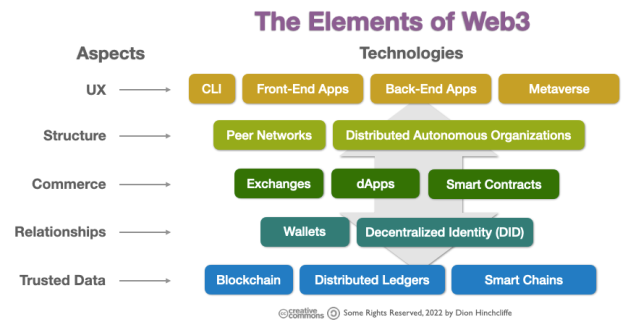


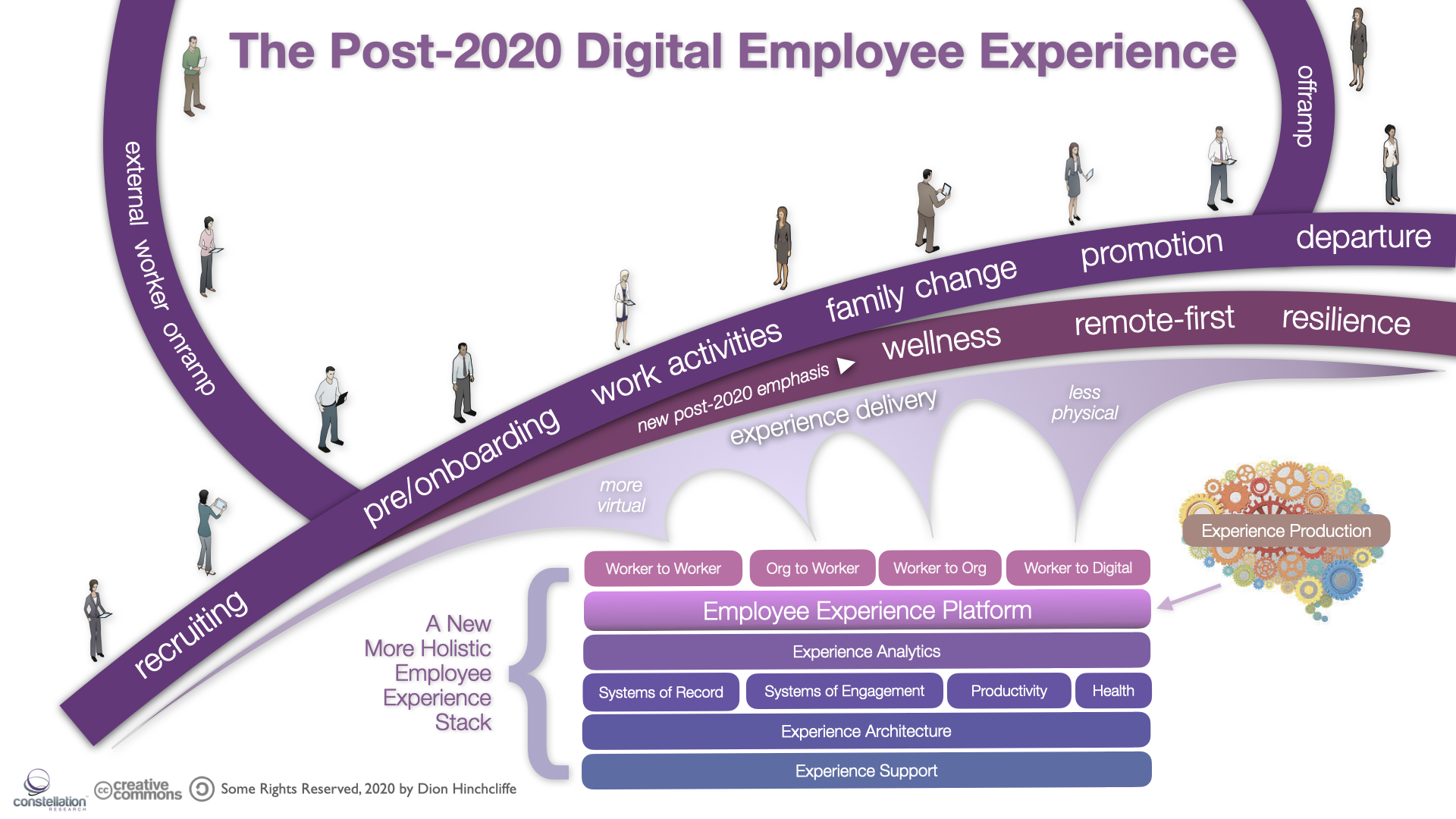
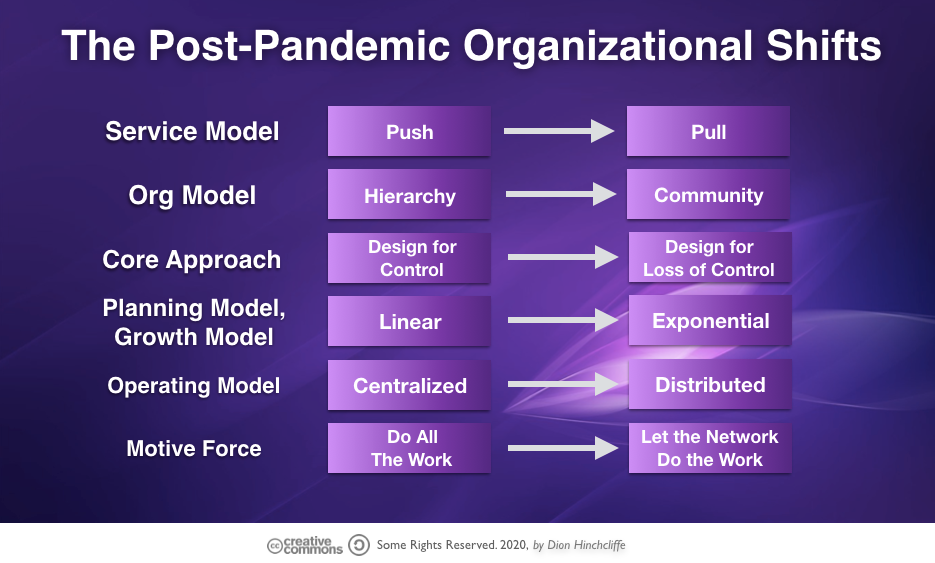







































 On Digital Strategy | Dion Hinchcliffe