Sunday Musings: New Social Business Research, Plus Disruptors of Tomorrow’s Enterprise

All in all, it was a good week for the exploration of big ideas in social business. PWC’s Technology Forecast quarterly published an epic 68 page examination of the future of collaboration in the enterprise. For those without the time to read through it all, Sameer Patel wrote a great overview of the contents today.

Standout areas of focus in this report include 1) an emphasis on dealing with exception handling as the norm in collaborative environments, 2) an underscoring of the central role of the CIO, which is something I’ve seen as key for success in social business, and 3) last — but certainly not least — positioning social media to directly support ongoing business processes. Says Sameer:

One thing enterprises have learned is that siloed, standalone consumer Web-style microblogging or social networking tools rarely work well inside an enterprise. Social technology that’s embedded in the enterprise application environment to offer collaborative support to specific business processes, or explicitly targeted at unifying all communications and collaboration, can be much more useful.

If you’re not sure about this, the importance of connecting social business to workflow was clearly driven home this week in the discussion that Laurie Buczek sparked in the Enterprise 2.0/Social Business community. See the comments and pingbacks in the link for details but it’s clear the social media for its own sake just isn’t enough to drive significant business impact.

For me, it’s become abundantly clear that smart social business initiatives — and the ones that will ultimately have the most success — will focus on connecting their efforts directly with 1) meaningful line-of-business activities and/or 2) transforming and integrating the most important horizontal functions like the intranet, content management, and document management.

But PWC’s report and Laure’s noteworthy post were not the only significant happenings this week. Earlier today Ray Wang published an engrossing and significant overview of 43 Use Cases For Social Business. Maps like this are important to help those trying to understand how to apply social media to various parts of their business. Ray’s use cases cover the gamut of the following areas:

  • Public relations/ marketing (PR/MA). Key impacted business process: Campaign to lead
  • Sales (SFA). Key impacted business process: Lead to deal
  • Service and support (CSS). Key impacted business process: Incident to resolution
  • Projects (PBS). Key impacted business process: Kickoff to delivery
  • Innovation/ product life cycle management (PLM). Key impacted business process: Concept to production
  • Supply chain (SCM). Key impacted business process: Sourcing to acceptance
  • Human capital management (HCM). Key impacted business process: Hire to retire
  • Finance. Key impacted business process: Invoice to payment

I DM’d Ray and indicated I felt that this was just a start on where social business will have an impact and he agreed. The list is light on general purpose workflow/collaboration, but then again Ray’s view here is actually connected to specific business activities, as per the previous discussion. We should also keep in mind that Ray’s perspective is based on actual data gathered from those engaging in social business, which makes it particularly invaluable as a look at ground truth. I especially liked his chart on the top 20 use cases based on the responses of over 100 early adopters:

Top 20 Social Business Use Cases By Early Adopters

Ray and his team has been doing some great research lately and I look forward to watching what they put out next.

The Disruptive Business Landscape Adds Big Data, Algorithms

As enterprises get backed farther into a corner by the constant changes swirling around them, there’s been a lot of speculation about the root causes of disruption at present. Everyone knows that cloud, social, mobile, and now increasingly big data, are to blame, but are they really the whole story? Not by a long shot in my book and Michael Fauscette agrees.

Citing the usual suspects, Michael took a fairly deep dive this week into the additional forces that are remaking the way we work and operate our businesses and came up with some gems that paint a fairly complete picture. I’ve taken a shot at describing the macro changes several times in the last year or so, but Michael’s list has a great perspective. Be sure to read it yourself, but Organic Business Networks was the one that resonated most with me.

Disruptive Changes To The Enterprise Cloud Social Mobile and Big Data

For my part, I think the BBC’s When Algorithms Rule the World adds the final item of serious competitive disruption to both our lists. Will we truly be smart enough to rule over them while only reaping the benefits? I worry that we won’t and that few of us are putting enough thought into the implications of big data and the analytics that will pervade just about everything we do. Next-generation enterprises will be ones that own their classes of data while being able to maintain the highest leverage over what they know that others don’t. See my discussion on closing the “clue gap” between what most enterprises can do today, and what tomorrow’s leaders will be able to do.

Finally, as Web technology continues to provide an ever-growing force multiplier that’s placed into the hands that master it, I’ve been exploring one of the new leading edges of social business: The process of extracting strategic intelligence from the knowledge, connections, patterns that become much more visible when organizations become social. It’s a topic that’s growing central to the discussion of ROI as well as attaining long-term competitive advantage. You can see all the details at Harnessing Social Business Intelligence: Nine Strategic Uses and Social Business Intelligence: Positioning a Strategic Lens on Opportunity.

At Dreamforce in San Francisco this week

I’ll be in downtown San Francisco for Salesforce’s massive and increasingly influential Dreamforce 2011 conference from Tuesday onward. Expect pictures, videos, and blog posts in my Twitter feed as we see what they have in store for the social enterprise. I’ve been having discussions with a number of Salesforce partners this week that are announcing innovative and intriguing add-ons and support capabilities for Chatter and other elements of company’s growing and increasingly impressive ecosystem. I’ll cover as much as I can here and elsewhere. It’ll be a great week of conversations and moving the thinking forward in this fast moving space, even as social business tries to keep pace with social media.

Putting Social Business To Work

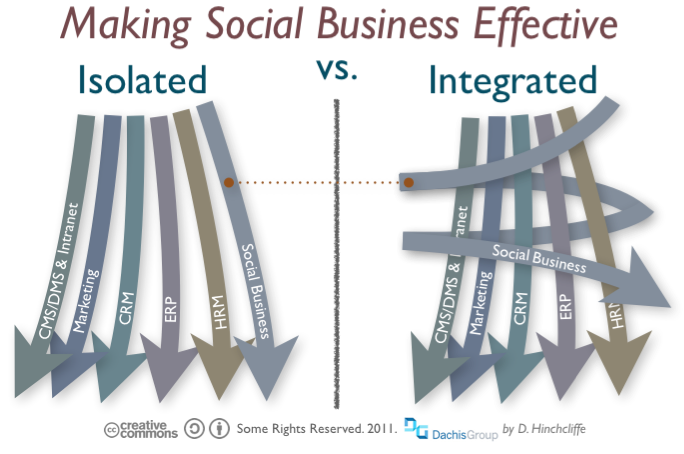
A great post yesterday by Laurie Buczek brought home for me a key issue that I’ve been pondering lately, namely how surprisingly disconnected some social business efforts end up becoming. We know many of the reasons this happens: Not-invented here, political fiefdoms, integration challenges, the tendency of many applications to turn into silos easily, etc. However, social media in the enterprise is about connecting deeply to those around us to improve the way we work. It’s certainly not about isolation, yet that sometimes becomes the state of affairs. How we organize for social business determines much of our success, as emergent as the process is. As Laurie said in her post (her emphasis):

The big failure of social business is a lack of integration of social tools into the collaborative workflow.

I should be clear that it’s not social business as a concept that’s the problem here. It’s that social must be connected to the day-to-day work that takes place. Unfortunately, most work today is done through existing systems that aren’t very social. If we’re lucky, we can forge a link to a piece of enterprise data from within a social tool, a basic requirement for social collaboration. But more likely we have to manually copy information from the systems of record in order to collaborate on it. Even more likely, the social business environment just becomes a parallel silo that’s not connected to the business and is used for light conversation and status updates instead of meaningful, high value line of business activities.

Social Business Connected To Flow Of Work

Yes, many large ERP, CRM, and HRM vendors including Oracle, Salesforce, IBM, Saba, and many others have either added or are otherwise incorporating social layers in their products that can help address this. But this is not necessarily the same as making our businesses fundamentally or more meaningfully social. Such duplication of social tools has its own silo issues and ultimately, rolling out social software on its own does not in itself produce results. No, the ladder of social business maturity requires more from us than that.

Instead we need to wrap our businesses in social in a more ambient and deeply connected manner. To work, this must be more than for example merely adding threaded conversations to our systems of record. It’s about weaving collaboration into everything we do, efficiently and simply. The good news is that there’s now hope to readily address what Laurie was referring to and connect social to workflow. With recent advances like real, mature, standardized social integration with OpenSocial 2.0 — with widespread support by enterprise software makers for the first time — there’s a genuine opportunity, right now, for us to connect our daily departmental and enterprise-scale work activities en masse to an overall social fabric that enables real change, real results, and real ROI.

Note: I do not think pure technology can ever be the full answer to this issue. But whenever we have a means of much more easily putting social in the flow of work we must go well beyond paper strategy and employ them.

So it’s up to us to see the importance of doing this and making it happen. Want social business become just a fancy chat tool in your organization? Don’t put social business to work. Do you want to unleash untapped worker potential, including cognitive surplus, peer production, and collective intelligence and all the big strategic buzzwords? Then put social business to work. The big lesson here: Failure to connect social business to work on the ground will pretty quickly result in limited value. We are now in the possessions of techniques to avoid this and we must use them.

See my writings on connecting business software to systems of engagement, social networking applications, and social app stores for more details on this subject. The Social Business CIO Shortlist can help as well.

Ten Aspects of Web 2.0 Strategy That Every CTO and CIO Should Know

Over the last year I’ve worked with organizations around the world that are attempting to grapple with Web 2.0 and the growing external marketplace pressure being exerted for the change and transformation of their businesses. Along the way, I’ve been fortunate enough to be able to identify and assemble a working list of some consistent recurring issues and themes around Web 2.0 strategy.  I’ve provided them below at a high level. Your comments and additions are very welcome as we try to frame up a consistent picture of what’s happening in the marketplace.

It used to be a little surprising how long it’s taken for Web 2.0 to begin to have serious impact on or even high-level interest in the business world.  However, the ideas have had staying power and have also largely been validated; there are now fundamentally different and very powerful new models for engaging with customers, designing our products, and applying technology in general to our business that are proven and have growing bodies of knowledge.  The Web has become the single most important driving force in many fields of endeavor as well as the leading source of both innovation and potent new modes for communicating, collaborating, socializing, and working together. It’s taken a few years but businesses are now feeling the change in the air.


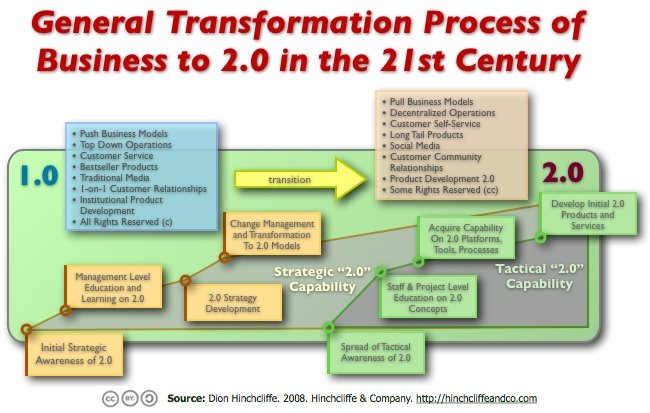
The Web 2.0 Transformation and Change Management Process for Business and Enterprises for CTOs and CIOs


However, as I’ve said a number of times in my various discussions of Web 2.0, the power of the network has deep roots in some profound shifts in society and culture, particularly the singular move from push-based systems (the 1.0 era going way, way back until right around now) to pull-based systems (the 2.0 era from roughly a few years into this century and going forward).  That this shift is well under way is clear if you look at the sudden explosion of the blogosphere, social networking, social media, open source software, online communities, and peer production in virtually all things.  The good news (or bad news, depending on how you look at it) is that despite the remaking of more than a few industries already — including media, software, advertising — this shift is only just beginning.

This all raises the question of how to make the transition from 1.0 to 2.0 safely and non-disruptively with your business largely intact, perhaps even with a superior competitive position.  That this transition can actually be accomplished by most businesses is still far from clear though some early transitions have met with varying degrees of success.  This list represents some of what we’ve learned so far  about 2.0 transformation but it’s something that strikes at the very heart of most businesses today: The rules for success are not-so-gradually changing and the marketplace is driving it in an often-subversive grassroots, bottom-up way.  The question now is no longer about “if” but increasingly about thriving long-term, period: What are you willing to do to adapt to a new business world?

This list is aimed primarily at CTOs and CIOs since they are mostly likely to be located at the convergence of traditional business thinking and the wave of 2.0 change coming in off the network. However these ideas apply to anyone looking at how to embrace 2.0 transformation in their organization and take advantage of it.  This is one of the most exciting eras to be in businesses since so many directions are in flux and the outcomes, players, and market leaders of the near future are far from certain.  Those who can see the new opportunities clearly through the lens of 2.0 transformation not only have a fighting chance, but are able to seize them with once-in-a-generation ease.

Note: I’ve dropped the “Web” in Web 2.0 for this discussion because one of the big lessons is that many traditional business thinkers turn off when they hear the word, even though Web 2.0 design patterns and business models have truly profound implications across any business today.  Consequently, hat the Web is driving most of these changes is being considered incidental for this discussion (though it’s absolutely the opposite when actually executing on these new models.) Instead, this is targeted a discussion about the transformative models themselves (such as who creates the products and where, how they are used, who supports them, how are they remixed, syndicated, franchised, licensed, IP protected, etc) in a strategic businesses sense. At the core of this discussion is how 1.0 business models of the 20th century are very much being eroded, transformed, and frequently dethroned by the immense motive forces that lie in the pervasive, open networked systems we have today, which are taking us deeply into a very new place: the 2.0 era.

Ten Key Aspects of Web 2.0 Strategy

  1. It’s not about technology, it’s about the changes it enables.  While technology is a close second (and ultimately makes 2.0 business models possible), the real discussion is about the disruptive new opportunities it creates.  Instead the discussion should be focused more around strategies such as harnessing millions of customers over the network to co-create products through peer production, engaging in mass customer self-service, customer communities, and open supply chains to thousands of ad hoc partners with open APIs. These are just some of the examples of using the network to create far richer and more profound results than could be created in the 1.0 era.  Don’t get caught up in the technology of 2.0 at first other than to understand the business possibilities it affords.  Avoid technology-first discussions like the plague.  Premature monetization discussions around 2.0 are also to be avoided, they tend to have a negative impact on process if done too early.
  2. The implications of 2.0 stands many traditional views on their head and so change takes more time than usual.  In the 2.0 world customers and partners have a much closer, more sustained relationship because of social interaction and tightly integrated online supply chains, to name just two reasons.  The shift of control from institutions to communities of users takes a lot of getting used to.  Just understanding how and why intellectual property is better covered by Creative Commons instead of copyright will take the legal department years (if not decades).  Each part of the organization will have its miniature 2.0 revolution.  These take time to happen and sort themselves out.  This means getting these new ideas into people’s heads is one of the first steps…
  3. Get the ideas, concepts, and vocabulary out into the organization and circulating.  If you’re trying to affect 2.0 change in an organization, there’s no better solution that exposing people to it.  Demographics can be a problem in this situation depending on the industry.  Younger workers tend to live and breath 2.0 while older workers may be aware of it but don’t think it applies to them.  I use point education where change needs to happen either first or quickly and then internal communities that bring the discussion of change, innovation, and transformation to the entire organization.  Either way, learning and education around 2.0 are a vital trigger to begin change and should be started early and non-disruptively.
  4. Existing management methods and conventional wisdom are a hard barrier to 2.0 strategy and transformation.  You don’t have to get far into discussions about the Perpetual Beta or Product Development 2.0 before existing management methods seem outdated, inflexible, and ineffective.  This is one of the more difficult aspects of adopting 2.0 models and the implications is that we’ll have to do a lot of rethinking how we manage businesses driven by 2.0 models, where the boundaries of organizations are less clear, the ownership is much more community-based, and the outcomes are far more diverse and spread out, making them less trackable, controllable, and directed.  Overhauling management practices and techniques will be a core activity in a 2.0 transformation and will be hard to achieve quickly enough due to the Innovator’s Dilemma.
  5. Avoiding external disruption is hard but managing self-imposed risk caused by 2.0 is easier.  The great fear than many businesses have is facing a fast-growth competitor that takes these ideas and either wrests away market share rapidly and aggressively or cuts them off at the pass with entirely new products.  YouTube did this to the broadcast and cable industry, which responded with Hulu.  Apple did this with iTunes to the recording industry and the blogosphere did the same to the newspaper industry.  Other industries are next likely including the financial services industry, real estate, and others.  Internally, however, risk management is still a challenge but is much more manageable.  The big implication for this is that starting internally first with things like Enterprise 2.0 initiatives and prediction markets to learn the ropes on how to deal with unexpected outcomes and results can help organizations climb the maturity curve.
  6. Incubators and pilots projects can help create initial environments for success with 2.0 efforts.  Too much contact with the traditional support environment of an existing, primarily 1.0 organization makes it hard for 2.0 efforts to succeed; everything gets done in the traditional way instead of the new ways that are required.  The traditional tools, processes, and skills just aren’t there or are just too slow and burdened with unnecessary overhead.  Creating dedicated incubators that are designed to use the strengths of the organization while being isolated from its weaknesses can help.  Incubators are at risk of becoming too isolated however, and won’t inform or change the greater organization unless care is taken to roll the lessons and capability back in.
  7. Irreversible decisions around 2.0 around topics such as brand, reputation, and corporate strategy can be delayed quite a while, and sometime forever. Most organizations get paralysis around change and transformation because of concerns around decisions that can’t be reversed.  Concern over damaging the company’s brand is one of the top issues I run into and it’s a valid concern.  The good news is that many organizations are discovering they can safely leverage the advantages of their organization (such as their extensive customer base to drive initial growth of 2.0 engagement and adoption of new products and services) without dragging their brand into it whatsoever.  New 2.0 products from major companies are now often released under new brands entirely. This enables serious experimentation with 2.0 while taking little risk to the organization.
  8. The technology competence organizations have today are inadequate for moving to 2.0.  This is key if you’re a CTO or CIO today; your organization is almost certainly not ready to handle the development, management, scalability, identity, governance, and openness issues around 2.0.  If you’re not sure, just ask your IT staff.  Examples include cloud computing, open APIs, mashups, rich user experiences, Web-Oriented-Architecture, community platforms, Enterprise 2.0, 2.0-era computing stacks like Rails and Django, are all disciplines that are considerable in their own right, of rapidly growing importance to organizations in the 2.0 era.  These are all likely to be things your staff needs to come up the learning curve on in significant ways and with the rate of change on the network what it is presently, falling behind is too easy to do.  Note: The existing technology landscape of most organizations will have to change as well which is where Web-Oriented Architecture (WOA) is getting quite a bit of attention today.  And the Web products themselves have moved far beyond the model of the Web page and most enterprises are very far behind.
  9. The business side requires 2.0 competence as well.  This includes how to design, build, launch, market, support, and maintain 2.0 products and services as well as the ways that workers should use the tools and concepts to work together.  I recently suggested that learning how to be effective in working within and directing communities of workers/users/partners to accomplish large-scale outcomes will be a vital skill in the very near future.  All of this requires both a new perspective as well as a hard-headed effort at skill building and a re-orientation of existing work habits and processes.
  10. Start small, think big.  We have discovered that the leverage the network can give us is almost unlimited.  It’s ability to scale ideas, products, and communities of users as fast as they are able to is one of the aspects that makes it so attractive to business.  2.0 products tends to be very simple at heart, and though there is certainly challenges and complications growing, small ideas can become big very, very quickly.  Getting to the right solutions, not-overinvesting (which leads to complication and heavyweight management and processes) and letting customers and partners take the seeds of great ideas and run with them is what makes sudden success turn into a large-scale success.  On the Web, starting small, and thinking big can take you a long, long way.  Read more about network effects driven by architectures of participation .

Please share your ideas around what else is essential in a Web 2.0 strategy below.

A Timeless Way of Building Software

Most of my readers know that I’m a software architect by trade.  I’ve been creating software large and small for over twenty years.  And I’ve experienced movement after movement in software design from object-orientation in the 1980s and early 90s to component-based design, distributed objects, Web-based software, service-oriented architecture and too many others to even mention.  I’m pretty jaded at this point because I’ve learned, in general, the problems that you couldn’t solve in the previous generation of technique are often only marginally more solvable in the next generation (which is invariably invented to "fix" the previous problems.)

Alas, a genuinely better mousetrap is really hard to find.

So in the end, if you couldn’t do whatever it is you wanted to do with the previous generation of technique, it’s actually not that likely you’ll succeed in the next.  Certain software problems remain hard, and in general, it mysteriously happens to involve the juncture between technology and people in some way.  To paraphrase this, I could say that the software and techniques get better fairly constantly, but people remain the same.

And please, bear with me because I will attempt to connect a great many dots in a moment. 

Because every once in a long while, something new and big actually does come along.  Or at least something that looks new and big.  One of the new and big things that came along about ten years ago was the concept of design patterns.  It was pretty neat stuff.  It said that despite the current technology we have, the processes that continue to evolve, there are certain timeless solutions to certain software design problems.  It was a revelation at the time.  And the writers of the book that explained this got both famous and very successful.  Why? Because these design patterns really worked is why.  And anyone who has read the books and has ever really built software recognizes these patterns.  And what was strange was that no one really expected it. One day, we just had them.  And the kicker was, they were always there, but now they were in our conscious thought and we had real names for them.  My point: They were in our face all the time but most of us couldn’t see them.

We are in a similar place with the Web right now.  We’ve done this Web stuff enough now that we are just beginning to see the design patterns.  What works, and why, in a specific situations, bounded by forces.  Some folks have had the hubris to give this next generation a name and to tease out these patterns.  Some people are just now going aha, and some people haven’t got it yet, and most of the rest of us either aren’t ready for it or just haven’t heard of it.  But, I will tell you this.  It’s quite real.  The best practices and design patterns of Web software are just starting to become understood.  The strange part is, we’re discovering the same things over again.  What’s old is new again.

Now, before you get all worked up or worse, I bore you and you stop reading, I will give you a nice list of the the forces behind these patterns.  If you recall, design patterns are a solution to a problem in context.  We are starting to get the context and even the outlines of the patterns of this "new" generation of software.  But we have a long way to go still.  The Web is a monstrously big space with big problems, and it’s not getting better.  There are one billion of us out here now.  Clearly understanding what it takes to create great software on the Web that is successful, useful, and vibrant will be an ongoing challenge for a long time.  But it will get easier because we are codifying our knowledge of this exciting and huge place where we now find ourselves.

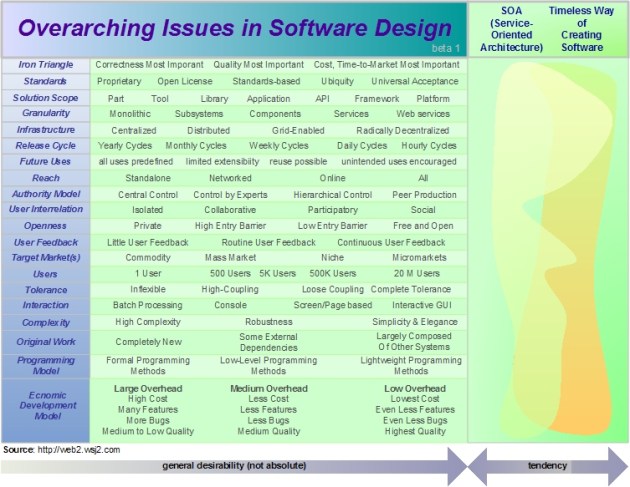
Comparing SOA, Web 2.0, and a Timeless Way of Building Software
Figure 1:  The driving forces in modern software.
With a rough comparison between SOA
and The Timeless Way (Web 2.0 by any other name).


So, here is where we take a quantum leap to the next level of thinking.  I’m going to use Christopher Alexander’s opening chapter of a Timeless Way of Building and tailor it to describe this old-but-new way of building the Web and software for it.  We are lacking for a little inspiration and this book in particular continues to sell upwards of 10,000 copies a year, 25 years after it was frst published.  And Christopher Alexander, for those of you who may not know, was the person that originally discovered the design pattern.  But it wasn’t for software.  It was for creating great, timeless buildings.  He was one of the first that realized that his field of endeavor has certain elemental, timeless cores, no matter the technique, building material, or the people.  It was an amazing discovery that poured over into the software world with considerable success. 

My assertion is that nothing has really changed in software, we might understand the forces better but they are almost always the same.  People want software that does what they want, is available when they need it.  They want software that grows with them, helps them, teaches them, and lets them do the same with others.  They want software that gets out of their way, disappears, and is more convenient by far than inconvenient.  And they want to pay as little as possible for it, but enough so that it’s worth it.  They are willing to have software get right into the middle of their lives.  If it’s the right software.  And as long as we’ve had software, they’ve always wanted this. But now they might actually start getting it.

In any case, I don’t literally believe every phrase in this take-off, but I do believe the overall concept deeply and profoundly as a software professional.  And I will continue to update the diagram above (clearly marked beta 1) until we have more of the forces in it. And some are definitely missing.  Please, as always, leave any comments and suggestions for improvement below.

And now, without further ado, here is the The Timeless Way of Building Software, with sincere apologies to Christopher Alexander:

The Timeless Way of Building Software
Inspiration For The Next Generation of Web Software


There is one timeless way of building software.  It is decades old and is the same today as it’s always been.  And because it is timeless, it will always remain this way.

The great software of our time has always been created by people who were close to this way.  It isn’t possible to create great software – software that is satisfying, and useful, and makes itself a natural extension of life – except by following this way.  And as you will see, this way will lead anyone who looks for it to elegant, vibrant software which is itself timeless in its form.

It is the process by which the function of a piece of software grows directly from the inner nature of people and naturally out of the raw bits, the otherwise meaningless digital medium, of which it is made.

It is a process which allows the life inside a person, or a group of people, or a community to flourish, openly, in freedom, so vividly that it gives rise, of its own accord, to the natural order which is needed to be contained within it.

It is so powerful and fundamental that with its help you can create software that is as beautiful and enriching as anything else you have ever seen.

Once you understand this way, you yourself will be able to create software that is alive, that is intertwined comfortably with your life and the lives of others. You will design worlds where you and others will want to work, play, and co-exist together; beautiful places where you can sit and dream comfortably.

This way is so powerful, that with its help hundreds or thousands, or even hundreds of thousands of people, can come together together to create software and community which is as alive and vibrant, peaceful and relaxed, as any living experience has ever been.

Without the central control of authorities and experts, if you are working in this timeless way, a genuine place will grow right from underneath your fingertips, as steady as the grass in the fields or the trees in your backyard.

And there is no other way in which a software which is fundamentally good can possibly be made.

That doesn’t mean that all ways of making software are identical.  Quite the contrary. It means that at the core of all successful software and at the core of all successful processes of creation and evolution, there is one fundamental invariant feature which is responsible for their success.  Although this way has taken on a thousand different forms at different times, in different places, still, there is an unavoidable, invariant core to all of them.

Take a look at the some of the great Web software like Google’s search page, Flickr or del.icio.us.  They all have that unique, yet unhurried, grace which comes from perfect ease and natural balance.  But what is it they have in common exactly?  They are beautiful, ordered, harmonious – yes, all of these things.  But especially, and what strikes to the heart, they live.

Each one of us yearns to be able to bring something to life like this. Or just be a part of it somehow.

It is a fundamental human instinct, as much a part of our desire as the desire to be part of something greater than ourselves.  It is, quite simply, the desire to make a part of nature, to complete a world which is already made of mountains, streams, stones, buildings, ourselves, our living systems, and our increasing connectedness together.

Each one of us has, somewhere in our heart, the dream to make a living world, a universe, and place of our own for us to share with others.

Those of us who have trained as software designers have this desire perhaps at the very center of our lives; that one day, somewhere, somehow, we shall build a software experience which is wonderful, beautiful, and breathtaking; a place where people can go and live their dreams.

In some form, every person has some version of this dream; whoever you are, you may have the dream of one day creating a most beautiful place, virtual or otherwise, where you can come together with others and freely share your knowledge, learn, participate in your community or government, and otherwise conduct your daily interaction with the rest of the world.

In some less clear fashion, anyone who is concerned with communities and other large group efforts has this same dream, perhaps for the entire world.

And there is a way that software can actually be brought to life like this.

There is a definable sequence of activities which are the heart of all acts of software design, and it is possible to specify, precisely, under way conditions these activities will generate software which is alive.  All this can be made so explicit that anyone can do it.

And just so, the process by which a group of independent people can make software become alive and create a place as real as any other can equally be made precise.  Again, there is a definable sequence of activities, more complex in this case, which are the heart of all collective processes of software creation.  And it is also possible to specify exactly when these processes will bring things to life.  And once again, these processes can be made so explicit, and so clear, that any group of people can make use of them.

This process is behind the design of community built software like Linux, Apache, Wikipedia, and many others.  It was behind the design of the great virtual places for people to live and work: the Internet, Usenet, and the World Wide Web.  It was behind the creation of simple, satisfying software of the kind that powers the iPod, the Blackberry, and Firefox; of SourceForge, Wikipedia, and BitTorrent.  In an unconscious form, this way has been behind almost all ways of creating software since the beginning.

But it has become possible to identify it, only now, by going to a level of analysis which is deep enough to show what is invariant in all of the different versions of this way.

This hinges on a form of representation which reveals all possible design processes, as versions of one most fundamental set of patterns.

First, we have a way of looking at the ultimate constituents of the environment: the ultimate "things" which a piece of software is made of.  As we shall see, every piece of software is made of certain fundamental entities known as design patterns; and once we understand software in terms of its patterns, we have a way of looking at them, which makes all software, all of their parts and function, all members of the same class of thing.

Second, we have a way of understanding the generative processes which give rise to these patterns: in short, the source from which the ultimate constituents of software come.  These patterns tend to come from certain combinatory processes, which are different in the specific patterns that they generate, but always similar in their overall structure, and in the way they work.  They are essentially like languages.  And again, in terms of these pattern languages, all the different way of building software, although different in detail, become similar in general outline.

At this level of analysis, we can compare many different software creation processes.

Then, once we see their differences clearly, it becomes possible to define the difference between those processes which make software vibrant, alive, and useful, and those which make them the opposite.

And it turns out that, invariant, behind all processes which allow us to make great software, there is a single common process.

This single idea is operational and precise.  It is not merely a vague idea, or a class of processes which we can understand: it is concrete enough and specific enough, so that it functions practically.  It gives us the power to make software and virtual communities live, as concrete as a match gives us the power to make flame.  It is a method of a discipline, which teaches us precisely what we have to do make our software what we want it to be.

But though this method is precise, it cannot be used mechanically.

The fact is, that even when we have seen deep into the processes by which it is possible to make software alive, in the end, it turns out this knowledge only brings us back to that part of ourselves which is forgotten.  Although the process is precise, and can be defined in exact scientific terms, finally it becomes valuable, not so much because it shows us things which we don’t know (though it may do that as well), but instead, because it shows us what we know already.

Of course, this way of building software has never be named.  It’s not service-oriented architecture, or the personal software process, or agile methodology, or the unified process, or CMM, or any of the others.  It’s the actual things that are conceived and done and worried about when software is created and used.  For now, because all software is quickly becoming connected to all other software, and because the Web is becoming the place where more and more of the relevant software is, and finally because it is a more complete reconception of what we thought we knew, we’ll give it a name temporarily.  An unsatisfying name, but one that we can remember for now.

We will call it Web 2.0.

What do you think?  Are we at a place where we can really identify the design patterns in Web 2.0?

Is Web 2.0 The Global SOA?
Are we heading towards an architectural singularity in the software industry? Sometimes it looks that way. If you do a superficial comparison at least, Web 2.0 is all about autonomous, distributed services, remixability, and is fraught with ownership and boundary/control issues. And yet, Service-Oriented Architecture (SOA) is all about, you guessed it, autonomous, distributed services, composite functionality, and is fraught with ownership and boundary/control issues. Sound similar, no?

It does seem that we have a classic case of fractal architecture on our hands. Is Web 2.0 actually the most massive instance possible of service-oriented architecture, realized on a worldwide scale and sprawling across the Web? The answer folks is, apparently so.

I’ve been thinking about this carefully for several weeks now as the similarities seemed to inexorably call to each other as I worked with each of them in turn (disclaimer: I’m a SOA architect by trade). Both Web 2.0 and SOA are already slippery, nebulous concepts yet there are unmistakable patterns within each that actually are very tightly related, though wrapped in slightly different cloth. Each encourages the liberation of the underlying functionality of software systems by providing open access to everyone that needs it. Both warmly embrace Web services and the aggregation of existing functionality into new solutions. And Web 2.0, according to O’Reilly, looks at Data as the Next Intel Inside, making large, back-end database driven functionality a core competency. SOA totally gets this as well. And both Web 2.0 and SOA provide the building blocks for creating people-centric processes starting at the scale of an organization and going up.


Granted, most SOAs are conceptually trapped inside an organization’s firewall or VPN. And Web 2.0 envisions the global Web as the stage writ large upon which to act out your grand visions of building collective intelligence and mashed up functionality. But scale is only one of the minor differences really, and not a genuine discriminator at all.

Do the linkages go deeper, to a more fundamental level? Are Web 2.0 and SOA different at their core and if not, how exactly do they relate?

I believe that there are at least two significant connection points. One is that Web 2.0 can be conceptualized as a global SOA. Two, that many traditional brick-and-mortar business that are currently using SOA as their architectural model will want to connect their Web/Web 2.0 faces up to their SOA. This makes Web 2.0 not just being the Global SOA but makes meeting smaller SOAs everywhere not just likely, but inevitable. Note that the respected industry analysis firm, Gartner, recently said that by 2008 that 80% of all software development will be based on SOA. And interestingly by 2006, Gartner believes that 60% of the $527 billion IT professional services industry will be based on exploiting Web services and technology. We’re talking serious convergence of focus here folks. If true, this means that more than half of all software development, SOA and otherwise, will revolve around the Web, inside or outside organization boundaries. All of this means Web 2.0 and SOA will meet each other both coming and going, and begin to become each other as well.

Web 2.0 = Global SOA? Why Should We Care?

But the real question really is does the relation of the two give us an advantage as we design and build Web 2.0 applications, services, and SOAs? One problem could be that many folks outside the IT industry just haven’t heard of SOA. And even then, there are vociferous arguments about what an SOA really is, just like there are endless debates about what Web 2.0 is. But in the end, there are best practices that need to cross pollinate here and SOA’s IT-bound sphere of influence isn’t really a factor. In fact, really only Web 2.0 designers (yes, you) will have to understand these techniques and their connections. Web 2.0 users themselves will generally be blissfully unaware of Web 2.0 as the global SOA.

Now, don’t get me wrong. Web 2.0 and SOA also have significantly divergent elements too. Web 2.0 emphasizes a social aspect that SOA is completely missing. And probably to its lasting detriment. SOA has much more central control, management, and governance while Web 2.0 is free wheeling, decentralized, grassroots, and with absolutely no command and control structure. Web 2.0 also talks about presentation, the front-end displayed to the user. SOA is largely silent on the issue of presentation though it certainly admits it exists. So SOA tends to be generic and faceless where Web 2.0 makes much of human/service interaction. They seem to need each other to be whole. Finally, Web 2.0 is almost too informal and practically calls out for discipline while SOA is mute and autistic in comparison, a technical virtuosity that wants to be social but doesn’t know how.

All of this makes me want to view one through the other to check basic principles. For example, SOA has best practices for building business processes into vast supply chains (so too does Web 2.0). SOA is also a mature view of software that eschews a technical view of information and data. And it identifies a motive force for these processes via something called orchestration. This is a concept that Web 2.0 does not have explicitly and could certainly use (an orchestration mash-up anyone?) though it is provided in some degree by its users. SOA principles also encourage creation of a common vocabulary across systems that is in the language of the domain (common definitions of customers, order, channel, product, for example). So it gets very close to addressing a big issue in software development today: That too many IT systems today tend to have technology myopia and ignore their most important elements… the people that use them and the way that they work. Web 2.0 gets this part even more right in all the significant ways. Web 2.0 embraces people, collaboration, architectures of participation, social mechanisms, folksonomies, real-time feedback, etc. All things that SOA, in its grey, dull, corporate clothes, does not, at least not explicitly. The complementary nature between the two seems clear.

So, I believe there are complementary synergies between these two powerful software approaches. One can very much be used to check and finish the other. SOA is both the “Mini-Me” of Web 2.0 (identical in almost every way but 1/8 its size) and a key archetype for it as well. Though admittedly one that lacks a few important ingredients. What is compelling, and I’ll talk about this in detail in future articles, is that Web 2.0 actually has powerful mechanisms that “complete” SOA (if you’ll allow one last Austin Powers reference.) Web 2.0 offers a face to SOA with numerous best practices for presentation, has emerging technical innovation like radical decentralization that is necessary for stability and scalability which SOA too often doesn’t address, and Web 2.0 identifies important techniques to immerse users into social processes that can make SOA data and services vastly more valuable.

Yes, so Web 2.0 is a global SOA, done right for the whole world. It’s big, it’s everywhere, and it’s here today.

Do you agree that Web 2.0 is the Global SOA? Post your thoughts below…

Update: Early stage VC investor Peter Rip had some interesting things to say about this article, including “Web 2.0 is a lighter weight version of SOA.”
Update 2: Both Richard Monson-Haefel and ZDNet’s Joe McKendrick weighed in on this topic with good observations and commentary.
Update 3: This eventually turned into the SOA Web Services Journal cover story in Dec. 2005: Web 2.0: The Global SOA.  This in turn led to March’s SPARK event with Microsoft on the convergence of Web 2.0, SOA, and SaaS.
Update 4: This topic (and related issues for Web 2.0 in the enterprise) has turned into a regular blog on ZDNet.
Update 5 in May, 2006: Om Malik writes a detailed piece on the future of Web 2.0 and is most sanguine about it for the enterprise, interestingly enough, and links to this post.


Technorati:
web2.0, soa