The Building Blocks of Digital Transformation: Community, Tech, Business Models, and a Change Platform

I’ve been making the argument lately that the single largest obstacle in successful digital transformation is change itself. Surprisingly, the arrival of new technology is generally not the large hurdle to becoming more digital in a meaningful way, though it certainly represents a large and growing learning curve. Yet learning the new technology is manageable by most organizations in my experience, if they have the will to do so.

Finding the right business models can be a bit more of a challenge, but the process of discovering the best ones is increasingly well understood these days. One somewhat ironic lesson is that we’ve also learned that we usually have to build an audience first, often well before we decide on new digital business models, that are centered around some activity or capability of significant shared interest with the market, before we can experiment and find the right path forward in terms of generating value, such as revenue from sales, subscriptions, advertising, etc.
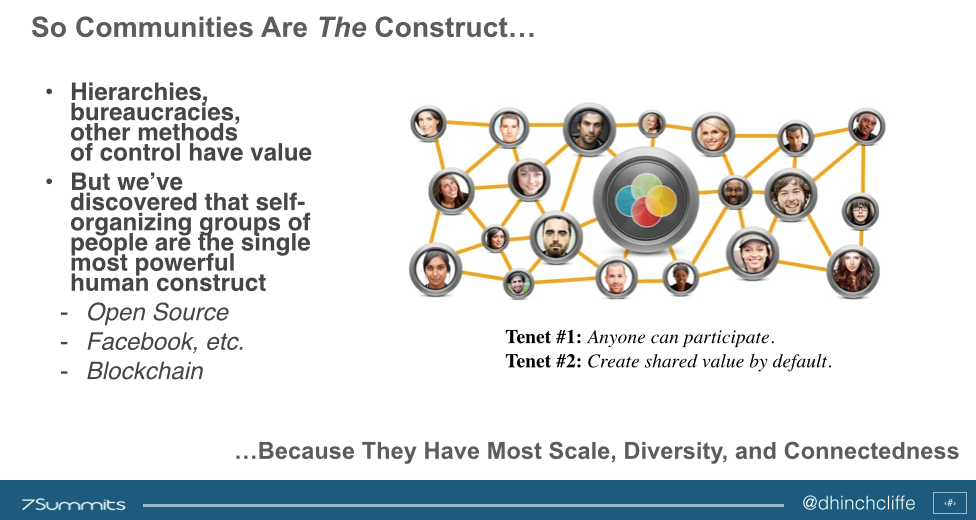
Online Communities Are the Business Construct That Create the Most Value

From my Enterprise Digital Summit 2016 Paris Keynote Deck

Why Digital Needs a New Mindset

It actually turns out the most important and challenging building blocks for digital transformation is people and the processes that can change them. Thinking in digital terms requires a significant shift in mindset, such as designing for loss of control, understanding the power laws of mass connectedness, the startling revelation that the network will do most of the work, and understanding how open participation is the key to unleashing digital value in scale to our businesses.

However, shifting the mindset en masse of the large number people that exist in the average enterprise (i.e. tens or even hundreds of thousands of workers) is not something that can be done to them, but can only be done with them as Euan Semple frequently likes to point out. So, what’s the single best venue in which to engage significantly in a time efficient and sustainable fashion? I now suggest that the most likely and cost-effective vehicle for this that we know today is online community.

The building blocks of digital transformation is a topic that I recently had time to study in depth as I prepared my closing keynote for the always terrific Enterprise Digital Summit 2016 (formerly the Enterprise 2.0 SUMMIT) in Paris this month.

Step 1: Gather Stakeholders into Communities of Digital Change

The fundamental building block of digital transformation is therefore not technology, but people, a much more challenging proposition. However, if we can somehow connect the collective workforce in the organization together in an effective fashsion to begin a shared and dialogue-based process of learning, understanding, experimenting with, and then carrying out the tasks of digital transformation across the enterprise as a much more aligned and self-supporting way, then we are much more likely to succeed. As I’ve discussed, we’ve even started to witness evidence that IT is shifting in this direction steadily, with the rise of empowered change agents and even unexpected source of pre-existing tech change using forces like shadow IT as a key resource for creating decentralized technology adaptation across the organization.

But it all starts with community, for which I believe the evidence is now clear is the most powerful way of organizing human activity and creating shared value yet developed.

Step 2: Assemble a Modern, Market-Facing Technology Stack

From there, we do need to look at the technology lens at what our business does and how it does it. We can no longer realize all tech change ourselves, as our competitors have already learned that the single greatest force for value creation is capturing and wielding community contributions of customers by the millions via mass co-creation, and business partners by the thousands (see APIs + hackathons). I recently summarized the many other emerging enterprise technologies we must consider all the time as well, but the most important ones are customer facing and involved in co-creation.

We therefore must instead now becoming highly competent in building strong and effective architectures of participation, as most digital leaders harness the vast capacity of the Internet to do most of the value creation:
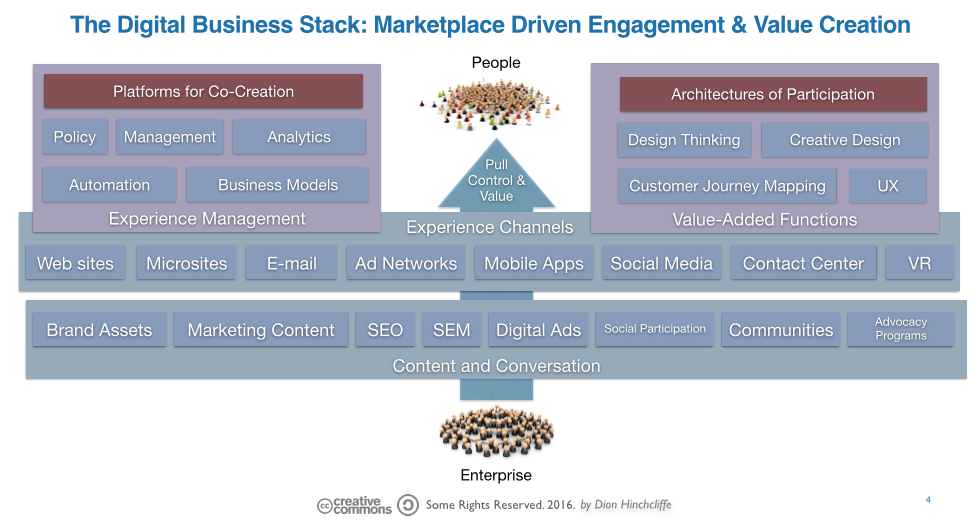
The Digital Business Stack: Marketplace Driven Engagement & Value Creation

Step 3: Create and Nurture Digital Experiments

From there we can combine people-led digital change at scale with a portfolio of digital engagement and experience technologies and processes — that must prominently include market-facing community — to begin creating, launching, and growing healthy and vibrant new products and services. Growing hacking in fact, has become an important new technique used by top Internet companies to ensure early lift and adoption, and has been a key subject of interest by top technology leaders like Microsoft CEO Satya Nadella. So grow the results of digital transformation this way, then generate revenue:
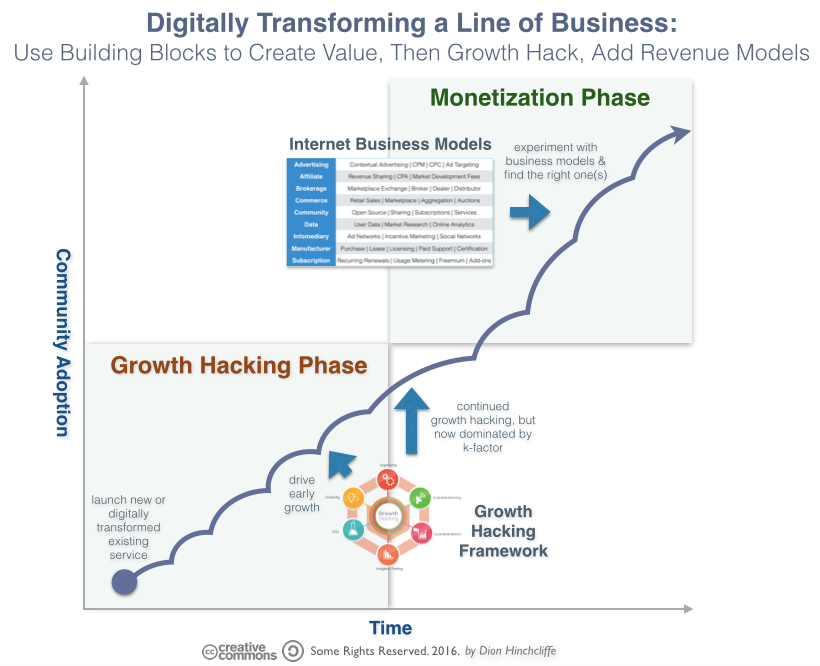
Digitally Transforming a Business with Growth Hacking, Business Models, and Community

Step 4: Get Serious About Revenue Models

Finally, the last building block is digital business models, which one the service has a successful audience or community, can be experimented with and validated, though certainly some services, such as sharing economy ones, can monetize from the outset, though often at break even levels. Below is a representative list of some of the most common Internet business models, though by no means all the possibilities. For example, there are at least 18 separate known business models for open APIs alone. The high level Internet business models break down like so:
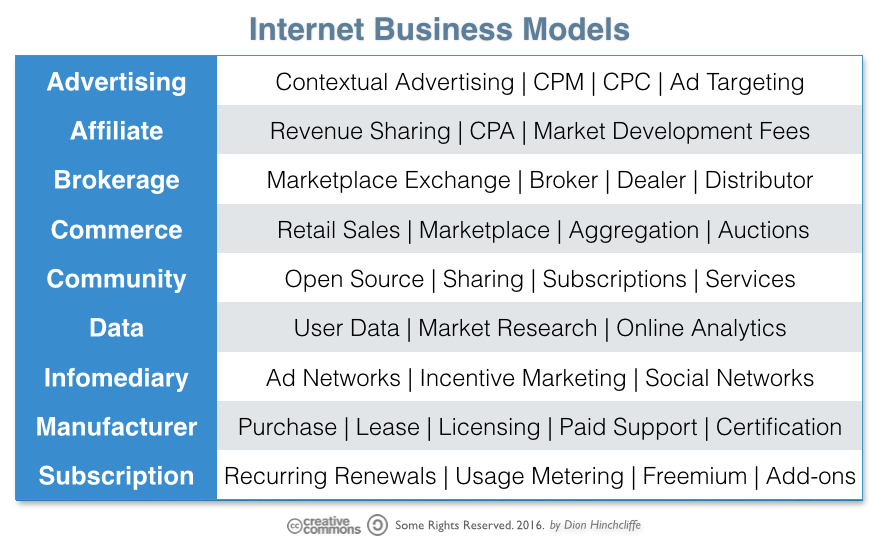
Common Internet Business Models

For a more complete exploration, please view the video of my closing keynote on this subject in Paris on June 2nd, 2016:

Or download a copy of the Slideshare deck that I presented with.

Additional Reading

How IT Can Change For the Digital Era and What Leaders Can Do About It

The digital transformation conversation shifts to how

Restructuring the C-Suite for Digital Business: The Future of the CMO, CCO, CIO, and CDO

I’ve noticed lately what appears to be an emerging trend in marketing and communications leadership in some large companies. Specifically, the positions of chief marketing officer (CMO) and chief communications officer (CCO) are sometimes being consolidated into a single role, even in very large enterprises. Such consolidation has already happened at PG&E, Walgreens, and Citi, and I’ve recently encountered other notable instances as well. This might seem odd at first glance, as specialization of roles is usually emphasized in large entities as expansive purviews tend to be harder to manage.

It actually turns out, for several key reasons, that examining this closer is an interesting — and both useful and practical — thought exercise in how the single vast continuum of digital is putting growing pressure on the traditionally separated functional silos that have comprised most of our organizations for over a century.

This trend, and another like it I’ll propose we’ll see soon, is actually an apparent reversal of what organizations have been doing lately to better organize for technology, which is moving to the very center of how our organization operate and create value. In fact, the proliferation of C-level stakeholders for the rapidly expanding world of digital business has continued unabated in recent years, as chief data officers, digital officers, community officers, experience officers, analytics officers, and other similar C-level tech roles emerge and grow rapidly.

The Consolidation of the CMO and CCO for Digital Transformation

Too many cooks in the kitchen, some might say, but I pointed out last week on ZDNet that digital disruption — a wildly overused yet still quite apt phrase of our times — is now anticipated by most executives within the current planning cycle. The counter argument that is made for proliferation is that we need a lot more leadership on deck to more rapidly adapt our organizations to digital and head off disruption. The imperative is that we now have to a) think more like venture firms and startups, in other words our digital efforts have to move out of the quarter earnings cycle and become long term, while shifting to experimenting and failing fast until finding what works and b) our organizations require digital change capacity that is matched to today’s exponential cycle of technology evolution. Without both, we can’t maintain a sustainable pace matched to the market or reach a successful future state quickly enough.

In fact, what’s often hampering us in fact functional silos, both in our org structures and in our technology. We saw this very painfully with social media and social business a few years ago, and now we are witnessing it writ large as our customer experiences, the vital journey of which is the very lifeblood of our organizations, becomes ever more fragmented and divided across digital channels and our organizations’ operational silos. Customers get thrown over the wall to disorganized and inconsistent experiences as their journey takes them through our marketing departments, sales teams, customer service staff, and product development groups. Increasingly, our attempts to engage with companies as a customer is just ignored as we use new digital touchpoints that is obviously so much better — to us, but still unfamiliar to companies. In short, as organizations, we don’t have the capacity to be everywhere we are expected to be in the customer journey, and as organized today, don’t have a way to get there.

So how does the convergence of top-level roles in communications and engagement solve this problem? By removing a key silo while also adding the responsibility for both internal and external comms. Internal comms in particular is a critical addition, and is a key part of what a corporate communication officers oversee, as they are often the sponsor for the corporate ESN and intranet, essential platforms for organizing change at scale. As gaining holistic and integrated oversight and control of experience management — across customers, business partners, and employees — has become paramount, this merging of roles gives us a way to prevent it from fragmenting across projects, initiatives, technologies, tools, and digital channels. No more dividing internal and external engagement, giving us less inconsistent messaging and responses. In return, we can achieve better internal scale, more unified platforms, policies, and governance. We have one role for primary engagement.

One Likely Outcome of Digital Transformation: A Refactoring of the C-Suite

In other words, with CMO and CCO consolidation, we will have a single top-level org structure that is substantially better suited to oversee engagement across the single continuum of digital. We used to think that digital/social centers of excellence were required to bring together a consistent response to technology. This may be a better answer.

We will see how this trend plays out — and there are still open questions about where secondary engagement such as customer care and product development fit in — so I have begun tracking the industry data in LinkedIn to see if we can confirm a real trend based on my and others anecdotal experience. But from an critical thinking standpoint it makes sense why organizations are doing this.

The Fall of the Chief Digital Officer Too?

Which brings to my second trend, which is that we’ll likely see the same consolidation of function happen with the chief information officer (CIO) and the chief digital officer (CDO). I was initially bullish on the CDO a few years back — and still think they have an important combined innovation and P&L role to play, but as some like Theo Priestley have observed, the role is already under pressure and it’s time is likely to come to an end, at least as a top-level role. It will still exist of course but in this consolidation, would appear under the CIO purview. It now seems likely that many CIOs will merge CDO functions back in for all the same arguments that the CMO and CCO purviews should be combined.


Following this argument, removing silos in our organizations so that we can remove them from our digital products and experiences makes sense on its face. It can eliminate friction, make it possible to scale better, reduce poor execution, and create more shared value. I should point out however, it’s only part of the story for organizing better for digital. While other related topics like the bi-modal/multi-modal conversation seems to have hit a fever pitch, with McKinsey even joining the bandwagon, I think it’s vital that we also carefully consider simpler “digital hacks” to our organization that should be far easy to implement, but would in practice have significant impact.

Consequently, the consolidation of top digital roles into a chief marketing and communications officer (CMCO) and chief information and digital officer is — I now believe — a practical response to the proliferation of C-level digital roles to create the consistency, coherency, and effectiveness we need to change. However, this centralization will be an improvement as long as — and only as — such consolidation is properly balanced by bottom up and grassroots digital change programs, like a network of excellence powered by decentralized change agents, or a formally supported Shadow IT and marketing technology program. Without realizing both C-level role consolidation and networks of change together, sufficient digital scale and capacity will simply not exist for converged leadership to cultivate and guide.

Additional Reading

How Should Organizations Actually Go About Digital Transformation?

The digital transformation conversation shifts to how | ZDNet

How Chatbots and Artificial Intelligence Are Evolving the Digital/Social Experience

Digital engagement is once again shifting, as we can see from the main discussions at Facebook’s F8 conference this week about the new release of Messenger and its smart chatbots, or when we look at what’s happening with popular team messaging services like Slack, which is being “overrun by friendly, wonderful bots.” While bots seem like a minor improvement to digital user experience, some believe — including myself — that a combination of today’s latest technologies will transform this what’s-old-is-new-again technology into a major new force in contemporary digital experience and social engagement.

Over the last couple of years, conversing in everyday language with our digital devices has become relatively commonplace with the advent of widely used digital concierge services like Siri, Google Now, and Amazon Echo. Known more formally as ‘conversational user experiences (UXs)’, this dialogue-based interaction model actually has quite a long history going way back to command-line programs like Eliza and Zork (both of which yours truly spent far too much time with when younger), the first commercial expert systems in the 1980s, IRC bots, and other early examples.

Anatomy of a Chat: How Conversational UXs Add Value

While there’s always been an assumption that bots had a bit code behind them with a little situated intelligence — from performing simple services like scheduling reminders via IM all the way up to the first textual AI-based systems such as MYCIN for helping doctors diagnose infections — most conversational interfaces tend to be relatively simple affairs with a little bit of basic natural language processing connected to a decision tree.

That’s clearly about to change in a major way as the introduction of more powerful forms of artificial intelligence and machine learning are combined with new UX channels like voice, video, virtual reality (and soon enough brain/machine) into solutions designed to assist people in their daily activities. These bots will ultimately be unleashed on a) all of the visible digital data in existence, b) apply vast computing power and cutting-edge algorithms to make sense of it all, and c) provide the ability to use this knowledge to converse with us about the world in a deeply meaningful way.

Siri on Apple devices, the conversational UX I use most, has been able to handle increasingly complex and useful queries over the years, often aided by deep smarts from 3rd party services like Wolfram Alpha. Siri is a good example of the overall progress of general purpose chatbots, but it — and the others like it — are really just the tip of the iceberg. I predict you’ll see chatbots appear in almost every user interface in the near future as a way to almost completely remove the friction between our computing systems and us.

How Chatbots Will Impact Online Community

How will the rise of chatbots with AI affect the most important new digital environments for our organizations, online communities and enterprise social networks? I wondered this recently, in particular how it might affect the highly strategic and valuable role of community management. To explore this more, I posed this question yesterday on Twitter to a couple of top colleagues in the space, Rachel Happe and Carrie Basham-Young, with Constellation’s Alan Lepofsky joining in:

Chatbots for Community Management: A Twitter Conversation with Rachel Happe, Alan Lepovsky, and Carrie Basham Young

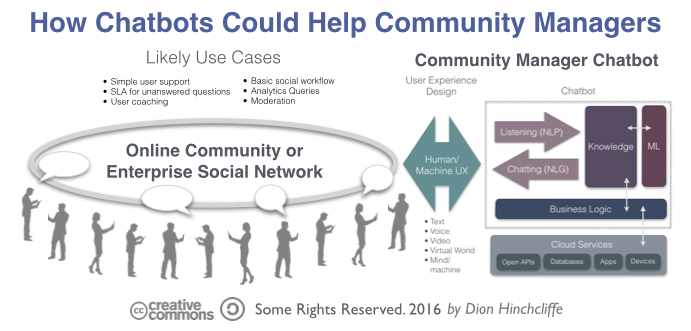
Why would chatbots help with digital leadership roles like community management? By being connected to the global activity stream and then assisting in the most fundamental — and therefore most common — community management scenarios. This would offload a very overworked role to handle routine digital enablement like helping users through common issues, basic community skill building, ensuring a basic SLA for questions and answers, and providing coaching to community/ESN users on the fly. Other likely scenarios include capturing community data and reporting on it and providing a queryable interface on community needs, hotspots, and quiet zones to improve social business adoption and drive business performance. Chatbots in this space have great potential in my opinion and we’ll soon see them more and more in the social business world.

How Chatbots and Artificial Intelligence could Help Community Managers

But are chatbots for community management — and other domains of digital engagement — really going to happen? I’d argue that since they already are in many other similar functions, such as Web site sales and support, that it’s almost certain, as a greater share of conversation shifts from human-to-human (H2H) to human-to-machine(H2M.) In fact, an employee from Cognizant even chimed into the above Twitter conversation that they are actually working on this. A smart chatbot to aid in community management will likely do volumes to improve the effectiveness of online communities, which are still getting short shrift in terms of investment in the professional skills needed to manage and facilitate them well.

In short, I believe smart chatbots will revolutionize digital/social engagement by adding a much needed automation and support of communication, knowledge management, and collaboration. There are also high value scenarios for chatbots connected to the e-commerce especially, an area that Facebook was careful to emphasize at F8. Chatbots will likely contribute to some digital noise as well, but filtering has proven effective in general for social environments in recent years. Overall, the emerging ensemble of conversational technologies is going to offer a compelling new access point to digital value for the average people in a very substantial way. At this point, I’d strongly recommend that most organizations add them to the new enterprise technologies to watch.) I will be adding smart chatbots to my upcoming 2016 enterprise tech watchlist on ZDNet as well.