Dreamforce 11: Live Blogging the Benioff Keynote

Dreamforce 11I’m here at Dreamforce 11 right now in Moscone Center in San Francisco. Salesforce made major announcements last night about Chatter, their social business platform, that is now more Internet facing.

I once called Chatter an enterprise social operating system and these announcements make it even more true now. Expect that this will significantly improve their positioning in customer engagement as their CRM tool is probably the top product in the space. The move connects their core strengths to social computing even better than Chatter did before, while putting them into the Social CRM business in a significant way.

The new Chatter now has customer groups and social analytics features and more. Larry Dignan did a good round-up of the changes and additions this morning on ZDNet.

Social enterprise and Salesforce

It’s very clear with the prominent focus on social business this morning that Salesforce definitely wants to be seen as the social enterprise leader. They’re working very hard to position themselves as such. The confab certainly confirms no small level of market enthusiasm: There are huge crowds in the streets and tens of thousands of folks here.

Crowds at Dreamforce 11 outside Moscone CenterThough sales automation was Salesforce’s original focus, they are very much moving to become a full spectrum social business enabler. It’s a story all social business practitioners should follow closely and this is a pretty major series of announcements, not just for the products but because the messaging will be heard far and wide in boardrooms and the C-suite.

Liveblogging and analysis of the Dreamforce opening keynote

You can watch it live here and I’ll do some real-time analysis here, so refresh as often as you like. Note: If it’s in quotes, it’s very close to exact wording, otherwise it’s a paraphrasing of the speaker.

9:03 – The keynote is about to start with Marc Benioff on stage shortly.

9:11 – Still hasn’t started yet but they announced it will shortly.

9:14 – Salesforce’s Peter Coffee is announcing a Hawaiian themed opening ceremony, saying Marc Benioff has great appreciation for the state and its culture.

9:19 – Music montage, Benioff is not on stage yet.

9:23 – Benioff is up: “You are now part of the largest technology industry event.” Says 45,000 people in attendance and 35,000 people online.

9:24 – “Salesforce.com was born cloud and have now been born social.” “We want to delight our customers with something new. We’ll look at how Salesforce is helping organizations become more social.” Mentioning Twitter’s #df11 hashtag to follow everything.

Marc Benioff on stage at Dreamforce talking the Social Enterprise

9:26 – Talking about the transition from mainframe, to client-server, to cloud. Multi-tenant vision of shared services. Talking about their new philanthropic model. Took 1% of equity, profit, and employee time and put it into a 501(3c).

9:28 – Talking about the evolution of computing, from mainframe, to mini, client/server, Desktop/Cloud computing. Mentions Steve Jobs, everybody claps. “Entering new era, an exciting new era”. Not thanking IBM, not thanking big companies, we’re thanking Facebook that’s creating change and transformation, an “Arab Spring” in business.

9:32 – When will we hear a “corporate spring”, when customers rise up and demand that organizations listen? That’s the social revolution that’s coming. E-mail has eclipsed social networking users. Look at how Facebook is eating the Web. Now it’s all about Facebook.com/yourcompany, your company, your project, etc.

9:33 – It’s not just about social, it’s about mobile. Mobile apps are used now more than Web browsers. Tablets and smartphones are taking over.

The Five Stages of Computing Including Social Enterprise - Dreamforce 11

9:35 – It’s not just about consumers, it’s about the enterprise. “So, what’s happening, what do we need to be thinking about?” This social revolution has created a social divide. Your customers are social and employees are social. But are our companies? Our are enterprises social? This has really been on my mind since we last met.” It doesn’t matter if you’re in Japan, Russia, or the United States.

9:36 – We want to help organizations bridge that social divide. I’ve traveled more in the last six months than the last six years. This transformation is so important we need to find a new answer. “Think about this:” We’ve been looking for best practices, modeling the success stories, finding the companies breaking through and ask them when they are doing.

9:37 – We’ve come up with a 3 step process. First it’s about the database. You can learn more about your customers than ever before on the network. Step 2, we want to create an employee social network. We’ve been talking about that for several years now. We launched Chatter last year. We’ve learned from you that we need more than that, we need collaboration. It’s not just about another island of collaboration, or island of data, it’s about integrating all your business processes and workflow and applications into that employee social network. Including the sales force, the customer service organization, and including custom applications.

9:39 – Step 3, which was a huge wakeup call. Our really incredible customers were creating product and social networks. Including customers in the social network. It blew us away. We saw you doing this in social marketing, listening, analyzing, deeply in the network. In other words: Social analytics and social business intelligence (my take on this.)

9:40 – We have to step up. Want to excite you, inspire, and look into the social enterprise and take you through the door, a door we’ve locked ourselves. Now he’s talking about Salesforce and the cloud.

9:41 – Your project is portable, your data is portable. Everyone can participate.

9:44 – Discussing their social enterprise research from around the world. Says that their vision of the social enterprise “is inspired by you.” Telling the story about using social networks, travel, and their organization. How in his recent trip to Boston, they talked extensively on their network about their plans, yet the hotel knew nothing about what they discussed. “Delighting customers means knowing who they are and what they like.” Getting that customer database so that they have a great experience when they use your products.

9:46 – We have to get back to our data models, back to the core. Introducing Dan Darcy, VP of product development. Showing a contact record in Salesforce. “Your contacts, they’ve gone social.” The new social customer profile builds an entire picture. Name, picture, where they are geolocated, what apps they use, what deals they are involved in, what customer service issues they have. A deeply integrated view.

9:47 – Says social contacts is really exciting, the crowd claps. Talks about giving everyone the tools to really “delight their customers.” Takes everything from Facebook, Twitter, and public information and streams it into Salesforce. As of today, everyone can go into Database.com, with APIs, OAuth, and start working with this information.

9:50 – You can choose where your data is. It doesn’t have to be in our datacenter, it can be in your data center with the new data residency option (DRO) for those that store sensitive data and it is compliant with many corporate and government policies. Now you have the ability to keep it where you want. Note: This has been a major sticking point for many companies.

9:51 – This sets us up to for something really amazing, really critical. Inspired by Facebook, LinkedIn, and all these networks out there doing collaboration. “Why do I know more about those strangers on Facebook than my own family or employees?

9:53 – Let’s look at some stories about Chatter. CEOs on Chatter: “This is a change that is going to last forever.” “The conversations really focus around our customers and products, all in one location. How they’re thinking and interacting and that we’re moving in the right direction.” “Instead of wondering how such-and-such is going, now someone whips out an iPad, and says let’s find out.”

9:54 – “It’s a wonderful place to be. I can see using Chatter to really drive changes in our top line.” “Companies that don’t have this collaborative and competitive advantage will fall behind.” “Wherever I can, I can very effectively communicate with 18,000 people in our company.” “The biggest impact in the next 5 years for companies effectiveness will be the use of social media.”

9:56 – Dan claims Chatter has become the leader in employee social networking. “We’re excited to make a series of new announcements” (so far everything that’s in Larry Dignan’s post.) Including Chatter Now, screen sharing for collaboration. We’ve learned that the key to success with social collaboration is integrating social into workflow. Collaboration is not an island. (Note: Great stuff that’s spot on with current Enterprise 2.0 effectiveness discussions.) There is even Chatter for SharePoint.

New Chatter Features in Winter 12 - Dreamforce 11

9:58 – Introducing Kraig Swensrud, Salesforce CMO, to demo the new Chatter features. “Chatter has really started to bridge the divide between different departments.” New features are coming in the Winter 12 release. Sharing stories from meeting rooms, people chiming in, and streaming information back into the meeting. Says customers wanted an open system, says APIs are available for social integration. No word on OpenSocial support (yet.)

10:00 – The Chatter activity stream shows what’s going on in the entire company, “it’s never overwhelming, can be drilled into, filtered.” You don’t have to spam the whole company with questions. You can post something and “the answer finds you.” This is crowdsourcing. Chatter for your entire company means you don’t have to fumble around and find the right system. Including ambient IM, hyperlinks, file sharing is part of Chatter, a killer app we think.

10:02 – We have an amazing social collaboration happening inside our company. “Wouldn’t it be great if we could bring our customers into this process.” Can create customer groups, “user empowerment”. Looks like normal Chatter groups. Shows a group with 12 employees and 3 customers. Says it’s happening today, just with legacy technologies to share proposals, marketing, working on RFPs. It differentiates you as a business to connect with them this way. Customers don’t have access to private and secure company info, just what’s in the group.

10:04 – Kraig is talking about mobile social apps to customers, says all their capabilities work on mobile devices. Demoing the app now. Now showing Chatter working on Android Honeycomb, very cool. “This is the new world of social collaboration, the face of the new social enterprise.”

10:06 – Now going back to Marc. “Now customers can be part of your Chatter network.” They are firewalled off from all your other information. Just introduced Neil Young and is talking about how he’s using Chatter to collaboration and produce his next film. Also using it on their new Hires for the Masses product and more.

10:10 – “Now we’ve been talking about collaboration. But there’s another key part of building your employee social network.” Has been traveling around and getting inspired by his companies. Talking about Groupon visit and seeing the energy level, growing at 22,000%. The way they achieved it by hiring as fast as possible 5,000 sales people. The level of communication and collaboration, planning, logistics is amazing. $750 million in revenue, constant collaboration and building custom apps to support new capabilities.

10:12 – Talking about 150 new features. The big ones are social contacts and social sales. Now they are announcing Data.com, access leading providers of data including Dun and Bradstreet to connect it into the CRM process.

10:15 – Benioff is discussion how HTML 5 is going to revolutionize the mobile user experience. Pinching devices to access fields. They are announcing touch.salesforce.com. All these apps are going to run natively on HTML 5, including all the apps customers have already built are going to be brought forward. Note: I think this is a very smart move to improve user experience on Salesforce.

10:17 – Kraig is back and talking about Salesforce sales features. “Under every deal is Chatter.” Includes support for pricing approvals, sales strategy, mapping out the organization and influencers and decision makers.

10:18 – “Of course, everything is now mobile. This is what you’ve been asking for.” Showing a demo of the new touch site. Looks like a native iPad experience, but is not, all HTML 5. Showing how well the user experience works on touch-based tablets and smart devices. Everything apparently runs in this new interface with little to no rework.

10:20 – Now looking at social customer profiles. “What if I don’t have the information about the customer yet?” Shows how new Data.com services might have what you need. One-click integration of external social information from their partnership with Dun and Bradstreet. Then you can see who they are and what they’re talking about in external social networks. Salesforce clearly understands big data, social media, and the strategic value of data use.

10:22 – Talking about bring the customer into social meetings in Chatter to collaborate and discuss. One final new aspect, everything is integrated in real-time including mobile, so messages are immediate everywhere. Get an immediate Chatter notice “that someone has exceeded their sales quota” right when the order is booked.

10:25 – Marc introduces the president of Verizon Business, Bob Toohey, to talk about shaping the social enterprise. “Need the flexibility to create the B2B to C in a very simplified way.” Benioff asks him how their customers are becoming social. “They want to know more about their customers. They want identity management. Customers want to be able to say I want the flexibility to integrate everything and make it work.” Hints at predictive analytics.

10:27 – Now Marc is talking about the customer they are going to profile this morning, carefully selected so they can learn from it. It’s NBC Universal. Now showing video of talking about NBC Universal’s social enterprise experience.

10:30 – NBC Universal video concludes. Marc: “It was only a couple of years ago that we made a strategic decision to get involved into the customer service business.” Says it’s their fastest growing product line.

10:31 – Talking about Zynga, with 30,000 customer service cases per day. Over 1,000 representatives online. $597 million in revneu, 392% annual growth. Marc’s calling it a “new age company”. Now mentioning Bank of America handling over 1,100 tweets requesting support per day. Twitter.com/Bofa_Help. “An incredible story about a modern bank becoming a social enterprise.”

10:33 – It’s not just about banks. Now talking about airline KLM’s 130,000 Twitter followers, reduced first call resolution rate to 1 hour. KLM’s customer service is “deeply integrated into the social universe.” KLM has taken this “to a level I’ve never seen”.

10:37 – Marc asking if the CEO understands the need to become a social enterprise. Does the C-suite understand? Does the board understand? Do our employees understand? Announcing Chatter Service to enable customer service and taking “the Service Cloud even higher.” Community feeds, suggested knowledge, crowdsourced answers, agent escalation and much more.

10:39 – Kraig is back out showing off Chatter Service in the Service Cloud. “It all started with Twitter. When Twitter started amassing users, everything was public.” Instead of contacting the company, customers just post, hoping that someone will help them in hundreds of millions of users.

The Chatter Service Cloud at Dreamforce 11

10:40 – With the Service Cloud, customer service gets plugged into the social conversations. Showing a live demo of real-time streams of YouTube and other social media and route the issue right into the service center to resolve the problem proactively. Talking about taking all the “paradigms of the social world and plug it into your organization.” Exploring Cirrus computing story with an example of how it all works, including cross-posting resolutions back out to Facebook and Twitter.

10:43 – “Helps you service your customers in completely new ways.” Call center can’t be left behind. “Of course, we’re integrated into telephony”, including the social profile, right when they call in so the agent knows what they are doing and what their concerns are. The knowledge base will recommend the right answer and relay it to the customer via e-mail or telephone. But in a social world we can do something better. Can even do Facetime service to iOS devices. And he’s showing it live.

10:47 – Marc is back and talking about Avon, BMC, Kelly Services are running social apps on Force.com and others creating “breakthrough apps”. Very interesting: Now Facebook’s CIO Tim Campose is talking about how they use Chatter and “have been able to adopt it across the board”. 70% of Facebook’s internal apps run in the cloud and most of them use Force.com.

10:49 – Now Parker Harris is on video from the show floor talking about the exhibits and campground. Continuing to talk about Facetime integration. Invites those to come in and see how all the technologies discussed integrate together.

10:54 – Marc is talking about Step 3: creating a customer social network. “The customer social network has been a real eye-opener for me.” It started with their acquisition of Heroku. Has the Heroku team stand up. Says that it now runs Java, not just Ruby. Talking about Disney’s dynamic social communities. Games, vacation communities, photo sharing applications. ESPN, Best Buy, and Warner Brothers are all doing this and using Heroku technologies. Now with Heroku with Java and frictionless scale, availability immediately. Brings 6 million Java developers right into their social platform.

10:57 – Talking more about social marketing. Now having MC Hammer standing up in the front of the crowd. Now MC Hammer is actually saying pretty good sound bites about how the wall is coming down in enterprises. Social universes can be used to see if products “really resonate.” Relating his experiences with crowdsourcing ideas in the music industry, and using betas to strategically validate ideas with customers. What’s working, not working, and making changes dynamically based on social feedback loops.

10:59 – Marc is now bringing up the great (but now fairly old) story about Gatorade’s social media network operation center. Video is playing about their story.

The Challenge of Social Media Listening, Analytics, and Social Business Intelligence

11:01 – Here’s the exciting part of the confab for me: Discussing the Radian6 acquisition, social media analytics, and how it turns into social business intelligence. Half of the Fortune 100 uses Radian6 to analyze social media. “The beginning of the marketing cloud”. Demonstrating Heroku and Radian6 with a Disneyland app. Companies are creating social experiences and doing it on Facebook to create phenomenal customer experiences.

11:08 – Still demoing social customer experiences. “The next generation of listening and engagement. Marc is back up. “Most exciting part of the keynote. Going to talk about an incredible new capability.” A new product called “Product Social Networks”, will affect every company in the world. Showing a video about the Burberry CEO Angela Ahrendts about how to create a “consistent feel for customers regardless of how they were accessing the brand.” For any CEO that is skeptical, she says “You have to [do this]. You have to have a social enterprise. Otherwise I don’t know what your business model is in five years.

11:12 – Now Angela — who is actually here — is up talking about the borderless enterprise is the future. Talking about the Burberry Community vision. They want to bring together their “great customers”, suppliers, partners, into a social enterprise. “What is the next step?”, asks Benioff. “How do you plug all of this back into the existing infrastructure?” says Angela. None of that goes away, Salesforce is an addition to plug it all into to optimize the social enterprise. As a global luxury brand, and the brand is the #1 asset, is what they’re selling before they sell anything else. The opportunity to take Chatter and brand it completely as Burberry is the key for them.

11:17 – “It’s not about channel, it’s not about technology, it’s about wherever the customer goes.” – Angela. She looks at the audience, “you are the social revolution.”

Angela Ahrendts CEO of Burberry Talking about the Social Enterprise

11:19 – Marc is talking about Toyota and the social enterprise. Relating the story about Toyota Friend, and how they are using that as the first part of their transition to the social enterprise. Connecting dealerships, customers, distributors, support centers, and even vehicles together socially. “Get your cars running on these social networks.” Now they are going to show Toyota Friends actually working so the user can see the charge level, maintenance cycle, tire pressure, interior temperature, etc. All information streams to you in a chatter feed (great stuff showing how devices and sensors can be social as well.) Connects to the whole family of cars and can be extended out to Facebook, Twitter, and so on.

11:24 – Continuing the Toyota Friends demo. Not just for customers, dealers, but also internal employees of Toyota. Marc’s back up, saying “this is happening to companies all over the world.” Discussing Enterasys and how they redesigned their products to be social. “Their switches are social.” Users receive real-time alerts.

Toyota Becomes a Social Enterprise with Toyota Friends

11:26 – Coca-Cola is now being featured on how their rewards, events, and other communities including food service, mobile payments, and other capabilities to brought into a single social enterprise experience. Marc is now standing by a vending machine and uses his iPhone to get a loyalty point for standing in front of the machine using geo-location. “It starts to have a relationship with me. We can bring the offline world online and increase customer intimacy.”

11:27 – Bringing up the CTO of Coca Cola, Alan Boehme, and talking about the vision for Coca-Cola and the social enterprise. Where have you said “wow, this has really opened up for me.” Over 700,000 partners and colleagues around the world. Their big challenges: Who’s know who, who knows what, and who know who that knows what.” Technologies that bring people together creates major opportunities.

11:29 – Marc is taking about a new social enterprise license agreement so that per-user pricing delivers every product for every employee. Alan inspired them to create the new social enterprise licensing agreement.

11:31 – Wrapping up now, talking about transforming and “igniting” organizations around employee social networks, customer social networks, and product social networks. Eric Schmidt, Vivek Kundra, and Metallica are all coming up today and tomorrow.

Summary: Overall an impressive amount of messaging and pretty spot on for the most part. We definitely get a better sense of where their social strategy is going as well as the larger outlines of how they’ll be going to market with this. Frankly, I’d be worried if I were a lot of social software vendors, because of the deep cross-product integration, opening of the platform, and the sheer number of key, strategic features now operational for true social business. If I were a CIO considering the social enterprise, I’d now be including Salesforce in my short list. I’ll be analyzing this more on ZDNet, the Dachis Group Collaboratory, and elsewhere soon.

Marc Benioff Wraps Dreamforce 11 Keynote on the Social Enterprise

Sunday Musings: New Social Business Research, Plus Disruptors of Tomorrow’s Enterprise

All in all, it was a good week for the exploration of big ideas in social business. PWC’s Technology Forecast quarterly published an epic 68 page examination of the future of collaboration in the enterprise. For those without the time to read through it all, Sameer Patel wrote a great overview of the contents today.

Standout areas of focus in this report include 1) an emphasis on dealing with exception handling as the norm in collaborative environments, 2) an underscoring of the central role of the CIO, which is something I’ve seen as key for success in social business, and 3) last — but certainly not least — positioning social media to directly support ongoing business processes. Says Sameer:

One thing enterprises have learned is that siloed, standalone consumer Web-style microblogging or social networking tools rarely work well inside an enterprise. Social technology that’s embedded in the enterprise application environment to offer collaborative support to specific business processes, or explicitly targeted at unifying all communications and collaboration, can be much more useful.

If you’re not sure about this, the importance of connecting social business to workflow was clearly driven home this week in the discussion that Laurie Buczek sparked in the Enterprise 2.0/Social Business community. See the comments and pingbacks in the link for details but it’s clear the social media for its own sake just isn’t enough to drive significant business impact.

For me, it’s become abundantly clear that smart social business initiatives — and the ones that will ultimately have the most success — will focus on connecting their efforts directly with 1) meaningful line-of-business activities and/or 2) transforming and integrating the most important horizontal functions like the intranet, content management, and document management.

But PWC’s report and Laure’s noteworthy post were not the only significant happenings this week. Earlier today Ray Wang published an engrossing and significant overview of 43 Use Cases For Social Business. Maps like this are important to help those trying to understand how to apply social media to various parts of their business. Ray’s use cases cover the gamut of the following areas:

  • Public relations/ marketing (PR/MA). Key impacted business process: Campaign to lead
  • Sales (SFA). Key impacted business process: Lead to deal
  • Service and support (CSS). Key impacted business process: Incident to resolution
  • Projects (PBS). Key impacted business process: Kickoff to delivery
  • Innovation/ product life cycle management (PLM). Key impacted business process: Concept to production
  • Supply chain (SCM). Key impacted business process: Sourcing to acceptance
  • Human capital management (HCM). Key impacted business process: Hire to retire
  • Finance. Key impacted business process: Invoice to payment

I DM’d Ray and indicated I felt that this was just a start on where social business will have an impact and he agreed. The list is light on general purpose workflow/collaboration, but then again Ray’s view here is actually connected to specific business activities, as per the previous discussion. We should also keep in mind that Ray’s perspective is based on actual data gathered from those engaging in social business, which makes it particularly invaluable as a look at ground truth. I especially liked his chart on the top 20 use cases based on the responses of over 100 early adopters:

Top 20 Social Business Use Cases By Early Adopters

Ray and his team has been doing some great research lately and I look forward to watching what they put out next.

The Disruptive Business Landscape Adds Big Data, Algorithms

As enterprises get backed farther into a corner by the constant changes swirling around them, there’s been a lot of speculation about the root causes of disruption at present. Everyone knows that cloud, social, mobile, and now increasingly big data, are to blame, but are they really the whole story? Not by a long shot in my book and Michael Fauscette agrees.

Citing the usual suspects, Michael took a fairly deep dive this week into the additional forces that are remaking the way we work and operate our businesses and came up with some gems that paint a fairly complete picture. I’ve taken a shot at describing the macro changes several times in the last year or so, but Michael’s list has a great perspective. Be sure to read it yourself, but Organic Business Networks was the one that resonated most with me.

Disruptive Changes To The Enterprise Cloud Social Mobile and Big Data

For my part, I think the BBC’s When Algorithms Rule the World adds the final item of serious competitive disruption to both our lists. Will we truly be smart enough to rule over them while only reaping the benefits? I worry that we won’t and that few of us are putting enough thought into the implications of big data and the analytics that will pervade just about everything we do. Next-generation enterprises will be ones that own their classes of data while being able to maintain the highest leverage over what they know that others don’t. See my discussion on closing the “clue gap” between what most enterprises can do today, and what tomorrow’s leaders will be able to do.

Finally, as Web technology continues to provide an ever-growing force multiplier that’s placed into the hands that master it, I’ve been exploring one of the new leading edges of social business: The process of extracting strategic intelligence from the knowledge, connections, patterns that become much more visible when organizations become social. It’s a topic that’s growing central to the discussion of ROI as well as attaining long-term competitive advantage. You can see all the details at Harnessing Social Business Intelligence: Nine Strategic Uses and Social Business Intelligence: Positioning a Strategic Lens on Opportunity.

At Dreamforce in San Francisco this week

I’ll be in downtown San Francisco for Salesforce’s massive and increasingly influential Dreamforce 2011 conference from Tuesday onward. Expect pictures, videos, and blog posts in my Twitter feed as we see what they have in store for the social enterprise. I’ve been having discussions with a number of Salesforce partners this week that are announcing innovative and intriguing add-ons and support capabilities for Chatter and other elements of company’s growing and increasingly impressive ecosystem. I’ll cover as much as I can here and elsewhere. It’ll be a great week of conversations and moving the thinking forward in this fast moving space, even as social business tries to keep pace with social media.

Putting Social Business To Work

A great post yesterday by Laurie Buczek brought home for me a key issue that I’ve been pondering lately, namely how surprisingly disconnected some social business efforts end up becoming. We know many of the reasons this happens: Not-invented here, political fiefdoms, integration challenges, the tendency of many applications to turn into silos easily, etc. However, social media in the enterprise is about connecting deeply to those around us to improve the way we work. It’s certainly not about isolation, yet that sometimes becomes the state of affairs. How we organize for social business determines much of our success, as emergent as the process is. As Laurie said in her post (her emphasis):

The big failure of social business is a lack of integration of social tools into the collaborative workflow.

I should be clear that it’s not social business as a concept that’s the problem here. It’s that social must be connected to the day-to-day work that takes place. Unfortunately, most work today is done through existing systems that aren’t very social. If we’re lucky, we can forge a link to a piece of enterprise data from within a social tool, a basic requirement for social collaboration. But more likely we have to manually copy information from the systems of record in order to collaborate on it. Even more likely, the social business environment just becomes a parallel silo that’s not connected to the business and is used for light conversation and status updates instead of meaningful, high value line of business activities.

Social Business Connected To Flow Of Work

Yes, many large ERP, CRM, and HRM vendors including Oracle, Salesforce, IBM, Saba, and many others have either added or are otherwise incorporating social layers in their products that can help address this. But this is not necessarily the same as making our businesses fundamentally or more meaningfully social. Such duplication of social tools has its own silo issues and ultimately, rolling out social software on its own does not in itself produce results. No, the ladder of social business maturity requires more from us than that.

Instead we need to wrap our businesses in social in a more ambient and deeply connected manner. To work, this must be more than for example merely adding threaded conversations to our systems of record. It’s about weaving collaboration into everything we do, efficiently and simply. The good news is that there’s now hope to readily address what Laurie was referring to and connect social to workflow. With recent advances like real, mature, standardized social integration with OpenSocial 2.0 — with widespread support by enterprise software makers for the first time — there’s a genuine opportunity, right now, for us to connect our daily departmental and enterprise-scale work activities en masse to an overall social fabric that enables real change, real results, and real ROI.

Note: I do not think pure technology can ever be the full answer to this issue. But whenever we have a means of much more easily putting social in the flow of work we must go well beyond paper strategy and employ them.

So it’s up to us to see the importance of doing this and making it happen. Want social business become just a fancy chat tool in your organization? Don’t put social business to work. Do you want to unleash untapped worker potential, including cognitive surplus, peer production, and collective intelligence and all the big strategic buzzwords? Then put social business to work. The big lesson here: Failure to connect social business to work on the ground will pretty quickly result in limited value. We are now in the possessions of techniques to avoid this and we must use them.

See my writings on connecting business software to systems of engagement, social networking applications, and social app stores for more details on this subject. The Social Business CIO Shortlist can help as well.
Sunday Musings: Google’s Identity Struggles, Plus Social Media Bans Around the World

The Web’s missing features for built-in user identity have become a real headache for the industry, and for its users too. It certainly took its toll on market leader Google this week as its “Identity Theater” continued (Source: Kevin Marks.) The issue? It’s turning out that making every single user comply with the Common Names policy isn’t workable for a variety of reasons. Reports of Google deleting accounts en masse are driving a lot of the discussion. Robert Scoble has his own recommendations for Google and while they’re probably the least that would be acceptable to the majority of people, it doesn’t go far enough I think.

It certainly doesn’t have to be this way. Twitter allows companies, bots, and just about every other type of social account and it works quite well in the end. Twitter ran into a similar identity issue in a big way a couple of years back after facing lawsuits and widespread complaints. They managed to muddle through with Verified Accounts.

A growing consensus is that Google should allow user-defined accounts as well, with verified identity for those that want or need it. Personally, I’m not sure I see Google coming around with a response fast enough to prevent some damage to services and impacting Google Plus‘s runaway adoption. But in my analysis, it’s most likely to only hurt the commercialization of the service, not regular usage for most for now.

Social Identity Ownership - Google or Facebook?

Worse, the problem may actually be core to the way Google’s stack is conceived and architected. It may not be easy for them to change course in the short-term without ripples through the way global Google’s services fundamentally operate from a security and identity perspective. It also may not be good for their business model which is almost certainly based on the fact they know who people really are. This issue is one to watch given Google’s pervasiveness. It also has some significant implications for business users of its products, especially now that they seem to be gaining some much needed traction in the social networking wars.

For now, I’d recommend that businesses use Google Plus with an eye towards experimentation while the Web giant gets its philosophy and policies around identity sorted out. Frankly, the bigger industry issue is social Web identity itself. Users and companies increasingly depend on commercial providers like Facebook, Twitter, and Google to provide everything identity-related, from login access to storage and maintenance of their social graph. This is causing key elements of power and control to start to swing away from the open standards that made the Web so successful and essentially fair.

Will the W3C step in and resolve what’s appearing to be an increasingly glaring absence in the Web stack? So far it seems unlikely given the failure of many years of open standard Web identity efforts. The culprit? You have only to look in the mirror. Apathy by users and lack of consensus on the part of Web developers. There’s also a lot at stake financially for those that end up owning a big chunk of Web identity. Consequently, online — and especially social — identity is likely to grow into a full blown brouhaha in the next couple of years as issues, missteps, and abuses inevitably surface. However, we could also decide to put our own house in order before governments step in, the least desirable of all outcomes in most imaginable scenarios. The worst probably being governments owning, issuing, and centrally managing verified Web identity credentials for everyone.

Which brings us to the next subject…

Government Bans Chipping Away At Social Media Freedoms?

A couple of interesting things happened this week with governments aiming their considerable might at social media. While knee-jerk responses to this space were common enough a few years ago, with the U.S. Marines banning social media access for a while for example, these are now generally understood to be counterproductive and unworkable for a long list of reasons.

However, that didn’t stop the German government from banning the Facebook ‘Like’ button on Friday, sure to ignite a small firestorm in that country given that it seems to apply to any site accessible from inside its borders and the fine is a stiff €50,000. The Like button, used on millions of sites around the world to enlist users to leverage their Facebook social network to share content from 3rd party sites (see: k-factor), is significant enough on its own to put German Web businesses at some competitive disadvantage on the global stage. The concern is over privacy and that “all the information was sent to the US company even if someone was not a Facebook member.

In another similar situation, the Missouri state government’s new law preventing teachers from using social media to communicate privately with students, the former who just announced that they are fighting back, is another case in point. There are obvious free speech issues with the law despite the good intent on its face to protect students. The real issue is that the law is that violations are almost impossible to detect and enforce, until its too late, and that it ensures teachers, one of the most collaborative and interaction driven professions with far reaching impact, can’t have much of a social media presence of any kind until the implications are sorted out. It also presumably doesn’t prevent teachers from privately communicating with their students in any number of other digital channels. All of this means the law won’t accomplish a whole lot other than sowing confusion and promoting the use of increasingly obsolete methods in an increasingly fast-changing economic and societal landscape.

The real issue with both of these laws is that they are 1) essentially short-sighted, 2) exhibit such poor understanding of social media as to be essentially useless, and 3) are therefore unlikely to be meaningfully carried out. Worse, they chip away at the edges by introducing step-by-step, largely ineffective government oversight and control over social media, one of the largest economic, cultural, and societal changes of our time. This will become an even hotter topic as the Middle East’s social media coordinated model for uprising spills out of the developing world. In fact, this has already happened in Britain and there are already cries to ban social media in cases of civil unrest.

I should be careful to note here: I’m not by and large suggesting there’s any overarching government scheme to interfere with and control social media. Instead, I’m suggesting we keep a close eye on these developments as social media legislation increasingly (and inevitably) accumulates in bits and pieces on the base of knee-jerk responses to individual situations. This will have a great many unintended and unwanted consequences. The continued growth of laws and regulations in a vital new industry that thrives on inherent openness and trust has the potential to limit it so profoundly that we could lose much of the great promise that social media can provide.

While we must find ways that work to protect our citizens, we must also provide them access to one of the most open, free, and powerful means of interacting that has been invented. Let’s push back on unreasonable measures while also proactively being responsible for solving them. It’s up to us to start finding globally acceptable solutions to privacy, security, and misuse in social media and getting them into the hands of those who don’t understand this space well enough yet to govern it. The options for making this happen are something I’ll explore as soon as I can.

Connecting Agile Business with Social Business

When Jim Highsmith graciously invited me to give the opening keynote at the inaugural Agile Executive Forum in Salt Lake City this week, I had to really sit down and think about what I’ve been working on the last few years, namely social business, as compared the conference theme, agility and business. While agile methods have had many separate and distinct threads within the business and technical worlds over the last 20 years, one of the most active areas has been in software development. For its part, social business is a much newer phenomenon that’s become a top priority for many business leaders in the last couple of years. So, while I’ll cover the details of my presentation — in which I connected agility and social business as drivers of innovation, in another post — I will attempt to more formally to capture the specific similarities here.

In recent years, as agile development has been increasingly borne out as a fundamentally better, more efficient, lower risk, and more cost effective way of doing things, there has been significant and growing effort apply agile lessons to business in general. And, as it turns out, agility and social business, as two major new ways of connecting and organizing people in directed activity, have plenty in common. Perhaps even more importantly, they have key things to learn from each other.

I’ve had quite bit of experience with agile methods personally, having led extreme programming project teams and been closely involved in large, distributed SCRUM projects in years past. I’ve seen agile methods work significantly better than classical processes. This is probably why it’s now the most common development process in software that developers identify with in my experience. Consequently, I’m in a position to see some of the connections between business agility and social business, in all their many flavors. The connection isn’t trivial either. There are hard won lessons learned from agility that social business initiatives could certainly benefit from. Just as there are innovative new approaches to scale, transparency, process, and tooling that social business brings to the table, as extreme and radical as they may appear to agile folks, who are more used to being the harbingers of change.

Comparing Agile Business and Social Business

What’s the point of connecting these two approaches? Because they can learn a great deal from each other. Agile methods can be updated and modernized from what social business brings to the table, and social business can apply some maturity and rigor to what it does, as appropriate. This I believe is a fruitful exercise for both disciplines and is one I summarize below.

Agile Business and Social Business: Side-by-Side

Keeping in mind that some agile process purists are still on the fence about applying the methods more broadly, the focus here is on agile processes of any kind as applied to general people-based business activities. Some processes are more amenable to agility, just as some are more amenable to social business. In general, however, the less collaborative, more rigid, and user-isolated a business activity is, the less applicable either agile or social media methods will be to it. However, if you have a complex, open-ended, and outcome-oriented business process involving many people, especially including those that it most directly affected (typically, the customer, internal or external), then both approaches represent the very best ways that we know of today to deliver successfully on them.

As you’ll see, agility and social have much more in common than they have differences. Here’s my take on how they break down:

  • Coordination Instead of Control. Both agility and social eschew using centralized hierarchies to achieve control. Instead, as Brad Appleton has long recommended, they both work best with autonomous, adaptive, and accountable actors. The first two are something that applies very much to social business, while the latter is something inherent in any social environment that has a strong identity system (which, unfortunately, not all do.) The lesson here is that emergence (an important and prized aspect of Enterprise 2.0) and self-organization are very similar and are shared as core values in both disciplines.
  • Designing for Change/Loss of Control. This is something in which agile is inherently stronger than nascent social business methods, which are just wrapping their heads around this. Not killing emergence requires the acceptance that external change is a desired constant and should be responded to productively to get the right results with the resources at hand. Ignoring that requirements aren’t what the customers need, that the planned outcome of a business process won’t be very useful, and other denying of reality is anathema to both disciplines, but is more formal and well-defined in agile methods. Social business does recognize that the majority of productive output is on the edge of the network and largely outside of formal control, but other than measuring community sentiment, that’s often as far as it goes in terms of responding to new ground truths. The best results in both approaches are when there are tight feedback loops to all stakeholders and that a planned response to that feedback is the central factor in re-engagement with the project or online community in the next cycle. For additional insight, read Tim Leberecht’s great overview of this issue, titled Openness or How Do You Design For the Loss Of Control.
  • Frequent Work Cycles. Agilists call work cycles iterations. Social business doesn’t have as strong a notion of discrete work cycles because it’s essentially continuous and itself emergent, a more extreme version of agile when you look at collaborative work in social media environments such as crowdsourcing efforts or Social CRM. In either case, the project and/or community must assess and respond to change at the end of each iteration, or do it continuously which is more common in the case of social business processes.
  • Open Contribution. Social business works best when the broadest possible invitation is made for stakeholders to get involved and contribute. Agile processes tend to define valid contributors to a smaller audience, though it’s entirely up to the project and varies widely. Social business realizes that the “anyone can contribute” default stance is one of the most powerful concepts in recent business history (as only those that care about the outcome will get involved, yet that’s almost always many more people than you thought.) Agile methods could learn from the extreme openness and fewer contribution boundaries and barriers in social media. I made the point in my speech that open source software has proven this in the real-world better than any a priori speculation about what works best ever could.
  • Working Results. It’s long been the mantra that agile processes value working software as soon and often as possible at any given time in the project. When the requirements are right and/or the budget runs out, you have the best possible output, ready to use. Social business is not yet so disciplined in its directed outcomes, yet by its very nature is always up-to-date with the latest revisions, contributions, or updates.
  • Continuous Processes. While agile business typically recommends iterations, milestones, review steps, and other processes to happen as often as they provide useful course corrections (typically every few days, or weeks at most), social business is even higher velocity and larger scale. Consider real-time processes that run around the clock globally involving tens of thousands and sometimes a million or more simultaneous contributors. This means the scale and velocity of social business often outpaces agile by two to four orders of magnitude. Social business could learn a lot about continuous in the small (builds, releases, work product iterations, etc) while agile can perhaps learn to scale and go even faster in a way it never could before.

This comparison just scratches the surface but is a useful start. I’m happy to be called out on any details anyone feels like I may have gotten wrong. I do believe that agility and social business go hand-in-hand and that we can cross pollinate the two to create far stronger results that either can by themselves today. Put simply, agile business and social business are two sides of the same coin. That may be a controversial statement to some but I believe that as far along as these two disciplines have come in parallel, they will do better with more explicit and effective connection. Our organizations (businesses, organizations, government, etc.) will almost certainly benefit.

What do you see as the commonalities and differences between agility and social?

On Web Strategy

Global Use of Social Networks and E-mailMy old Web 2.0 blog is finally closing due to hosting issues so I’m moving the conversation here going forward. I’m also relocating my large library of old posts and visuals to this blog over the next few weeks. Collectively they’ve had over 12 million views and are witness to an amazing time in the history of the Web, business, and society. 

It’s been a profound era of change by any measure, and one that we’re fortunate to live through. Over the last seven years we’ve seen the rise of social media, Web 2.0, Enterprise 2.0, and now social business. Put simply, the Web-based world has changed nearly everything about the way we globally connect together and create shared value. For now, this blog as well as ZDNet, ebizQ, Dachis Group, and Hinchcliffe.org, will be where I will continue exploring the emerging edge of business and technology, with this blog focusing more on the Web itself and my other channels focusing more on the enterprise aspects.

I’m renaming this blog to On Web Strategy because I’ll continue to focus on the way the Web works, particularly what makes it so powerful for those that understand it. There’s lots of exposition available online about the changes taking place today, but not enough exploring the specifics of how Web-based networks are driving pervasive change. Among the endless information streams available now, there’s still room for more thorough examination of the way the Internet is co-evolving into the single most powerful platform for self-expression in history. I believe this is true whether you’re a person or a business; there is no other place nearly as compelling, innovative, valuable, or relevant today. And the Web itself, far from reaching maturity, remains the single most exciting — and most rapidly moving — place to improve and transform how we live and work.

Knowledge Work Dominates U.S. Labor by SectorWhile my primary interest lies in connecting the two too-often loosely connected roads of business and technology, I think the increasing convergence between them is where much, if not most, of tomorrow’s opportunity resides for those that can successfully overcome the obstacles. For its part, social media has become a leading force for value creation in the world along with the rest of our digital footprints, with which we are now creating the richest and most vibrant record of our times. Visionary enterprises are now seeing how to tap into this and join in partnership with the rest of the world to create entirely new types of products and services together with their customers. From the data, it’s clear that social co-creation and other new and closely related models, such as crowdsourcing, are genuinely changing the nature of human activity, especially value creation, control, ownership and other less-tangible qualities like trust, openness, and understanding.

While some organizations and individuals will continue to debate the actual magnitude of the changes that the new low-barrier, high scale, and virtually free tools of self-expression are fostering today in the large, there’s little doubt looking at the macro trends that momentous things are happening. I have certainly been asked, “are these changes as big as the printing press? As big as mass media? How about personal computing” Yes and yes and yes. And much more significant in terms of actual change wrought. I’ve included here a few recent pieces of my research that illustrate the case that the business, cultural, and societal landscape is being remade right now, and doing it quickly in some cases. This includes the following data points:

Trends and Drivers of Work and Life Today

    Portion of the Web That's Peer Produced
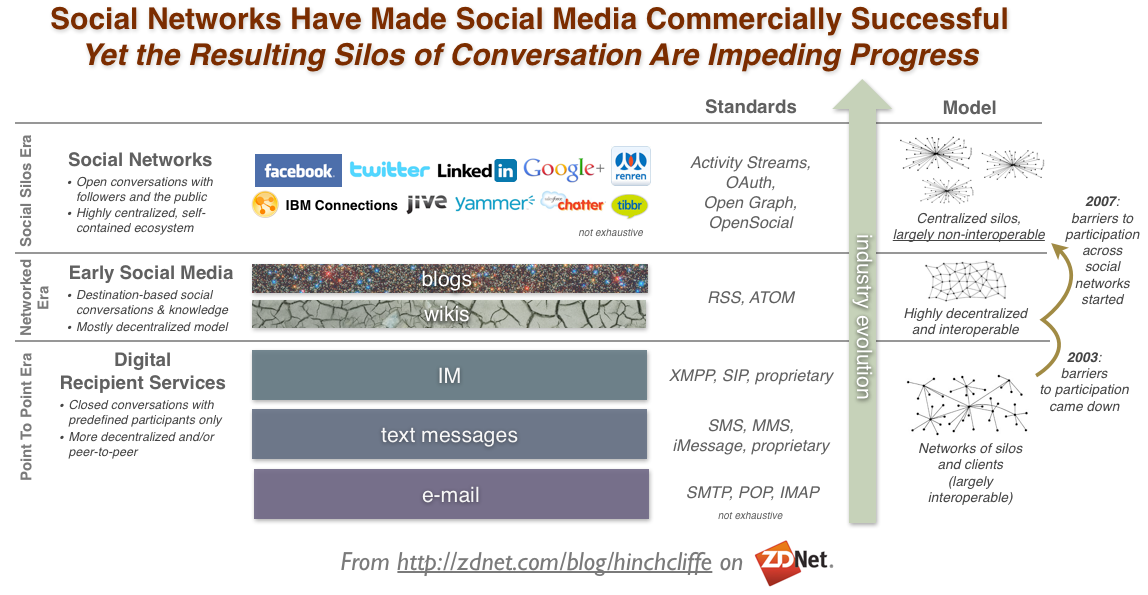
  • Social is how we communicate today. There has been a generational change of communication from point-to-point (e-mail) to social in four short years (see first figure above). Certainly e-mail is in decline and will be with us for a decade or two, but it has dramatically lost its prominence and relevance in recent years. For now, social media is the way we increasingly prefer to connect and work together. Traditional organizations have had some trouble catching up to these trends, but I’m finally seeing evidence that they’re doing so.
  • Knowledge work is the driver of our world economy. People-based activities centered around the creation and exchange of information (financial services, real estate, education, media, governing, etc.) are what modern economies are built on (see second figure above.) Methods that greatly improve the creation and exchange of information will have inordinate value, especially models that optimize for it, i.e. social media and by intent, social business. Knowledge work is about 60% of the labor force today and growing steadily. The less valuable service economy is growing as well and is also a beneficiary of these new and emerging forms of communication and collaboration.
  • Peer production is now the primary motive force for creation and sharing. Centrally controlled models for production in business and government are much less powerful and inordinately more expensive. The creation of information on the “edge”, by individuals, has transformed traditional media as well as the Internet: It’s now made by us, with approximately 80% of information on the Web (see last figure, right) now coming from user generated content. In the future, sensors and other information generators may outpace us, but for now the most important trend is that productive capability has moved decisively into the hands of us out there in the long tail.

What does this all mean? That’s what this blog was developed to figure out. Come back and visit. I’ll be exploring Web strategy and cutting-edge innovations that are likely to have significant impact to the way we run our organizations and live our lives. Please drop me a line if you want to share your ideas, or better yet, contribute them in comments below or in your own blog or social network.

The Social Graph: Issues and Strategies in 2008

One of the hottest topics in the online world in the last couple of years has been the growth of social networking services such as Facebook and MySpace, as well as the addition of a social element to existing user experiences.  Despite riding several waves of hype, it's now clear that the social networking space will only get hotter in 2008 according to most watchers.  Social software has come fully into its own as of 2008 — for all appearances permanently — and understanding the reasons for this rapid rise as well as figuring out how to leverage it best is the job of everyone who wants to make the most of the Web 2.0 era.

Gaining a deeper insight to the social networking phenomenon, now exhibited by the tens of millions of users employing them globally on a daily basis for both personal and businesses uses, currently means understanding the fundamental unit of the social network, also one of the biggest new buzzphrases of the year: the social graph.  Fortunately, that's simple enough despite the term's oblique reference to graph theory, which it is heavily based upon.

Social Graphs - The pattern of social relationships between people

Simply put, a social graph is a set of people, referred to as nodes, that are connected together by vertices — better known as links or connections — that reflect their social relationships.  You can see a conceptual social graph above, showing the typical distinction of social networks to reflect whether a connection with another person is direct or indirect.  For example, the popular business social networking service LinkedIn, uses this model and sorts a member's social graph into different degrees of separation, which you can see a typical example of below and taken from my LinkedIn profile:


Organizing Social Graphs - Degress of separation is popular

Also becoming popular is the burgeoning field of social analytics, such as the Socalistics application in Facebook and the Interactive Friends Graph, though there are also commercial standalone products here or on the way for the enterprise and open Web spaces from companies like KnowNow and Bravadosoft.  The Interactive Friends Graph is a nice, simple example anyone can try on their own and you can see mine from Facebook below.  Hovering over nodes in the live version in your Facebook profile allows you to see who is connected to others in your network and begin to gain insight and understanding of the relationships in your network.

 Social Graph Example - One of many way to depict a social graph

But what are the top issues one must understand about the social graph in 2008?  As I've seen social networks become common on corporate intranets and in daily use on the Web, some of the issues are rapidly becoming clear.  However, the full story will certainly continue to unfold for the next several years at least.  Here's what we're seeing at the moment:

Strategies and Issues for the Social Graph – Circa 2008

  • The social graph is poised to replace the address book and contact list as the preferred organizing structure for personal and business relationships. This was one of my Web 2.0 predictions for 2008 and it won't fully come true for the majority of users for at least several years since there's such an installed base of traditional tools for managing relationship information.  What's the difference?  Social networks are usually opt-in, two-ways for one.  And they are social for another, meaning they tend to encourage communication and collaboration, such as through user profile event streams and status messages.  They also offer up and actively make use of the deeper insight into the full graph's social surface area beyond direct contacts, such as LinkedIn's introduction service.
  • Ownership of the social graph is going to be a ground zero issue in 2008.  Robert Scoble's widely covered attempt recently to use Plaxo Pulse to export his 5,000 Facebook contacts recently got him banned temporarily from the service.  But as users begin to realize that the contact lists they are building using online Web tools might not be portable, this will become a growing concern, particularly since two-way opt-in makes a social graph more valuable (and accurate) but significantly harder to recreate on demand elsewhere. This takes us to our next subject…
  • Many social networking services will adopt open data initiatives.  Both Google and Facebook recently showed support for DataPortability.org and Google has an interesting play in their OpenSocial initiative.  This is welcome news that will resolve some of the concerns around who owns the graph but interestingly, traditional corporations will be the slowest get this and will rarely let workers take their hard won social graphs and user profiles with them elsewhere as they move to new jobs.  Public social networking sites Web sites are leading the way here and this will only drive more business users to the open Web, where they at least have some control over their social graph.  Smart organizations will provide their workers with some form of open social graph support, lest they lose control completely as workers keep more and more of their graph in Facebook, LinkedIn, and Plaxo and not in prescribed relationship management tools.
  • Attempts to monetize social graphs will drive interest in regulation and legislation.  Social networking is now a global Internet phenomenon and that the information contained within them is highly central to everyone's lives.  This will make everything from protecting children to individual privacy of social graphs a hot issue for some local and federal governments.  All it will take is one or two widely covered exploits to make this happen.  Expect the European Union and the U.S. government to begin seriously examining the issue this year with many other governments following suite.  Good citizenship of sites that manage social graphs will be essential to prevent excessive government involvement.
  • The line is blurring between personal and business use of social graphs.  We're all rapidly getting one large social graph each already, with everyone we know in them.  Most public social networking sites do a poor job of separating different subgroups of our social networks, such as allowing pictures and status messages to only go to a specific subgroups (work messages to business, family message to family, friends messages to friend, etc.)  This actually works a little bit better in enterprise social networks, but not much, since it largely consists of a Contact Type field.  Segmentation of social graphs will be an increasingly requested feature by users struggling with their use.  The social graph management services that make this distinction and enable its leverage may do very well indeed.
  • Open Web identity, which will ultimately form the global "primary key" for social graph nodes, will not get anywhere soon.  This despite it being needed badly but the users of the Web have not yet felt compelled to demand it.  Data portability of social graphs will begin to drive adoption of user controlled Web identity, and hopefully government regulation will not.  See Dare Obasanjo's deep exploration of using openid to enable social graph interoperability as an example of what will need to happen, despite there being little incentive currently for sites to use other site's openids.
  • Making social networking "gardening" and administration easier will drive new innovations.  Most individual social graphs are primarily tended by hand today, although a growing number of products, such as Visible Path, do all the tedious work for you by watching your social interaction online such as through tight integration through e-mail and instant messaging, building a rich graph for you (even sending invitations) as you go about your daily social activities.  New innovations like these will make social graphs easier to maintain and richer in overall information while also driving adoption through ease of use.
  • The optional two-way confirmation of a social graph link becoming standard.  Many social graph management platforms (Facebook and Linked for example) require confirmation from the other side of the connection before adding a person to your graph.  Sites like Spock, which make it optional, will ultimately be more practical for managing a social graph while still allowing discernment of two way confirmations, which tend to be more valuable and convey key information about the trust and real extent of a social relationship.
  • Social networking fatigue will not set in as perceived constraints such as Dunbar's limit do not prove to be universal.  While there are many theories on how big a social graph can get before it become unmanageable and sees diminishing returns on growth (note that both Facebook and LinkedIn encourage ceilings), the fact is that the are many different purposes for a social graph, from data mining and historical research, to marketing and customer relationship management.  

What else is going to be key to dealing with the social graph in 2008?  Please leave in comments below and I'll update this post with any good submissions.

Ten Aspects of Web 2.0 Strategy That Every CTO and CIO Should Know

Over the last year I've worked with organizations around the world that are attempting to grapple with Web 2.0 and the growing external marketplace pressure being exerted for the change and transformation of their businesses. Along the way, I've been fortunate enough to be able to identify and assemble a working list of some consistent recurring issues and themes around Web 2.0 strategy.  I've provided them below at a high level. Your comments and additions are very welcome as we try to frame up a consistent picture of what's happening in the marketplace.

It used to be a little surprising how long it's taken for Web 2.0 to begin to have serious impact on or even high-level interest in the business world.  However, the ideas have had staying power and have also largely been validated; there are now fundamentally different and very powerful new models for engaging with customers, designing our products, and applying technology in general to our business that are proven and have growing bodies of knowledge.  The Web has become the single most important driving force in many fields of endeavor as well as the leading source of both innovation and potent new modes for communicating, collaborating, socializing, and working together. It's taken a few years but businesses are now feeling the change in the air.


The Web 2.0 Transformation and Change Management Process for Business and Enterprises


However, as I've said a number of times in my various discussions of Web 2.0, the power of the network has deep roots in some profound shifts in society and culture, particularly the singular move from push-based systems (the 1.0 era going way, way back until right around now) to pull-based systems (the 2.0 era from roughly a few years into this century and going forward).  That this shift is well under way is clear if you look at the sudden explosion of the blogosphere, social networking, social media, open source software, online communities, and peer production in virtually all things.  The good news (or bad news, depending on how you look at it) is that despite the remaking of more than a few industries already — including media, software, advertising — this shift is only just beginning.

This all raises the question of how to make the transition from 1.0 to 2.0 safely and non-disruptively with your business largely intact, perhaps even with a superior competitive position.  That this transition can actually be accomplished by most businesses is still far from clear though some early transitions have met with varying degrees of success.  This list represents some of what we've learned so far  about 2.0 transformation but it's something that strikes at the very heart of most businesses today: The rules for success are not-so-gradually changing and the marketplace is driving it in an often-subversive grassroots, bottom-up way.  The question now is no longer about "if" but increasingly about thriving long-term, period: What are you willing to do to adapt to a new business world?

This list is aimed primarily at CTOs and CIOs since they are mostly likely to be located at the convergence of traditional business thinking and the wave of 2.0 change coming in off the network. However these ideas apply to anyone looking at how to embrace 2.0 transformation in their organization and take advantage of it.  This is one of the most exciting eras to be in businesses since so many directions are in flux and the outcomes, players, and market leaders of the near future are far from certain.  Those who can see the new opportunities clearly through the lens of 2.0 transformation not only have a fighting chance, but are able to seize them with once-in-a-generation ease.

Note: I've dropped the "Web" in Web 2.0 for this discussion because one of the big lessons is that many traditional business thinkers turn off when they hear the word, even though Web 2.0 design patterns and business models have truly profound implications across any business today.  Consequently, hat the Web is driving most of these changes is being considered incidental for this discussion (though it's absolutely the opposite when actually executing on these new models.) Instead, this is targeted a discussion about the transformative models themselves (such as who creates the products and where, how they are used, who supports them, how are they remixed, syndicated, franchised, licensed, IP protected, etc) in a strategic businesses sense. At the core of this discussion is how 1.0 business models of the 20th century are very much being eroded, transformed, and frequently dethroned by the immense motive forces that lie in the pervasive, open networked systems we have today, which are taking us deeply into a very new place: the 2.0 era.

Ten Key Aspects of Web 2.0 Strategy

  1. It's not about technology, it's about the changes it enables.  While technology is a close second (and ultimately makes 2.0 business models possible), the real discussion is about the disruptive new opportunities it creates.  Instead the discussion should be focused more around strategies such as harnessing millions of customers over the network to co-create products through peer production, engaging in mass customer self-service, customer communities, and open supply chains to thousands of ad hoc partners with open APIs. These are just some of the examples of using the network to create far richer and more profound results than could be created in the 1.0 era.  Don't get caught up in the technology of 2.0 at first other than to understand the business possibilities it affords.  Avoid technology-first discussions like the plague.  Premature monetization discussions around 2.0 are also to be avoided, they tend to have a negative impact on process if done too early.
  2. The implications of 2.0 stands many traditional views on their head and so change takes more time than usual.  In the 2.0 world customers and partners have a much closer, more sustained relationship because of social interaction and tightly integrated online supply chains, to name just two reasons.  The shift of control from institutions to communities of users takes a lot of getting used to.  Just understanding how and why intellectual property is better covered by Creative Commons instead of copyright will take the legal department years (if not decades).  Each part of the organization will have its miniature 2.0 revolution.  These take time to happen and sort themselves out.  This means getting these new ideas into people's heads is one of the first steps…
  3. Get the ideas, concepts, and vocabulary out into the organization and circulating.  If you're trying to affect 2.0 change in an organization, there's no better solution that exposing people to it.  Demographics can be a problem in this situation depending on the industry.  Younger workers tend to live and breath 2.0 while older workers may be aware of it but don't think it applies to them.  I use point education where change needs to happen either first or quickly and then internal communities that bring the discussion of change, innovation, and transformation to the entire organization.  Either way, learning and education around 2.0 are a vital trigger to begin change and should be started early and non-disruptively.
  4. Existing management methods and conventional wisdom are a hard barrier to 2.0 strategy and transformation.  You don't have to get far into discussions about the Perpetual Beta or Product Development 2.0 before existing management methods seem outdated, inflexible, and ineffective.  This is one of the more difficult aspects of adopting 2.0 models and the implications is that we'll have to do a lot of rethinking how we manage businesses driven by 2.0 models, where the boundaries of organizations are less clear, the ownership is much more community-based, and the outcomes are far more diverse and spread out, making them less trackable, controllable, and directed.  Overhauling management practices and techniques will be a core activity in a 2.0 transformation and will be hard to achieve quickly enough due to the Innovator's Dilemma.
  5. Avoiding external disruption is hard but managing self-imposed risk caused by 2.0 is easier.  The great fear than many businesses have is facing a fast-growth competitor that takes these ideas and either wrests away market share rapidly and aggressively or cuts them off at the pass with entirely new products.  YouTube did this to the broadcast and cable industry, which responded with Hulu.  Apple did this with iTunes to the recording industry and the blogosphere did the same to the newspaper industry.  Other industries are next likely including the financial services industry, real estate, and others.  Internally, however, risk management is still a challenge but is much more manageable.  The big implication for this is that starting internally first with things like Enterprise 2.0 initiatives and prediction markets to learn the ropes on how to deal with unexpected outcomes and results can help organizations climb the maturity curve.
  6. Incubators and pilots projects can help create initial environments for success with 2.0 efforts.  Too much contact with the traditional support environment of an existing, primarily 1.0 organization makes it hard for 2.0 efforts to succeed; everything gets done in the traditional way instead of the new ways that are required.  The traditional tools, processes, and skills just aren't there or are just too slow and burdened with unnecessary overhead.  Creating dedicated incubators that are designed to use the strengths of the organization while being isolated from its weaknesses can help.  Incubators are at risk of becoming too isolated however, and won't inform or change the greater organization unless care is taken to roll the lessons and capability back in.
  7. Irreversible decisions around 2.0 around topics such as brand, reputation, and corporate strategy can be delayed quite a while, and sometime forever. Most organizations get paralysis around change and transformation because of concerns around decisions that can't be reversed.  Concern over damaging the company's brand is one of the top issues I run into and it's a valid concern.  The good news is that many organizations are discovering they can safely leverage the advantages of their organization (such as their extensive customer base to drive initial growth of 2.0 engagement and adoption of new products and services) without dragging their brand into it whatsoever.  New 2.0 products from major companies are now often released under new brands entirely. This enables serious experimentation with 2.0 while taking little risk to the organization.
  8. The technology competence organizations have today are inadequate for moving to 2.0.  This is key if you're a CTO or CIO today; your organization is almost certainly not ready to handle the development, management, scalability, identity, governance, and openness issues around 2.0.  If you're not sure, just ask your IT staff.  Examples include cloud computing, open APIs, mashups, rich user experiences, Web-Oriented-Architecture, community platforms, Enterprise 2.0, 2.0-era computing stacks like Rails and Django, are all disciplines that are considerable in their own right, of rapidly growing importance to organizations in the 2.0 era.  These are all likely to be things your staff needs to come up the learning curve on in significant ways and with the rate of change on the network what it is presently, falling behind is too easy to do.  Note: The existing technology landscape of most organizations will have to change as well which is where Web-Oriented Architecture (WOA) is getting quite a bit of attention today.  And the Web products themselves have moved far beyond the model of the Web page and most enterprises are very far behind.
  9. The business side requires 2.0 competence as well.  This includes how to design, build, launch, market, support, and maintain 2.0 products and services as well as the ways that workers should use the tools and concepts to work together.  I recently suggested that learning how to be effective in working within and directing communities of workers/users/partners to accomplish large-scale outcomes will be a vital skill in the very near future.  All of this requires both a new perspective as well as a hard-headed effort at skill building and a re-orientation of existing work habits and processes.

  10. Start small, think big.  We have discovered that the leverage the network can give us is almost unlimited.  It's ability to scale ideas, products, and communities of users as fast as they are able to is one of the aspects that makes it so attractive to business.  2.0 products tends to be very simple at heart, and though there is certainly challenges and complications growing, small ideas can become big very, very quickly.  Getting to the right solutions, not-overinvesting (which leads to complication and heavyweight management and processes) and letting customers and partners take the seeds of great ideas and run with them is what makes sudden success turn into a large-scale success.  On the Web, starting small, and thinking big can take you a long, long way.  Read more about network effects driven by architectures of participation .

Please share your ideas around what else is essential in a Web 2.0 strategy below.

Building Modern Web Apps? Better Have A Deep Competency in Web 2.0, Open APIs, Widgets, Social Apps, and More

The Web has an interesting property that those building Web applications and online businesses usually encounter soon after they first launch: It has its own unique and unforgiving rules for success and failure.  Appreciating them requires a certain level of understanding of the intrinsic nature of the Web and how it works.  Actually leveraging those rules requires an even deeper and more profound understanding of the Web. The challenge these days? The Web competency bar is climbing fast.

To drive the right decisions in what they do product designers, marketing teams, software architects, developers, strategy officers, and other key roles in today's generation of online businesses need to have a solid handle on an extensive array of Web topics.  This ranges from appreciating why plain old HTTP is so good at underpinning the Web to more sophisticated topics like modern application architecture, the latest in online user experiences, next generation computing models (grid/cloud/utility/SaaS/PaaS), cost-effective scalability, user identity, network effects, Jakob's Law, analytics, operations, user community, as well as the many compelling new distribution models that are nearly mandatory in the first release of most products. 

This extensive set of competencies is what's required nowadays to deliver a credible online product to a receptive user base and it has dramatic implications for both uptake and overall cost/time-to-market.  Worse, this body of knowledge has become extensive enough that many Web startups frequently fall far short of what they need to know in order to be successful with these far flung practice areas. 

Web Product Distribution Models - Web 2.0, Widgets, Social Apps, Open APIs

Does this complex body of knowledge mean the era of the two-to-five person Web startup is coming to a close? Not at all, at least not yet. The productivity level of the latest tools and techniques remains almost astonishing though the level of knowledge required of these teams is creeping up and up.  And as we'll see, new models for product distribution are pushing the capability envelope of the typical Internet startup team to the point we may very well see the day soon that they won't have all the skills necessary to deliver a fully-scoped modern Web application.  It is also one reason why fewer and fewer Web startups have the goods to be all around hits out of the gate.

Certainly, varying depths in subject matter are required depending one's exact role in a Web business, but Web-oriented products are fundamentally shaped the vagaries of the network itself.  Tim O'Reilly himself still has the best quote on the subject: "Winners and losers will be designated by who figures out how to use the network." And as we'll see, the Web is driving the evolution of a major new generation of online distribution models.

Why Adopting New Distribution Models Is Crucial 

As an example of this, I've been tracking some of the latest discussions around the hot topic du jour in the Web world: Social networking applications.  Specifically, it's been interesting to watch the surprisingly low level of industry attention around the titanic competition brewing between social networking application formats from Web giants Facebook and Google.  Why is this?  Some might say it's because these applications still have largely unproven business models.  Others, like Nick O'Neill at the Social Times recently observed (rightly in my opinion) that the struggle may have to do with a deficit in understanding why these new types of Web applications are so important. Nick notes that these widget and social networking style models for packaging and distributing Web apps often "have more eyeballs looking at their products than television channels have" and the challenge is that too many people just "don’t know what any of this means", despite the major players divvying up the online pie for themselves.  With the size of these next generation distribution audiences, ignorance has an extremely painful price: failure to produce results and growth, poor engagement with the marketplace, and loss of market share.

An excellent summary of the truly massive, but largely underappreciated scale of these new Web application models was last week's TechCrunch piece on the progress of Google's OpenSocial, an increasingly successful model for creating portable social networking applications that will run on any OpenSocial-compliant site.  Erick Schonfeld reported that OpenSocial now has a total reach of an astonishing 350 million users and it will soon be 500 million.  There are over 4,500 OpenSocial apps today, a healthy number for the application format but a small drop in the bucket compared to the number of Web sites in the world. But the key is that these applications are integrated much deeper into the social fabric of an engaged audience, interjecting themselves into the daily personal and work habits of the "captive" users of social sites and even have access to the personal habits and data of users of these sites.  Facebook's story is impressive as well with over 37,000 applications that have been installed over 700 million times.

And social networking applications are just one of many news ways that applications have to be packaged and distributed, yet far too many organizations persist in a very 1990s view of Web experiences, namely that Web sites themselves are the center of online product design.  Many even think that some of these other new distribution models are interesting but not part of their core online product.  Unfortunately, that's very much a parochial view in the present era.  Federated applications, atomized content and functionality, 3rd party product ecosystems through open APIs, and much more are required to establish a strong and resilient network effect which fends off competitors that are themselves bringing these potent new competencies to bear. 

 In fact, one of the things we emphasize over and over again in our conference workshops and in Web 2.0 University is that having a Web site is usually the least interesting things about new products.  Worse, it makes the customer have to find you amongst tens of millions of other sites.  Instead, these new models tend to focus on going to the customer, instead of making them come to you which is a much harder proposition. This can instantly give you the ability to reach millions of potential people with dramatically lower effort and cost, as long as you have something interesting to offer.

Unfortunately, the number of capable practitioners of these new distribution models remains relatively small compared to the large body of experts in traditional Web product development.  Demand is also low for these new skills as most organizations have been painfully slow to appreciate how much online product development has changed.  A quick search of the job aggregator SimplyHired tells the tale: Nearly a thousand Web designer positions are available while only 36 OpenSocial and 40 open API positions are open, for example.  This despite the the latter skills being able to project a product across the Web into hundreds of social sites or create an API that allows the product to be incorporated into countless other products for far less cost per customer than traditional methods.

The lesson here is that these new models still have a lot of fertile, unclaimed territory and many otherwise fierce competitors have not yet become fully aware of these new opportunities.  Get your piece of the pie while there's still time

The new Web 2.0 era distribution models remain largely untapped

I also find that the Web development industry has been slow to change, particularly outside the valley, and there is depressingly scarce information on how to deliver well on things like widgets, open APIs, social networking applications, and even syndication.  To help with this, I've put together a short primer and some good references for those that want to get started.

Because the good news is that there remains tremendous opportunity for growth and success — for both startups and traditional businesses — if they will actively begin incorporating these new product delivery models into their own online capabilities.

Overview of Online Product Delivery Models 

  1. Web sites.  This the classic model for Web presence.  During the early Web, creating a Web site was just about the only option for engaging with those online (e-mail being the other.)  Most early Web sites were used for publishing and not for user participation or peer production.  These days, Web sites are still important, though by no means mandatory, and have their content syndicated via RSS and ATOM (pushing the content to where it's wanted), provide an access point to obtain widgets, and maintain user identity, and create communities of users.  Upshot: They've evolved a lot but Web sites are only part of an extensive set of capabilities that must be brought to bear in the Web 2.0 era.
  2. Syndication. It took ten years for the Web community to figure out a workable syndication model.  Now RSS and ATOM are now the expected models used to distribute content off a single site and across the Web. Countless aggregation services now exist that make a site's information embedded in their services as well as a way to offer users a method for pulling information from a site and experienced in a means of their choosing, from Google Reader and Newsgator to the innovative Yahoo! Pipes.  Most sites still heavily underutilize syndication even for notifications and pushing out frequently changed information to draw attention to it much less the strategic ecosystem and integration opportunities it affords.
  3. Web 2.0 applications.  You might argue that Web 2.0 itself is not a product distribution model but a set of design patterns and business models and that would be a true statement. However, in this context we're referring to the fact that Web 2.0 apps package up the 3rd major type of networked value: user participation.  Before then, Web sites and syndication primarily had only centrally produced content or functionality that they could expose over the network and offer to the marketplace.  In other words, user participation its purest form — sometimes known as peer production –  ultimately results in products like Mechanical Turk and Predictify that provide direct networked access to user participation, but there are many fine gradations to this.  The bottom line, Web 2.0 applications plug the user into the network like never before and are a critical rung in the distribution ladder since it offers access to the largest set of content and information by harnessing collective intelligence.
  4. Open APIs and Web services.  This is one of the most important long-term decisions most online businesses can make.  Offering an open API lets anyone take the online components of a business, from its data and functional capabilities to the users themselves, and makes them open and accessible over the Web to be incorporated into other products and services, sometimes in the form of mashups and sometimes in the form of entire online products.  Amazon, one of the first Web companies in existence and is hence far downrange in terms of the experience curve, has been using this distribution model with notable success recently.  So have hundreds of others.  The real challenge has been how foreign this model is to the original Web model and thus to the various management and development competencies in most organizations.  It's much more an a way to OEM a product and leverage the customers and investments of hundreds of other partners.  However, overall, it affords the potential for much larger business outcomes than could ever be created with point Web presence.  It's now considered a significant oversight not to have an open API available for the typical online product.
  5. Web widgets.  Selecting parts of a Web site and it's data and packaging it up to make it run inside a portable, user distributable widget has been growing more and more popular over the last few years. For example, WidgetBox currently distributes 74,000 different kinds of Web widgets from its partners to over 1.2 million other sites.  Widgets lets users distribute a Web site to other places on the Web at no extra cost and it also creates an ecosystem effect, where other Web sites users become the users of the new site.  The YouTube badge is a notoriously well-known example of this that also helped drive the extraordinarily fast growth of the site.  Like APIs, widgets are now considered a mandatory must-have for new and existing online products. But unlike APIs where it's up to the API users, figuring out users want out of your site's widgets is still an art form.
  6. The Plaxo Pulse Story with OpenSocialSocial networking applications.  Sometimes viewed as an extension of the Web widget model, social networking applications are applications designed to run inside of popular social networking environments and usually have capabilities that tap into and make use of the social graph information resident in a user's social network account.  This is an amazingly fast moving field as you can see from a recent post on the latest happenings on the OpenSocial blog, to the extent it's hard even for well-funded companies to keep up.  However, despite skepticism that large businesses can be built exclusively through a social networking application, it's become ever more essential for a site to make its capabilities accessible usable in these environments.  Not only will users help distribute online products in these formats to their contacts but it also increases the overall usage of the your application including participation and its consequently growth of a site's network effect.  While not yet considered mandatory for online products, the ease with which these social network applications can be created and the large numbers of users they make available makes it a smart distribution option for most Web businesses.  Like widgets, however, figuring out what users will find engaging in a social networking application featuring your online product takes some research and experimentation.  However, the results can be very rewarding and some social networking applications have millions of daily users.  See the Plaxo Pulse story on Mashable for the details of how OpenSocial drove a 5x improvement in traffic in only 3 weeks.
  7. Semantic Web and Web 3.0. The Semantic Web, one of the original visions for the World Wide Web, has taken a while to arrive but it's beginning to look like it may hit critical mass in the next 12-24 months.  Combined with Web 3.0, which takes the architectures of participation at the core of Web 2.0 and drives it through a lens of Semantic Web capabilities.  The benefits can be profound and can greatly increase the value and leverage of information on the Web.  While this is very much not prime time yet, unlike #1-#6 above, it likely will be and smart organizations can get ahead of the learning curve and get an early market lead using these techniques.  For now, however, I recommend that most organizations focus on executing well on the first six items before tackling this and waiting for the technologies to finish emerging and maturing.

The list above should provide good guidance for starting move into the potent new models for distribution on the Web.  I'm seeing, however, that because of the major shifts in strategy and product design emphasis these techniques demand, most organizations take an inordinately long amount of time to become effective with them.  The lesson here: Start small now and build core competency.  Small investments now can pay off later in terms of valuable experience made from early experiments and pilots.  When done right,
these new distribution models can become the dominant channels that the world uses to interact with your business, like they already have with Amazon and Twitter.

I'll be talking about these and other strategic online product design topics in my upcoming Building Next Generation Web Apps Workshop at the inaugural Web 2.0 Expo 2008 NYC next month.  I'll have more details about this deep-dive session in an upcoming post.

Social Media Goes Mainstream

While some will dispute what mainstream is defined as exactly — with my own personal favorite being when my grandparents and their grandchildren both are doing whatever is under discussion — the rise of consumer-powered media platforms has all the

While some will dispute what mainstream is defined as exactly — with my own personal favorite being when my grandparents and their grandchildren both are doing whatever is under discussion — the rise of consumer-powered media platforms has all the hallmarks of being something that’s not only here to stay, but something that’s increasingly pushing everything else off the stage.  Yes, I’m talking about blogs, but also wikis and every other kind of two-way, user controlled participation tool that is currently proliferating on the Internet in every country and almost all demographics.

Now before I present my case for the mainstreaming of shared, collaborative media, we should more carefully define the term that captures this best: social media.  Wikipedia of course has the most easily accessible definition of social media, describing it as “online tools and platforms that people use to share opinions, insights, experiences, and perspectives with each other. Social media can take many different forms, including text, images, audio, and video. Popular social mediums include blogs, message boards, podcasts, wikis, and vlogs.“  The key here is that people are the ones that use and control these tools and platforms instead of organizations and large institutions.  Further, I would add to this that social media platforms tend to work best in networked environments , particularly on the Web, but also behind firewalls though to a lesser degree.  Why is the networked aspect so important?  Primarily because it’s a powerful democratizing force due to its pervasive, low cost nature; anyone can get in the conversation with only a small investment of their personal time and access to a network.  And since communication is essentially free over computer networks today, combining an architecture of participation powered by network effects makes social media platforms almost certainly the most powerful form of media yet created.

The Emergence and Rise of Mass Social Media in the Web 2.0 Era

These todays anyone posting anything on a simple blog lets them automatically reach the 1.1 billion users on the Web today.  And with syndication, social media content is picked up and spread throughout Internet via feed engines and the entire syndication ecosystem and can be found by anyone looking for information via Technorati, Google Blog Search, TechMeme or dozens of other innovative discovery mechanisms. At long last, hundreds of years after the invention of the printig press, anyone can truly reach a global audience by spending a couple of minutes of their time creating a blog on one of the hundreds of free blog sites.  I’ve highlighted in the past how social media has been used in both emergent and deliberate fashion to do everything from locating the survivors of natural disasters to motivating end-users en masse to create online video advertisements for a major corporation.

Of course, any effective technique or phenomenon has those who attempt to co-opt it or copy it, the latter which is the most sincerest form of flattery.  The recent Public Relations 2.0 flap, which ostensibly boiled down to whether or not traditional organizations can even conceive of how these new freeform platforms work, was a good example of how institutions firmly grounded in the 20th century struggle to understand the power shift under way.  Because these platforms are no longer under anyone’s control for the very reason that the Web is a system without an owner, except all of us together.

Bounding the Social Media phenomenon 

But how significant is this really?  What are the compelling datapoints that tell use that social media is changing the landscape of communication, collaboration, and personal interaction?  David Sifry’s quarterly State of the Blogosphere, most recently updated in October, is an excellent place to start. Taking a look at this, we can tracking over 57 million blogs, with over 900,000 blog posts a day on just about any conceivable subject.  3 million new non-spam blogs were created in just the most recent 3 months of tracking.  But blogs are primarily text and there are many other forms of social media and so it’s worth looking at podcasting and video, two important types of social media that are growing rapidly with the spread of high quality, fast Internet connections.  Fortunately or unfortunately, unlike blogs, podcasts or video sharing do not have their own syndication system and for the most part they just ride inside the existing RSS/ATOM feed systems.  This makes it hard to discern what is really happening and so we can only pull on some individual data points such as Google Trends data showing the rapid rise of podcasting as a search term.

The video side of social media is a bit easier, which Hitwise and YouTube providing enough hard data on the most recent version of the YouTube Fact Sheet to get a general though unscientific impression of what’s happening there.  According to this, YouTube has 60% of all online video viewers with up to 70 million viewers in an evening and over 65,000 videos uploaded every day, making it both the #1 online video site and #1 social video sharing site online.  This implies that most video consumption on the Web is already based on social media, and that there are over 115 million online viewers of video overall.  At least for video, social media is not an edge case and is they dominant model overall. Note: Yes, one can quibble about whether YouTube is truly a social media site and certainly it skirts the concept but in my book it makes the list.
Why is YouTube considered Social Media though?  What aspects does it — any many of the most successful media sites — have that make it social and non-coincidentally so popular?  To understand this best, it’s worth creating a list of what exactly must an aspiring social media platform actually have in order to be considered such.  Here is my take, culling the capabilities and features of the most popular social media sites as well as the consensus of leading thinkiners in this space such as Stowe Boyd, Tina Sharkey, and others.

Defining Social Media: Some Ground Rules
(as we understand them circa January 2007)

  1. Communication in the form of conversation, not monologue.  This implies that social media must facilitate two-way discussion, discourse, and debate with little or no moderation or censorship.  In other words, the increasingly ubiquitious comments section of your local blog or media sharing site is NOT optional and must be open to everyone.
  2. Participants in social media are people, not organizations.  Third-person voice is discouraged and the source of ideas and participation is clearly identified and associated with the individuals that contributed them.  Anonymity is also discouraged but permissible in some very limited situations.
  3. Honesty and transparency are core values.  Spin and attempting to control, manipulate, or even spam the conversation are thoroughly discouraged.  Social media is an often painfully candid forum and traditional organizations — which aren’t part of the conversation other than through their people — will often have a hard time adjusting to this.
  4. It’s all about pull, not push.  Like John Hagel and John Seely Brown observed in the McKinsey Quarterly a year ago or so, push-based systems, of which one-way marketing and advertising and command-and-control management are typical examples are nowhere near as efficient as pull systems.  Pull systems let people bring to them the content and relationships that they want, instead of having it forced upon them by an external entity.  Far from being a management theory, much of what we see in Web 2.0 shows the power of pull-based systems with extremely large audiences.  As you shape a social media community, understanding how to make embrace pull instead of push is one of the core techniques.  In social media, people are in control of their conversations, not the pushers.
  5. Distribution instead of centralization.  One often overlooked aspect of social media is the fact that the interlocutors are so many and varied.  Gone are the biases that inevitably creep into information when only a few organizations control the creation and distribution of information.  Social media is highly distributed and made up of tens of millions of voices making it far more textured, rich, and heterogeneous than old media could ever be (or want to be).  Encouraging conversations on the vast edges of our networks, rather than in the middle, is what this point is all about.

The rise of social media platforms within businesses, often dubbed Enterprise 2.0 , will place a significant challenge on organizations as they try to grapple with the ground rules above.  That’s because not following them will tend to reduce the long-term success and effectiveness of social media in business.  Also, increasingly, as more and more time and world-wide attention is given to social media, who really owns the discussions online will become a bigger and bigger deal.  YouTube recently announced they will begin paying their users for their video contributions (which are the seeds for often virulent conversation on that site), but they still place far too many restrictions on the content that is uploaded including making it belong to YouTube.

Both of these trends show that when users are in control via the highly democratizing tools of the Web, the fundamental ground rules change.  Understand them, follow them, and embrace them, this is the pre-eminent media model for the 21st century.

These aren’t the only rules for social software however, just social media in particular.  Be sure to check out my Notes on Making Good Social Software for more good ideas.

What else did I miss? What makes social media uniquely what it is?

Follow

Get every new post delivered to your Inbox.

Join 27 other followers